
A Light On The Lakes
Special | 1h 22m 29sVideo has Closed Captions
A Light On The Lakes commemorates 200 years of Michigan Masonry, helping shape Michigan’s identity.
A Light On The Lakes commemorates 200 years of Michigan Masonry. It chronicles the extraordinary influence of Michigan Masons, among them hundreds of legislators, over twenty State governors, and one President of the United States, as well as countless titans of industry including Henry Ford, William Kellogg, and Herbert H. Dow, whose endeavors helped shape Michigan’s identity.
Problems playing video? | Closed Captioning Feedback
Problems playing video? | Closed Captioning Feedback
A Light On The Lakes is a local public television program presented by WKAR
A Light On The Lakes
Special | 1h 22m 29sVideo has Closed Captions
A Light On The Lakes commemorates 200 years of Michigan Masonry. It chronicles the extraordinary influence of Michigan Masons, among them hundreds of legislators, over twenty State governors, and one President of the United States, as well as countless titans of industry including Henry Ford, William Kellogg, and Herbert H. Dow, whose endeavors helped shape Michigan’s identity.
Problems playing video? | Closed Captioning Feedback
Where to Watch A Light On The Lakes
A Light On The Lakes is available to stream on pbs.org and the PBS app.
Freemasonry has a tendency to flourish in democratic governments, and probably one of the biggest experiments in democracy was the formatio of the United States of America.
So it's natural to have a masonic influence there.
A lot of the founding fathers, our first president, Ben Franklin, I mean, you can go through the whole list of all the guys that were instrumental in forming the country.
We're also members of the fraternity.
George Washington was a mason.
He talked about leadership, wrote about leadership, and one of the reasons why he was, approached as the perfect candidate to be the first president of the United States was because very much of his leadership style.
He was the the commandin general of the Continental Army.
You're the American Revolution.
Arguably not the best choice.
There were other people who had better military credentials Arthur Lee and others.
Other people had served in the in the British military.
Other people had better success in the war.
Benedict Arnold being one of them.
And a lot of those military leaders would, would command and dictate and expect obedience.
And Washington didn't operate that way.
And when the war is tough, they're not getting the supplies they need.
They're not winning battles.
They're getting sick all the time.
They don't have any food.
They leave the desert.
This happened too frequently.
Washington was a good enough leader to understand that the way to solve this problem is not to dictate that they stay, but to meet them halfway and talk with them.
The story of Freemasonr in America reads like a romance.
It is a moral and human epic.
Long before a republic was born or had been dreamed of, masonry was busy as one of the builders of the New World.
The history of the War of the Revolution might easily have been a very different story.
Had noticed leaders, including Washington and many of his generals, being united by the unique tie which masonry knows how to spin and weave between men.
James Fairbairn Smith, Grand Lodge historian.
When you have men like George Washington and, and others, sitting in lodges with, just other farmer or other tinkerers or tradesmen inside of a community that would have to be a pretty, pretty unique organization for that to occur.
One of the core principles o masonry, of course, is equality.
And, you know, we talk about meeting on the level and lodge that no man, regardless of his station in life, is above any other brother.
When setting in lodge, when you come into a large, you're coming into a lodge of a group of people that are coming from very diverse backgrounds.
You know, some might be factor workers, some might be leaders of industry, some are politicians, some are, you know, janitors.
But when we meet as Masons, we're all the same.
We meet on the level.
And I think bringing all those varied experiences together is what makes a rich society.
In the earliest days of our nation, one man embodied the ideals that would guide generations to come.
George Washington, soldier, statesman and mason, stood not only as a founder of a new nation, but as a model of leadership grounded in courage, humility and vision.
In his Masonic life, he saw men of every background united by shared values.
Decades later, those same virtues traveled westward.
The frontiersman who came to Michigan carried with them Washington's spirit.
They were pioneers, bound by a belief that a better life could be built through working together in small settlements carved from wilderness.
They raised homes, schools and meeting halls.
But more than that, they built communities rooted in the same moral compass that had guided Washington himself.
And in these communities, a new fraternity took form a brotherhood born from the same principles that guided our first president, and one that became a beacon for men seeking purpose and connection in an untamed land.
And when Americans start settling in this region, beginning in the 1820s and, more ardently in the 1830s, settlers are coming from New England in New York.
And they're coming here to become landowners, to become profitable farmers.
They're looking to grow crops for market and so forth.
But in all of the sources that talk about that story, they all emphasize the importance of community, that you need the help of others.
I think they were viewed with what George Washington would call virtue.
That you do what's best for the community.
And that what's best for your own self-interest.
That's what a new organization is all about.
200 years ago, we were moving west and and building new cities and and everything.
People were leaving what they knew and moving into new areas.
And I think they were all looking for something together with other good people.
You know, I've heard stories that, you know, in a new town, the first thing you built was a church and a school and a masonic lodge.
So over those years, from the late 1700s into the early 1800s, if you had a farm, you needed labor to work that farm, that labor could come from your family.
So farm families were often quite big, but it often came from higher labor.
You got to bring that crop in and you got to get that crop to market.
And so to get to market you need to put it on the wagon or, you know, get it to the railroad.
That railroad was buil through of some company came in, but they need to hire people to do it.
The logging industry relied heavily upon labor, and it relied heavily upon the surrounding infrastructure of the town.
But not only the mills but the entertainment districts and the bars and the hotels and the restaurants and everything that would emerge.
And eventually, as people settled the schools and everything.
None of that can be created without communal work.
So the possibility of an individual to sort of succeed can only exist if that individual is working in partnership with other people.
So the economy was one that was really built upon a brotherhood.
So it's a really dynamic place with lots of different kinds of people moving in and out, back and forth.
And that can be liberating and exciting, but it can also be alienating, for individuals who enter this region.
And, don't know anybody.
A lot of times you had groups that were, I don't want to say segregated, but they tended to grou by where they were coming from.
So if they were coming from out east, or if they were immigrants from a particular country, they would tend to stay in these ethnic on plates.
And I think the social groups often allowed them to branch beyond that.
We have all these different nationalities coming over to our shores, and with that, we are defining.
I mean, this is a crucial time in American history because we are defining.
What does it mean to be in American clubs can give us respectability.
They can help us define ourselves.
They can be social networking place where you can meet other people.
So here are these places where I can feel like an American, and I can help defin that tradition of what it means to be an American by bringing my culture.
My initial introduction to The Craft wasn't the greatest.
I was out of state before I came to Michigan.
And went to go look at masonry.
And when I went there, they introduced me.
I got to go to their, I believe it was probabl their installation of officers.
And after I finished up, me with, junior warden at the time, he's like, I don't really think you're going to fit in here.
And so I, I stepped away from it.
And then when I moved to Michigan, got through graduate school, I wanted to look at somethin else and be part of a community.
So I started to rethink masonry again, but was on the fence.
I was a little gun shy.
And finally I had been driving by this building that had this crazy big parking lot in these columns, and I asked one of my coworkers at the time was like, what's that building over on Fuller?
And he's like, that's a Free Masons building.
Like, how do you join it?
He's like, well, you just asked that was it.
And from there I met with Omar.
He introduced me to Grand Rapids Lodge, came to a bunch of meetings, a bunch of meetings, dinners, events here.
So I think I can I can see myself here.
My introduction to the craft, I think, is interestin and happened at different times.
My mother told me that both of my grandfathers had been Masons in Mexico and in the United States, and so I always knew that there was this type of connection.
And because we were honestly too poor to visit very often, I think that there was probably an idea that doing things that they had done, that my grandfathers had done, that the rest of my family had done, would be a way to connect with them.
And if you fast forward a number of years after graduated from graduate school, I ran into a good friend, at a wedding, and he very casually mentions that he was a mason.
And I'm like, hey, I'm interested.
I want to know about that.
And he tells me what he likes about it.
You know the history of the organization and the culture and the meeting people and, you know, hearing the different voices from different generations or different backgrounds.
He was a mason in the Ann Arbor area.
So I'm influenced by the university culture.
There.
But I thin that there was also an undertone that you get to explore things like philosophy and existentialism and things that he and I shared in common as two graduates of the college that we we met at.
So I just took his word for it, to be honest.
And he didn't really know where to send me.
And he said, you should probably check on the internet and the Grand Lodge website.
So I did, and honestly, that's the only reason I'm sitting here today.
I didn't have this personal hand to hand connection to somebody who said, come on in.
I met them as strangers and they became family.
It was a really.
Crappy place in life.
My wife had died six years prior.
I did the bottle and drugs and, joined the motorcycle club.
I didn't think I was going to make, you know, and it was some friends of min and my family that that helped get me straight.
And my mom asked me one day, she says, why did you join a motorcycle club and not Freemasons?
I didn't even know they still existed.
So I did some research and, I was working at Michigan International Speedway for one of the NASCAR races.
The guy I was working with had a Knights Templar tattoo on his arm, and we were talking, and he was going to get me hooked up with the local lodge where I was at, and I said, no, don't bother I'm getting ready to move to LA.
So I said I'll just wait till I get there.
And, I moved to Owosso.
I didn't know anybody, didn't even have employment, you know.
I sent out, a message to the Grand Lodge, and they hooked me up with Owosso Lodge.
They contacted me when I did a couple of interviews and, next thing you know, I'm here, you know, and it completely turned my life around.
Changing the fortunes of one's life.
The thread connecting every settler looking to better themselves in the newly developing Michigan territory.
These first explorers came despite the harsh winters.
Despite the lack of resources and without any knowledge of what was to come.
Because they believe in themselves and what could be.
And when those first pioneers, farmers and fur traders needed a leader to govern the new Michigan Territory, one name was immediatel recognized for these qualities.
Louis Cass as a mason.
Cass was already selected as the Grand Master for the Grand Lodge of Ohio in 1810, and over the next 18 year he organized local governments, promoted settlements, and brought cooperatio between the natives, merchants, and explorers that made up the Michigan Territory.
Forging the path for Michigan to achieve statehood.
But before Michigan's ascent into statehood, one organizatio was already building its legacy on the shores of the Detroit River.
In 1764, the occupying army unit was the 60th Royal Regiment, and they had come originall from New York, and at that time it was largely wilderness.
Thoug going back to New York to attend a lodge meeting was just not an option.
So they petitioned the Provincial Grand Lodge of New York to start a lodge here that would eventually become Zion Lodge Number One.
From the time Zion Number one began to function in April 1764, more than 62 years were to become history before Masonic stabilization, engendered through the medium of a Michigan Grand Lodge, was to take place in the vast territory of Michigan.
Military lodges, both English and Irish provincial lodges owned by the New York and Quebec, added to the sum total of Masonic activity.
During the threescore years and two period.
All of the lodges which were to form the rock bed on which the Grand Lodge of Michigan was founded would constituents of New York.
It was during a meeting held July 6th, 1825, that the day was cast to unify the lodges working in the territory of Michigan.
On July 31st, 1826, the representatives of the Michigan lodges again assembled in the Masonic Hall in Detroit for the purpose of completing the organization of a Grand Lodge.
An election was held for grand officers, and Lewis Cass was elected Most Worshipful Grand Master.
He had a very interesting life as far as that goes.
He had a lot of accomplishments.
He was ambassador to France.
Secretary of War.
He was a presidential candidate, and he was the first Grand Master of the Grand Lodge of Michigan from 1826 to 1829, and then in 1829, then Grand Master Louis Cass issued an order that all leaders in Michigan shut down, ostensibly over the safety and welfare of the members.
There was starting to become a fact that, Masons could not be publicly known as Masons in many instances.
I think the fear is reall just a function of normal human wanting to know what's unknown.
And so they fear what they don't know that, like, this is automatic suspicion.
Our very first president, the hero of the time, George Washington, clearly a supporter of the Freemasons, not just a supporter but also an active participant, laying the cornerstone of the Capitol building in full Masonic regalia with a cornerstone ceremony.
So it's not lik they're trying to hide anything.
And I think it's a natural thing for people that aren't a part of that group to, like, wonder.
And so this kind of started this simmering suspicion of what's going on.
All these guys in positions of power and leadership, they have to have something going on under the radar.
So it just started festering.
And especially in, you know, the colonial states, New York, Vermont, New Hampshire, Upper Pennsylvania, there's like this focus of anti Masonic sentiment.
So it got worse as the 1800s kicked in up to the 1820s, this kind of tinder of anti Masonic sentiment was lit on fire by the Morgan affair in 1826, in Batavia in New York.
As early as the 1720s, there were already exposure documents people trying to expose what they felt were Masonic secrets.
So there was a lot of pamphlets and books already out by the time the Morgan affair hit.
So William Morgan comes over from Canada, claims to be a Freemason, gets into Batavia Lodge, and at this time, exposur documents are already out there.
So his character was kind of called into question very early on.
The Brothers of Batavia were like, this guy doesn't act like a mason.
He's basically being everything contrary to a Freemason.
So they're going to try to establish a Royal Arch chapter there in Batavia.
So William Morgan petitions and they've already got his number by then.
So he gets rejected.
And that did not make him very happy at all.
So he proceeds to hook up with a printer, and he wants to print up an exposure document showing the Masonic secrets, which kind of lends to the idea that this guy wasn't of the highest character to begin with.
Just that kind of reaction.
And he was arrested for what some people thought were like trumped up charges for very small debts.
But he's probably arrested by a masonic sheriff or a sheriff who's a Freemason.
He's probably about to go in front of a judge, in front of someon who is very likely a Freemason, except before they can do that.
His debts are paid off by some brothers from Batavia Lodge, which sounds very brotherly, except for the fact that after they pay off his debts, they escort him out of the jailhouse into a carriage, and he's never seen again.
So the people who ar already suspicious of Freemasons think that those brothers from Batavia killed him.
The truth of the matter is, those brothers pled guilty to kidnaping, but they were adamant that they left him.
They left him alive.
They said they might have roughed him up a little bit.
Left him at Fort Niagara on the shore of Lake Erie, but basically said, go back to Canada.
We don't want you to come back here.
We don't really kno what happened to William Morgan.
A body was never found, but the people who were suspicious of Freemasonry said, we don't need a body.
The Freemasons killed them.
And this is just an example of how much power and how malicious their influence in our community is.
So this whole anti Masonic movement explodes, starting with the Morgan affair in 1826 and basically evolving into a literally an anti Masonic party.
It's it's a political party called the Anti Masonic Party.
What's interesting about the anti Masonic Party, you're thinking 1832 A lot of stuff is going on in America.
A political party is probably going to have some opinion or some platform stance on slavery, statehood, taxation, immigration, you name it, across the board.
The anti Masonic Party ra on one thing and one thing only.
Keep Freemasons out of public office.
And you would think that that small focus wouldn't have an impact.
But during the 1832 election, they actually took the electoral votes for Vermont.
They won a state.
There are these studie by Stanley Milgram that happened just after World War Two, and they're called the obedience studies.
And they are absolutely fascinating.
But what we know is that it is fairly easy to control human beings to a ridiculous degree, with very little effort.
And all it take is some ambiguity and some fear.
And so when people were running around trying to win office in the anti Masonic Party, they were able to be that successfu in ways that no other party has.
And there have been other third parties.
By doing what?
By telling people they have something to be afraid of.
It was a trying time for Freemasonry.
I'm told that Stoney Creek Lodge here in Michigan, at their regular meeting night, always had a light in the window for the entire time of the Morgan here.
If you look at Stony Creek's original petition, Stoney Creek petitioned, a Grand lodge.
They petitioned the Grand Lodge of New York just prior to the formatio of the Grand Lodge of Michigan.
Their petition actually has Grand Lodge of New York on there, and the Grand Lodge of New York says no.
A Grand Lodge of Michigan just formed.
You guys have to petition them because you're within their geographical territory, and their petition has a cros out of Grand Lodge in New York, and they write in Grand Lodge of Michigan.
So the Grand Lodge of Michigan goes into suspended animation.
Grand Master Louis Cass gets together with the other Grand Lodge members, and they say, we're going to stop masonic activity into the Grand Lodge of Michigan until further notice.
Because of this anti Masonic sentiment that's floating around, they weren't really sure if it was safe to be a Freemason even in the Michigan Territory.
Maybe what kept it going is that there were so many prominent people who were Masons.
Many of of the original signers of the Declaration of Independence were Masons and I think a reasonable person would look back at that and say, wait a minute, maybe this incident happened and maybe there were some really bad things going on then.
But Freemasonry itself is not a bad organization and and wanted to be a part of it.
But the simple truth is, there's a span of time, a little over a decade, where there was no official Grand Lodge in the Michigan Territory.
And when the lodges decided in the early 1840s that that anti Masonic climate had simmered down enough to reorganize, there was some issues with like Masonic jurisprudence.
We have what was known as the Baltimore Convention in 1843, where various jurisdictions all throughout the country met in Baltimore.
This is right after the end of the Morgan affair.
A lot of the anti Masonic feeling in the country had finally subsided.
Michigan was denied admission, because they were ruled that the effort to restart a Grand Lodge in Michigan was being done improperly.
They weren't dotting the right I's, they weren't crossing the right.
So Michigan was denied entry at the door at that.
So it wasn't until 1844 they were finally able to get things to the point where they could restart the Grand Lodge of Michigan.
And then finally in 1845, that became official.
It took several years for many Grand Lodges to get restarted.
When you're talking a good ten, 12, 14 years before we really started going again and we kind of changed who we were a little bit, you know, we became more philanthropic.
We were always philanthropic, but we came even more philanthropic.
The evolution of the craft, expanding the scope of what it meant to be a mason through leadership, through philanthropy, was never more apparent than during times of conflict.
As the country and Michigan entered its greatest conflict, the Civil War.
These challenges helped define what it was to be a mason, to be a leader, to be charitable.
The leadership qualities that had defined the first Masons settling in Michigan would never be more apparent than on the battlefield, but never more personified than in the compassion shown for the survivors.
The war had forever changed.
Before the Civil War, we were the United States, but we were more like a union and we didn't think of ourselves as the United States is we were the United States.
Are we back then, 1826, earl 1800s, even up to the Civil War, people thought of themselves as citizens of their states.
They didn't really think of themselves as citizens of the United States.
They were like a citizen of Virginia.
There were a Virginian that was also a citizen of the United States.
But that's really why a lot of the guys split off into the Civil War, because they thought of themselves as Virginians.
Horace Nash Roberts was born in Rochester, New York, on March the 21st, 1828.
He was initiated in Lansing Lodge number 33 and raised August 4th, 1849.
He transferred to the Union Lodge of Soul, number three on March the 29th, 1852.
The election of officers.
At the close of that yea he was chosen Worshipful Master, a position which he hel most ably for the next six years at the session of the Grand Lodge, and in 1861 was elected Grand Master.
Soon after bein installed into that high office, he entered upon his military career and was not again see in the councils of his brethren.
When Fort Sumter fell in April 1861, he was at once tendere into service to Governor Blair, and reached a company of volunteers.
This company was known as the Michigan Hussars and formed par of the first Michigan Regiment, which started for the front in May 13th, 1861.
Roberts helped to reorganize the regiment for a three year term, and on April 28th, 1862 was made colonel.
He commanded his regiment at the Second Battle of Bull Run, and on the 30th of August 1862 participated in a desperate charge made by his regiment, in which he lost his life.
He seemed to have a premonition of his death, for just before going to his place in line, he called his chaplain aside and said, I trust that Michigan will belie thus close the life of Horace S Roberts as a soldier of freedom.
Michigan Missouri will always Revere the memory of Colonel Horace S Roberts, who, through serving as Gran Master of Missions in Michigan, felt that he could serve humanity in general, and his country in particular, to even greater advantage by answering the call of duty.
When the War of the States broke out in 1861, Roberts at all times served his nation well.
Camaraderie, the Brotherhood, knowin that we have each other's back, The rules that we live by.
That is all similar to what we we swore to live by in the service.
We have these huge influxes of membership, immediately.
And then following World War one and World War two and the Civil War.
And I think that a lot of it is because, men wan to have that sense of community, that sense of connection with each other that they jus don't find really anywhere else like we do in the Masonic worlds.
Well, I was in service many years ago.
When you're in a military and believe me, you depend on the guy that's in the room, we're here next to you or whatever, to help defend you.
And when I look bac at what I feel about Freemasonry is, I think the first word that pops up is trust.
I trust a mason instantly when I meet him, until he proves that I can't.
And I think in society is the exact reverse of that.
You don't trust anyone until they prove you can trust them.
And I think people start to understand that about Freemasonry.
And they they realize, especially in the military, you depend on the guy nex to you, whether you're in battle or whatever, more than you do in any other part of your life.
Probably.
And I believe that has something to do with them wanting to join Freemasonry, because they understand there is trust there.
Men of power inside of the military.
Nimitz, on and on and on.
You know, the men who who elevated to the top were invariably members of the fraternity.
Certainly MacArthur, Patton.
I don't believe Eisenhower was, but, Bradley was.
So you have, you know, have men in positions of authority that were members of the fraternity.
And I think that the fraternity gives them a different perspective on leadership than they would get otherwise.
Masonic leadership is a progressive development, and so is the military.
Again, the two there's a parallel between the two in that respect that it's a sense of duty.
It's something of giving back to, To those in need.
The Civil War was at the time.
It's important to understand that in terms of population in terms of scale of population, it just had an absolutely devastating effect as far as that goes.
And Michigan was a vital part of that war effort.
We sent several regiments, several sons of Michigan, out to figh those foreign battles and wars, and many of them did come bac maimed and crippled and whatnot.
So they had to find a way to take care of them.
So many.
What you had, in terms of not Masonic things, you had sanatorium started, you had medical houses.
The state of Michigan had a very large facility at one time that assisted towards that.
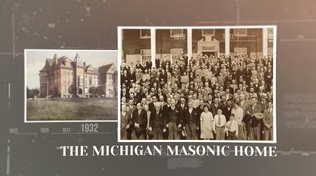
And obviously, for Masonic purposes, we had the home built as far as that goes.
And that led to like the beginning of the first idea of a masonic home.
For over 100 years, the Masons of Michiga have, in an ever expanding way, devoted themselves to the tas of caring for the needs of aged and infirmed master Masons and the widows of those Masons who have completed their task upon this earth.
The opportunit of supplying the needs of those who finish the strenuou tasks of life was first grasped.
The Grand Rapids in 1885, when a group of local masons, challenged by Brother John Jennings, enthusiastically decided to acquire the property at Reach Lake for the purpose of establishing a home for Michigan's aged masons.
In 1885, they basically started a boar for the planning and decided to.
One of the real go getters for that was a brother by name, Jennings.
He was from the Grand Rapids area, so that was one of the natural reasons why the first Masonic Home was built here in Grand Rapids was because one of the main supporters of that idea was a grand Rapids guy.
Following the Civil War and World War One, World War Two, there was a great need for Masons that that were in need of great assistance.
So the home started out as an idea of saying, this is one of our tenants.
We need to take care of each other.
And our forefathers then took that idea and they made it a reality.
And they didn't just make it a little reality, they made it a first class reality.
And, the home that we have there and alma is, is a monument to the the vision of masonry and the commitment to take care of each other.
We are all about charity.
And charity actually begins at home.
So I think it was befitting then, as now, to where you got members that have served the craft for 30, 40, 50 years.
And now when they're older years, they need somewhere to go.
They need some help.
A lot of times.
And they've helped so many people over the years.
And I think that the home gives them that place to go.
The fact that members, even if their money runs out their care, doesn't.
One of the obligations that we take as master Masons is to take care of each other.
And so I think it's just a natural progression that if a brother needs help later on in life and they can't afford to live on their own, that we help, that's what we promised we would do.
And it's the same with their widows.
We promised we'd take care of their widows if something happened to them, and that's a way for us to do that.
I feel like the Masonic Home 100 years ago and today is it's just a very big deal.
We talk about brotherly love, relief and truth.
And so that's what the home brings.
The first home was destroyed by fire in 1910, and the Board of Control accepted, free and clear of debt, the gift of a large and commodious building, with its furnishings and grounds, known as the Wright Sanatorium in Alma.
This new home would soon become insufficient, and in 1929 the Masons of Michigan purchased from Tommy Wright for the sum of $1 115 acres, located at the northern extremity of the city of alma.
Here, at a total cost of nearly $1 million, the Masons of this great state built and dedicated a new and beautiful Masonic Home.
The Gilded Age is not a golden age.
You've got these cultural changes going on, and a lot of them are due to the fact of innovation.
We have an industrial revolution.
Necessity breeds innovation.
And so all of a sudden cities are popping up with huge populations.
You have a huge expansion of of, industrial power, people leaving the farms, moving into the cities.
And cities are cold and impersonal places.
It's the it's probabl the loneliest place in the world is inside of a crowd of people.
And, and so you have Masonic lodges tha through the after World War one through the 20s into the 30s, grew geometrically.
It was almost it was in Michigan.
It was 1 in 4 men were members of some organization.
1 in 7 were members of the Masonic fraternity.
You had a lot of the United States, especially here in Michigan, transfer what was, mostly, agrarian economy a more agrarian focused society, more of a rural society, rapidly industrialized and rapidly become more urban and masonry changed, to an extent to, a lot of times, especially here in Detroit, as you get into more of like, say, like the 19th century, the 20th century, you had a lot of diversity of lodges when we look at the larges and oldest lodges, particularly that existed in Detroit at the time their memberships were massive.
These lodges had thousands of members, each 2500 to 4500 members in in most of the lodges in the city of Detroit coming into the 1920s.
This is unsustainable among a craft that's intended to be relatively small.
You cannot achieve the cultural changes, right?
They need things.
They need to build higher because, you know, six storeys is not going to be enough.
Technological innovation changes American culture.
You have an entire culture changed by immigrants.
And so redefining what does it mean to be American?
That is where it's golden, right?
That is where we do see some of the new things of the Industrial revolution that are great.
I've had many conversations with brothers that I wouldn't have known if it wasn't for Freemasonry, and they come from a completely different background than I did.
You know, maybe it's a different race maybe it's a different religion, maybe it's a different country.
And so I've had the opportunity to sit down and talk to them and say, you know, what was it like growing up in Romania?
What was it like growing up in Russia?
What was what was it like growing up in the ghetto?
I begin to appreciate the experiences that other people had by sitting down and talking to them.
And getting to know them but you're doing it as brothers.
I think that Freemasons are kind of, positioned to still to this day is explore those ideas of cohesiveness, finding those ways to get together as different people.
It's always been that way.
It always will be.
But almost anybody that doesn't want people getting together to work for a greater good is going to want to separate Freemasons.
They're going to divid and conquer is kind of like the the work of the day, the mode of the day for some organizations, for some governments.
That's why Freemasonry does not thrive in totalitarian governments or governments that are theocracy.
Because Freemasonry nurtures freethinking, it nurtures.
And part of freethinking is diverse ideas.
So you don't wan a bunch of people thinking about what's the best way to improve the world, because they're afraid that what the Masons are going to come up with is, well, let's start with getting rid of that guy, or let's start with getting rid of this system of government.
Let's try something new and try something different.
Experimental.
That's one of the reasons that we were so active in the formation of the United States is that this was a grand experiment in democracy, but really we are about progress and innovatio and trying to do things better.
And that includes technology.
It includes new ideas and new social awarenesses Grand Lodge of Michigan ha members of all races and colors.
And and I think that that is very, very important.
And it it's, it's something that shows wh we are and how we have evolved.
The tapestry of masonry i of the utmost importance to me.
And I've been involved with things like the diversit committee within the fraternity through different, grand masters who have, you know, really spearheaded those initiatives.
But the truth of the matter is is that if the Grand Architect of the universe create everyone, then everyone deserves respect.
In every era of progress the strongest leaders have come from the widest range of places, industries rise not because of a single viewpoint, but because of a diverse tapestry of people, eac bringing different experiences, skills and ways of seeing the world.
From manufacturing floors to boardrooms, innovation is sparked when perspectives intersect.
A leader shaped by an agricultural community thinks differently than one raised in a bustling city.
This is the true engine of leadership and the hallmark of Michigan masonry.
We've had a lot of leaders and an industry that have joined our craft, and you know, I've wondered about that.
We actually had the president, Whirlpool Corporation, a member of this lodge.
Those people have so much pressure on them in their business.
I mean, they're responsible for so many families that work for them that I think they all desire something to just get away from that pressure.
I know in bills case, that was one of the reasons he enjoyed Freemasonry, because he could come here an he wasn't president of anything.
He could have been a janitor and he would have been treated the same way.
And I, I think that may have had something to do with with why they joined Herbert Dow forming the Do Chemical Company up in Midland.
I mean, probably one of the largest chemical companies to this day in the world.
The idea that these guys might have been successful if they weren't Freemasons, but I think being Freemasons probably cemented their success and gave them less of a whim, less of chance, and actually kind of a concerted system of action that they probably pulled from Freemasonry to make it happen.
It was assumed that, that if you were going to be, for lack of a better term, a titan of industry, you you needed to be a mason, obviously, Detroit being kind of more of an automotive area.
We have quite a few people that were involved in that time, Henry Ford, being one of the more well known ones.
Ransome olds, he was also there as well, the Dodge brothers.
I think a lot of what motivated them as men and as Masons is that they went through the degrees they inculcated, the precepts and tenants that, every Mason is impressed upon as they go through degrees within our fraternity.
And each one teaches a different lesson.
More or lessons, philosophical lessons, spiritual lessons.
So I think they grafted that as far as their business practices as well.
I don't think it's a coincidence that we see these shakers and movers all across the board.
Government, industry, technology are connected to Freemasonry because I think our, our Masonic teachings have innovation in their DNA.
And I think it's so natural that the Freemasons that were involved in industry would naturally move towards innovation.
That's why they succeeded, because they were innovative.
They might have been innovated without Freemasonry.
But you can't tell me Freemasonry didn't light some fire to that innovation in the teaching that they had available to them.
And so you see Walter Chrysler working his way up through the corporation and forming Chrysler Corporation, you see Henry Ford, his automotive innovations basically changed the world, putting cars in the hands of common, everyday people.
It's hard to see.
And I kind of ge some of the conspiracy theorists because Freemasons have influenced the world in so many ways, but I don't think we can help doing it.
That's what we're driven to.
That's what we're trained to do.
That's the whole idea of what the fraternity is, is to innovate, take action, be active participants in lives in the world.
And so it's just natura that you see so many Freemasons doing that.
The benefits of the the olden days, this is what Henry Ford and many other people thought, that those old agrarian old days of the agrarian past and the emphasis on community was something to be lauded, and the industrialization which brought about individualism, privatization, you're not workin with the community on the field as much as you are working by yourself on the assembly line.
That that was fearful, the notion of the rugged individualist.
But that's the anomaly for the time, the rugged individualist would not succeed in the, in the 19th century.
What you need is community, and it takes work to develop that community.
And that work is built upon community, which is kind of this weird catch 22.
You need to work with others to build the cultural institutions and the community that would support those cultural institutions.
So I think, the cultural identity that develops over the 19th century is not one that's built on individualism.
It's one built on sort of understanding how to work with others.
It's a trait that I think we can se look across, even modern Masons is we invest in our communities and these guys, these lumber parents and these copper barons, the iron, mining and all these interests that that built our the U.P., that built our state, these men gave back to their communities far greater than, than any other because they obviously they had successful industries and businesses, but they gave that money back to the communities.
Communit has always been important to me.
Going back to my grandfather, he spent a lot of time in the community.
Volunteering his time, whether it was Masonic or or other organizations trying to make, you know, Marquett and the surrounding area better.
But my uncle was born with cerebral palsy.
And so he was given my grandfather and my uncle were given a lot of support from the community.
So it was kind of my grandfather's mission to always give back to those organizations that helped him and his family out so much.
And masonry is a great spot for learning more about leadership to get out in the community, to be a servant leader.
It takes time, it takes training, and, you know, those are all things that we're being taught.
And all of our lessons leaders, I think, are constantly looking for opportunities to lead.
So it's natural, in my opinion, and based on my observation, for a fraternity that has obligations that, has promises and opportunities for men to be better, to engage in self-improvement and self-development, it's a natural attraction for leaders to look into that and want to be a part of it.
After nearly 200 years of national history, Gerald Rudolph Ford J became the first Michigan Mason to become president of the United States.
He's the 38th to hold this most important of all offices and the 14th mason to become the chief executive of the United States.
Michigan Mason's know our president to be a most courageous, resourceful and inventive man who already has proven himself in the fields of world statesmanship and national politics.
Not since the days o Territorial Governor Lewis Cass has there been so much excitement over the possibility of Michigan.
At long last, having a representative in the top echelon of the administrative branch of the United States government?
Any number of our state senators, our national senators a large portion, our governors, a large portion of the have been Freemasons, a portion or a percentage larger than what the general population is.
As Freemasons, when you get to civil service or leadership, you're always going to find a larger percentage of them being Freemasons.
Not all of them.
But there's Freemasonry is much more represented percentage wise when you get to position of civil service or leadership.
And like I said, it's because we are almost trained to be active participants.
One thing that I really, as a non Mason, it becomes so apparent, is how involved members in the Masons were in the construction of civic landmarks in the community.
When you read the newspaper account, the procession to the cornerstone is led by the Masonic group.
It's not just in deference to custom, it's really the people who are leading these building campaigns.
And so it's no accident that the ceremonies are led by the Masons.
My parents called me up one day.
This was before I won a seat on City council.
Right.
And they said, never in my entire life thought that you would have run for city council.
It's just not who I am.
I was the outlaw biker, you know?
I was the one that that pushed against the rules.
But I've learned that, you know, now you can push against the rules, or you can change the rules because there's a process for that.
I've learned that there's a much easier way of doing things than just going out and causing trouble.
I never really cared when I was younger about learning how to run a business.
Now the old lady and I, we we have three businesses, three buildings in historic downtown, two rental houses.
This is not me.
It isn't me now.
It was not me a decade ago.
It was not me.
Before I joined Freemasonry, I think that for for those, exceptional leaders, they found the plan that God had for them, and they followed it.
And a lot of the, the, the ability or the reason they were able to do that was from the confidence and the skill set that they learned.
You know, being a member of the Masonic Lodge, basically a third of our presidents have been Freemasons all throughout our history.
The first six of our presidents, two of them were Freemasons.
We've had 47, 14 have been Freemasons.
So we're running about a third of our presidents have been Freemasons, which doesn't reflect how many men are Freemasons.
That's a big portion.
And so that kind of feeds that suspicion that maybe the Freemasons are trying to place people into positions of leadership, when really it's all about people who are drawn to positions of leadership and civil service, are drawn to an organizatio that can make you a better one.
I think masonry attracts people who are interested in leadership or who might excel at leadership is because of the the, the pure democracy that happens within the lodge.
There's this old story that I used to tell my humanities class that in ancient Greece there was a pure democracy and that if you were a citizen, then participation in the Senate was commensurate.
You had to no matter what.
And if you think of that in the current system, you'd think, oh, well, that's a great idea.
And then you think about that one cousin or that one uncle and you're like, oh that might not be the best idea, but the beauty of it was that if there is a town full, that the town full represented the constituency of town Falls, and so they deserved to be there.
When you come into masonry, hopefull there are not as many town fools and hopefully there are none whatsoever.
But the idea that whoever yo were or wherever you came from, whether you were already a CEO or whether you are a gardener or retired or anything in between, that you represent a constituency of that part of the world within the lodge.
And so everything deserves to be represented as an idea, as a motivation.
But I think the reason that masonry really encourages leadership and embraces leadership and fosters leadership is this idea of you probably always had it inside of you and that you almost hav no choice but to let it come out within Mason.
Or we say we make good men better when they come to this place.
They're looking to make a change within the world.
And I think with the leaders that we have, even right now, they're not just looking to make masonry better, they're looking to make the world and the community around them better.
And so we have had presidents, we have CEOs, we have all of these leaders that are Masons.
And this is what helps it grow is just what we offer as a craft.
One of my major motivations for becoming mayor to run for office was to try and do what I could to make it a better place, so that hopefully my kids and other kids as well could have a future here.
You are encouraged and supported into to take on leadership roles.
And how did that help me?
It's it's I'm not afraid to take on any challenge, and I don't think any Mason or any veteran would, would, would say any different.
Obviously, the fraternity has declined fo pretty much almost 70 years now.
We've been on a pretty steady decline, as have all organizations, not just Freemasonry.
I think in our case, we're lucky that we're still as big as we are because we were so big to start with.
You know there were 4 or 5 million Masons in the United States and now we're down to a million, which is still a big number.
But when you were 4 or 5 million, it's a pretty big decline.
I think part of the reason for that is society has changed and we, are not quick to, react to things like that.
I believe that what started the decline in membership and, in masonry in general is the exposure people have.
Years ago, people were kind of limited to their small world, and a lot of instances they had their community.
They did everything in their community and the their outlet was the Masonic Lodge.
Now there's the the world is so much broader for everybody.
I think the personal distance has impacted everything and everybody.
And I think that getting together with brothers has, just kind of taken a backseat.
Other things that have taken em away from the craft.
It's attributed to just how we communicate.
Now, like I said this you know, television, internet, newspape and everybody's world expanded.
And I think that the lodge suffered as a result of that.
I think one of the challenges that is probably not unique to masonry, but because of the longevity of masonry in the world, that tends to repeat itself often for us is this idea of generational divides.
I think you hear it all the time, and I remember sitting outside of the building one time and somebody mentioned, oh, gosh, you know, I bet you know the differenc between the Greatest Generation and a Gen X or a millennial or somebody is is one of the hardest things for, for, for masonry that, that it's ever endured.
And I said, I think it is probably really hard, and it is for all the reasons that we can identify and we can sit here and talk about.
But are you telling me that Revolutionary War, you know, veterans didn't have similar divides between themselves and the next generation, that there weren't divides in the Civil War and were honestly just talking about the United States at that point.
I mean, you talk about worldwide and there are lots of generational divide between one generation, another.
In psychology, we talk a lot about cohort groups.
You know, how old were you?
What were you doing?
How were you impacted when this event happened, when Kennedy was shot, when the challenger exploded, when 9/11 happened, everyone's impacted different.
And when you bring that different impact, that different worldview, that different ideology to the lodge and you say, I want to help continuing to make the next 200 years, but I want to do it from this perspective.
That can be a threat to certain people, that can be uncomfortable.
To certain people.
It can be, just the weirdness of new membership is, a very difficult challenge for not just the Masons, for all groups, whether it's you know, churches or any other civic group, fraternal groups, people just don't seem to be joining groups as much today to the detriment of society.
If people are not joining, they're not together.
They're spending more and more time, you know, and one of these, which is just a nasty little object that's driving everyone apart, it drives us into our ow little wormholes or cubby holes that, you know, just reinforces things that we might believe are conspiracy theorie or whatever it is that encourage us to be a separate or into a group that's so homogeneous in their thinking that you're not open to new ideas and new experiences.
As men and women, we need new experiences.
We need to be open to establishing new relationships and doing new things.
I think it's going t be very difficult going forward.
If we close that off, we get to a place where we only know ourselves and we only know the circle around us.
And sometimes that circle around us is just so individualized and not even hegemonic into what's going on.
It's just as they are.
And so if we don't socialize, we don't get to see the world around us We don't get to meet new people.
We don't get to see more diverse ideas and learn about other people, religions, cultures.
And so if we don't open up and we don't get to that place, we're going to be lost.
And so we, we, we miss out on that.
I think we need to b in that place where if we don't build on some of that fellowship, even outside of masonry, if we don't build on some of that fellowship, we're going to be a lost in what we do in our world.
Freemasonry in Michigan has inherited a great tradition.
Each generation of Mason takes this institution as it received it from its predecessors, wisely enlarging its scope and functions, improving its aim, expanding and heightening its chances, and preserving and securing its rituals and forms.
Then it must be transmitted to successors purer and better than ever.
We don't engage the new members quick enough, often enough for them to to start to understand Freemasonry.
The way those of us who have been her 60 years like me, understand it.
I go because I love Freemasonry.
But I don't know that you can teach someone that love unless you have them engaged.
The challenges of of social media.
I, generated, information, the ability to communicate across distances that, that before hand was unimaginable are going to fundamentally change the wa that that, that the membership of the fraternity looks at how it does what it does.
You know, most people they know about the Masons through Hollywood movies and, and conspiracy theorist on YouTube and in social media.
And we're really fallen short on that side of the, the equation.
I don't think people fully understand what masonry truly is and what we believe.
And I think if you jus went down to those core beliefs of patriotism, of, of, devotio to God, of justice and equality, how can you be against that in society?
But if they don't know about it, then we're just a secret society and we're not loyal, and we're no more secret than the Girl Scout.
You know, my wife sing songs that I don't know the meaning of that make them a secret society.
No, no more than the Masons are.
Since 1959, the Masonic fraternity, like all others, quite frankly, had been losing anywhere from three and a half to 4.5% of its membership every year.
And that if we didn't do something that by 2000, we would have been out of numbers.
Well, today is 2025 and we're still here.
So we beat the statistics from 19, probably 88 somewhere in there, 89 maybe.
But the trend has continued through that, membership, not just in masonr but in, fraternal organizations.
Social organizations in general is, down from what it was, because a lot of time that's a shift in the cultural landscape back in the, back, you know, the day when radio was in its infancy, in the 1920s, before TV and whatnot, social organizations and fraternal organizations served a vital role.
And, many men's lives.
Mack.
Before we had, TV, radio, social media and whatnot, obviously, 100 years ago, they didn't have that.
A lot of that.
What it is is that even though the overall raison d'etre for joining a masonic Lodge o any other fraternal organization may not be what it was at tha time, that need is still there.
But we have to write our own story and our story is really a powerful one.
It is quite literally a tandem, at times leading at times following the course of the development of this nation, even to its present day and through the nation's ups and downs.
We've been right there with it.
There's this idea that we should do it the way that it was intended to be done.
And I and I like that.
That's cool.
But what I think that fails to identify is the fac that the people who invented it were changing something, that they invented something new.
And so there is an argument to be made that if you really want to be truly traditional observant, then you should be changing things.
That the tradition is the change.
The tradition is this this idea of metamorphosis and newness and so there is, I think, thi tradition of adjusting to times and to making things relevant in our own time.
And that can be a challenge for certain folks.
But it's a challenge that masonry has risen to throughout its entirety throughout its history.
And it's probably our legacy.
It's probably the thing that our birthright, the thing that we can take forward with us now.
How do you grow a large well, I members of the community, the best way to secure it is get involved.
Get involved in your community, whether it be the farmer's market on the weekends or you're stopping at City hall for city council meetings, you know, or you're just volunteer for the the DDA or the historical Commission.
We have, as a fraternity have to get involved in our communities.
If we don't.
It's only a matter of time before we're gone.
Stuff I have never learned anything from being comfortable, and if I surround myself wit people who just think like I do, I'm never going to get anythin done.
I'm never going to grow.
Freemasonry is about improvement.
Making good men better.
That better is important.
We are trying to become better.
So to do that, you have to kind of put yourself in uncomfortable situations, which means you have to interact, not just interact, but you have to develop relationships with people who are different from you and find those things that you do have in common and can agre upon to work for a greater good.
And that's what Freemasonry i all about, is kind of combining those individuals, those people that are different into a bigger, stronger structure.
Masonry does is unifies society as opposed to dividing it.
And I think that's the important part, the lesson that we have to learn or relearn, because at one time our society wasn't divided.
You didn't have all the the media outlets and special interest groups dividing us into different categories.
And then the categories that they did, they create.
Well, you're it's you're this you can't like him and so on and so forth.
We're divided society and we shouldn't be as Masons, we can serve as the examples of how to get along with everyone and how to reach out and help people.
Master is that unifying glue that brings us back together?
One of the great things about Freemasonry since time was quality.
As far as that goes, it still offers those same things that it offered hundreds of years ago.
It offers a place that men can truly be at peace among themselves.
You're forming lifelong bonds with those men in the lodge.
I mean, you're going to kno them for the rest of your lives.
So you want to make sure that, you feel comfortable.
Where you at?
You want to make sure that this is something where you can truly feel that you have a home.
And that's one of the great things.
Freemasonry is just such a great a great organization, and it can be such a life changing experience for a man.
And it can have such positive impacts on the future of our country and our world.
I don't want to see it go away.
So I want to be one o those people that are out there in front saying, we need to change this, we need to do this the way that it's done in the 21st century.
If you think about our worl today, we don't have the common, groupings that we once did.
They just don't exist anymore.
We don't bowl together.
We don't really go.
Even golf leagues which once were a staple on golf courses, are going the way of the dodo.
Now they have leagues of two instead of four.
What happen then when those things are gone and they're not available for people who feel some need to connect with each other?
We have to be available.
And if and if we're not then I don't know where they go to find those kinds of connections.
The connections that I have in this fraternity are the most precious piece of my life.
They they have impacted me beyond words.
They're secrets that we have.
But then there's the secret that masonry is not secret, you know, and we need to get to this place where people see that these men that are part o masonry are here for a reason.
They're here to give in here to, you know, show who we are and continue to do that.
If we can continue to be that beacon, that place where people want to be Mason, we we will continue to grow.
The relationships in masonry have impacted my life in in my mind, the most interesting ways.
My father in law was an auditor for the state of Michigan.
So he audited auditors and he never spent the night away from home.
And so my wife and or poor wife kind of thinks it's normal that I have all these meetings and I'm constantly going to this thing, and I always try to ask permission, can I go?
And she's like, well, yeah you know, it's on your calendar.
You're supposed to go kind of a thing.
And I'm like, okay, I'll go.
But the idea that I have questioned, well, why does she think it's worth it?
Why is this cool for her?
Because she's at home taking care of the kids or making sure the house runs.
And she has said on a couple of occasions, you're a better person when you come home.
It's really interesting that the relationships teach us that they build us up, that they encourage us, that they support us, that they correct us when we need correcting, but that those relationships become part of yo and that you take that with you into all the other relationships that you have.
So it's odd.
It's even strange for me to sa that the Masonic relationships are a benefit to me because of the non Masonic relationships, but I think that's what the whole idea of Freemasonry is, is really taking difference and bring them together as one, so those differences will actually work together.
It's this family by choice.
You choose to expand this community that is normally a small unit family, and you choose to make it bigger and involve more people into that circle and be held to the same, I guess, obligations of of connection that you would expec from your own biological family.
You hold that.
You hold yourself to this larger fraternity.
I think there's something very attractive about that.
I think if you've ever run into somebody that doesn't come from a big family and they you invite them to Thanksgiving dinner to your big family, I think almost invariably they are so blown away by what they're getting out of that experience, this huge inner connective human experienc that they never thought existed.
That's on a bloodline Thanksgiving metaphor.
I think Freemasonry does that.
It connects you to this gigantic worldwide family that is like going to Thanksgiving every time you think about it.
The story of Freemasonry is often told in stone stitch and symbol, but its true foundation is family.
From the deep philosophical journeys of the Scottish Rite to the unbridled altruism of the Shriners, this extended family, these dependent bodies, have illuminated the light of masonry.
Immeasurably essential to this history are the Michigan brothers of Prince Hall, born from the same pursuit of liberty and moral truth.
The relationship between our jurisdictions has been a cornerstone for the continued development of the craft.
Together they have modeled a brotherhood that bridges, divides, fosters unity and strengthens bonds.
But our familial bonds transcend symbols and ritual.
They are forged in the teachings from our sisters in the order of the Eastern Star, the brothers of the Royal Arch and Knights Templar, and most critically in the development of citie and small towns across Michigan.
For over 200 years, masonry has not only built lodges, it has built better men, better families and better communities.
It has changed lives for the better and for all time.
If we think of Maslow's hierarchy, that botto level of the triangle is is air, water and food.
To survive in the very top of that train are.
The illustration of Maslow's hierarchy.
Is self-actualization being part of something greater than yourself, something that last for all time?
And when you talk about compassion and empathy and caring for other people, it's basically part of who we are as Mason, it is one of the fundamental tenets.
The principles that we live on is, is to take care of each other.
In all the organizations that I've been in, not once have I ever felt.
As loved or.
Needed as I do.
And Freemason.
This fraternity can take a guy who who doesn't have a job and turn him into a successful business owner, in a matter of a handful of years, just by doing what we do on a regular basis, this lodge built this community.
It founded the community.
It built the community he wanted to be.
Anybody in this community had to be a member of this lodge.
And, To see that history and to kno that the possibility is there.
We just got to get off our asses.
That's why I pushed so hard for us to do what we do in the community.
I think that it's less likely for people to understand that you can be an individual and part of something bigger.
At the same time, it's almost as if they feel that individuality excludes you from being part of something else.
And it doesn't, as lon as you have the right mechanism.
Freemasonry is that mechanism that binds those individuals together.
And I think it's much more likely that you'll find Freemasons are able to understand that kind of dichotomy between who you are.
I am part of something bigger, and I'm still an individual.
It sounds like a conflict, but it's not.
It's brought together as one big momentum.
If we are meant to be living stones for this building, not made of human hands, as the traditions of masonry tell us, then we have to have all the different kinds of stones in order for the entire structure to make sense.
If all of us were foundation stones, then no one comes to visit, because it's not very beautiful, is it?
If we're all the statuary of this Gothic structure, then it would fall under its own weight, because there are no foundation stones to keep it erect.
And so without the different threads, the different colors, the different, you know, weaves of the tapestry, then we can't be complete.
Do we want to have a society that is built upon, whether it's rugged individualism or, you know, charities and philanthropies will care for people?
Do you want to create a government that will provide a social safety net and so forth?
You know that's something to be debated, but there's never going to be a world in which we don't need philanthropy and a caring for your fellow man, regardless of where you fit on that sort of, polemic, what the role of government should be in that situation.
That.
It's just the nature of being a human being.
I look and I see the the impact of masonry in my life.
And I had two daughters.
Well they're not going to be masons, but the men that they married are good, honest, trustworthy, dependable men.
So they chose for their spouses men that exemplified, hopefully, the qualitie that they saw in me as a mason.
So I guess that ain't so bad.
There will always be a place for this institution.
Always.
And this institution will take its place, amongst the great, great creative, enterprises of of world history.
It already is in my estimation.
But the world is coming to the point where where it needs what we have a lot mor so than it might think it does.
And I think that when the, when, when men realize that and then they, as they today look out saying, you know, is this all that there is?
I want something more where the place where you can find that something more and that's, that's I think that if we could do that, then, the world will be a better place because the fraternity became a better place.
There never has been, nor is there now any doubt in the mind that restoration of the public acceptance of the bright image and traditional prestige of masonry will, in a short space of time, be reinstated and rise to the new heights of influence on me.
I in this work by seeing so mit ever be pax vobiscum.
TRAILER | A Light On The Lakes
Video has Closed Captions
TRAILER | Commemorating 200 years of Michigan Masonry, helping shape Michigan’s identity (30s)
Providing Support for PBS.org
Learn Moreabout PBS online sponsorship











Support for PBS provided by:
A Light On The Lakes is a local public television program presented by WKAR