
Beyond 250
Special | 56m 46sVideo has Closed Captions
Exploring the questions that have shaped American democracy for 250 years.
Beyond 250 examines how Americans have continually redefined citizenship, rights, power, and participation throughout the nation’s unfinished democratic experiment. Through expert conversations, historical context, and voices from Michigan communities, the program connects America’s past to the responsibilities of self-government today.
Problems playing video? | Closed Captioning Feedback
Problems playing video? | Closed Captioning Feedback
Beyond 250 is a local public television program presented by WKAR
Beyond 250
Special | 56m 46sVideo has Closed Captions
Beyond 250 examines how Americans have continually redefined citizenship, rights, power, and participation throughout the nation’s unfinished democratic experiment. Through expert conversations, historical context, and voices from Michigan communities, the program connects America’s past to the responsibilities of self-government today.
Problems playing video? | Closed Captioning Feedback
Where to Watch Beyond 250
Beyond 250 is available to stream on pbs.org and the PBS app.
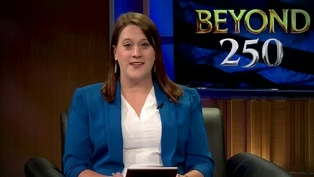
Hello, and welcome to Beyond 250.
I'm your host, Ashlee Smith.
This year, we've celebrated the 250th anniversary of the Declaration of Independence.
Today we move beyond celebration to reflection, asking a question fundamental to democracy.
What does it mean to govern ourselves?
As we look toward the nex 250 years, we revisit questions every generation has wrestled with.
Who belongs?
Who holds power?
How do citizens shape democracy?
Throughout this special, we'll explore how Americans have continually redefined citizenship, rights, and participation and what that means for each of us today.
Welcome to Beyond 250.
To begin we explore the enduring tensions at the heart of self-government.
Questions of equality, representation, and power that have shaped every chapter of our history.
To kick off our discussion, I'm joined by Richard Primus, the Theodore J. St.
Antoine Collegiate Professor at the University of Michigan Law School, Emily Conroy-Krutz, Professor of history at Michigan State University, and Charles Thomas, Founder and Director of the voter turnout organization When You Vote - I Win.
Welcome to you all.
Thank you so much for being here.
Thanks for having us.
Happy to be here.
So I want to get started with you, Richard.
I want to ground us in the American experiment a little bit.
Could you help to share a bit about the framework of self-government that was established by the Founding Fathers?
What were they trying to create with the Constitution?
Sure.
Great question.
And it's a question that we're usually taught to answe with some theory of government or theory of the Constitution of the kind that we learned in elementary school civics.
Right.
Here's the system and here's how it works, and here's why it works that way.
All of that sort of radically under-oversimplifies.
It pretends that there was a plan that there wasn't.
Lots of the founders went to Philadelphia to create what we kno is the Constitution with plans.
But they were all different plans.
There wasn't a general agreement about how the thing would work.
They had different interests.
They had different values.
They had different ideas about how the world worked.
They agreed on some things.
There was general agreement that the country neede a stronger central government.
That was the basic problem that they were agreed needed to be solved.
They had 17 different ideas about how to solve it.
They had different ideas about representation about government, about slavery.
And they spent a summer arguing with each other to figure out how to do it.
What they came up with, we mostly know, right?
A three branch government.
It's supposed to hav a system of checks and balances, a complicated system of elections that's supposed to distribute power.
And then because they knew they had to sell the thing to the people to get it adopted.
They didn't go out to the public and say, we had 17 different ideas, and all of us hate a bunch of parts of this plan but it's the best we could do.
They went to the public and said, look, this is what we have, and we have a theory that will explain it to you.
And they gave us the civics book theories, which are pretty good in some ways, but which are also not how the system works anymore.
Nothing stays the same for 250 years.
There's a funny thing in the way Americans think about government when when you learn American history, you learn about American government in the par where you learn about the 1780s as if the way the government was designed in the 1780s told you how it worked today.
And in a couple of respects, it does.
And a lot of respects really doesn't.
Yeah.
I think that's a really great point.
Thank you for talking about the fact that we're often looking back to the early days of history to describe how we are existing today.
And, you know, we speak about the America experiment, how it's enduring.
I'd love to know, kind of all of your thoughts on, has it been successful?
Is that even a question we ask Emily?
Do you have thoughts on that?
Oh, I got to start.
It's not over yet.
Yeah, right.
And that's, I think the really important part to start our conversatio about the American experiment.
I really appreciated the point, just made about how the sort of the Constitution is different now than it was when it was framed.
And, of course, the 17 different plans for the Constitution came out of several years under the Articles of Confederation, and an entirely different understanding of how the government ought to work.
And we've got 250 years of Americans arguing about who belongs, who doesn't belong, how to make this, a more perfect union going forward.
And it's an ongoing, and I think, ever increasing challenge to live up to those ideals.
Yeah.
Is that a sentiment you agree with, Charles?
I do, but I also think it depends on who you ask.
Right.
Because as we see, we have these, actions that seem like we are progressing and then it seems to b followed up by these regressions where, those folks that are in power, essentially, make determinations that lead us to believe that they are no in agreement with the progress.
Right.
And so we have these up and downs like a roller coaster ride where we are, looking like we're progressing toward, this idea.
But the we have those moments in history where we seem to be going backwards as well.
Yeah.
I think that's a good time to bring up the idea of the contradictions in our history.
When we look at the espoused values and principles of the country, the ones that are said that we should have in our society, it feels different sometimes than what we're seeing actually happening, that when we're seeing what we're seeing, within our society, within politics, within all of that.
And I'm just curious to know from each of you, what do you think are some of the biggest contradictions that have faced this country in its history?
It's a big question.
Richard.
most obvious and in some respects the most consequential one at the beginning was the contradiction of founding a society that was in many way more democratic than any large society that had ever been.
But one that was also based not just on a limited electorate, but on a society, a lot of which was enslaved.
That's a contradiction that people understood at the time was a contradiction and had lots of different ideas about.
And when you ask, you know, ha the experiment been successful?
Here are a couple of, you know, slightly unconventional ways of thinking about it.
From the perspective of a lot of people who made the Constitution, success of the Constitution would have meant to society, at least part of which can maintain slavery.
And that was successful for a time.
Right.
From the- from the perspective of a lot of other people, succes would have been a Constitution that maintains a system that keeps the peace over this deeply explosive issue of slavery.
And that succeeded for about three quarters of a century and then collapsed right in a bloody civil war.
Right.
A civil war is a failure of a Constitution, right?
But if that's what it is, right.
If your system of civil government is working properly, it keeps the civil peace.
Sometimes constitutional failures are better than successes, because the thing that it's trying to do, or at least one of the things that it's trying to do, is not something tha you want to keep going, right?
Measured from the perspective of 20th and 21st century egalitarian values.
The Constitution was enormously successful, to the extent that it laid the groundwork right for things to happe later on that made them better.
Measured by 2026, we have a highly dysfunctional government in 2026.
If you stopped the tape here, you would say it worked for a while, and now maybe not.
But as Emily said, the tape's not over, right?
It's still up to us to figure out whether it will look like success or failure when we get to 2040.
Right.
Absolutely.
And Emily, to that point what what changes have you seen?
How do you think what evolutions have you noticed over our 250 years?
I mean, I think if we're just talking around the general theme of sort of contradictions and, you know, how our founding values do or don't sort of play out, I would say, you know, the question of our 250th moment, right?
'All men are created equal.'
We've had lots of changes over how those terms are defined.
I loved your metaphor of the roller coaster, because that's one of the most profound parts of American history, where we have seen tremendous advancements and then real backlash.
Whether we're talking about, race, whether we're talking about gender or class or sexuality, this is something we've seen a lot of, of movement on.
And it's hard to give a kind of clear, you know, here's the trend of 250 years worth of history.
But I think what would be sort of the one consistent throughline that is really helpful for u in this moment of sort of crisis and turbulence in our government right now, is that there has always been debate over these questions, and whether we're talking about the late 18th century or the mid 19th century or the late 19th century, or any point in the 20th century as well, you have groups of Americans who will argue intelligently and earnestly and seriously about why this group or that needs to be included more, fully in the American body politic, why they shouldn't be.
And those kinds of debates we have, if it feels like we're a little, kind of at sea right now, there are plenty of examples through the past 250 years to help us to be grounded in how Americans have faced this before.
Absolutely.
And we could keep talkin about this for hours, I think.
But we're going to move on to our next topic.
Now, I want to say a huge thank you, Emily, Charles and Richard for being here with us today.
Happy to be here.
History tells one story of democracy.
But democracy isn't just something that we study.
It's something people experience, debate, and shape every day.
At a recent event exploring America's 250th through the lens of Michigan history, we asked attendees to reflect on the American experiment, patriotism, and the relationship between citizens and their government.
Here's what they had to say.
The American experiment goes back to the Founding Fathers and the Declaratio of Independence, with the idea that a republican form of government was possible.
You see, the experiment is having all of us together, all the different religions, races, people from all around the world, all living together.
To me, the word democracy means everyone has an equal opportunity to express the way they lik the country and their community to look and feel and to be a part of the compromise in making that happen.
Democracy is also a syste that gives people an even voice, not only the voice, but that it can.
Your voice actually matters.
With people, our our leaders answer to the people.
It's, to the way where they work.
They work for us in a way.
Yeah.
I think it really the primary reason for the American Revolution, to me, really speaks to the dream of self-determination.
I do think there is some truth to that.
'No taxation without representation' tag line.
I think that people want their local reality to reflect what's real around them, and not what's real to someone far away from them.
Patriotism, to me, makes me think of honesty, and I think a willingness to deal wit things that aren't always easy.
And to acknowledge, you know, how complex history and the present are, and to try to live up to tha idea of the American experiment.
That's a tough one, because to me, patriotism ca reflect a number of different, a different things.
A lot of the country, you know, you we have a country that you can criticize and criticize things that are done, but you can still love your country.
So for me, it means striving for better.
It's being patriotic to my country is that we can keep working towards the American ideal.
Patriotism, to me, is my father who fought in World War two.
My my grandfather, who came here from Germany at 15 years old, alone to come to America to make a better life.
Our democracy is always changing and evolving, evolving and changing.
And any kind of democracy, I think, or any kind of representative government.
The squeaky wheel gets the grease.
I think a lot of people, I think there's, I think there's kind of a silent majority, to use an old term from years ago.
I think also there's too much money and, too much money in politics.
Money.
Money talks.
I think a lot of people do miss that we don't live in a democracy.
We live in a republic.
Right?
Which is?
Which is the best thing that ever happened.
The people are the power, not the government.
It's been twisted a little bit over time, but the reality was it was designed for the rights of the people.
The government has no rights.
To some extent.
Unfortunately, I think very early we realize that there are limits to the degree to which popular government reflects the popular will.
And so, in fact, I think there are many example of the, wishes of the majority going unmet for years or decades on end.
Because of machinations within the government or without the government.
You know, there's an imbalance in not only who gets heard, but what value their opinion carries.
I wish our representatives- would government... would listen to people more.
I know you can't always do that in our form a government.
I wish they would listen to people a little more.
The thing that I wish was different about the U.S.
government than most was less of a representation of established monied interests, maybe more of an effort to include representatives from the working class.
I wish they listened more to the people.
I mean, you vote for certain things, and then they take that opinion and listen to it, but then they vote their own way.
I think that people are trying to hold the country and government to account, to bring the country closer to what they wish it was.
And I think that's a kind of patriotism.
The voices we just heard remind us that democracy is deeply personal.
They also raise another enduring question.
How do citizens hold power accountable?
Joining me now to explore those questions is Matt Grossman, Director of the Institute for Public Policy and Social Research at Michigan State University.
It's a mouthful.
And returning to our conversation is Charles Thomas, Founder and Director of When You Vote - I Win.
Welcome.
Thank you so much for being here.
Yeah, I want to get started because we've got a lot to talk about here.
So one central question of democracy i how power should be distributed and what prevents it from becoming concentrated in the hands of a few.
So, Matt, I'd love to know when our system of government was created, what mechanisms were put into place to keep power accountable?
Well, we have a lot of distribution of powe between the national government and the state governments.
To some extent, that has remained, although we've had a kind of a nationalization of policy over time.
We had a distribution across the branches of government.
And we still have powerful legislative executive and judicial branches.
But over time, the legislative branch has lost some of its power over war powers and, increasingly spending powers as well.
So, some have held, and others, have not.
Yet, were the founders more concerned?
Do you think about the government becoming too powerful or powerful interests capturing the government?
Well, the government obviously is, an amalgamation of different interests.
And so I don't know tha they saw a clean, distinction, but between them, but, certainly we have evidence of, interest group influence in contemporary, United States, of a very, broad, universe of, lobbying and advocacy, in the United States relative to other countries.
So regardless of whether they wanted to to keep the interests out, they have definitely proliferated over time.
Sure.
Absolutely.
And I think this is a great plac to kind of circle back a little to what we were talking about, Charles, in the previous panel, with the contradictions, what do you feel were some pivotal moments of accountability or attempts at accountability throughout our history, and maybe that could address some of those contradictions?
Yes.
I' have to start at the beginning.
And when I have these conversations, this is generally what I do.
I go back to the Declaration of Independence and, I have conversation to help people understand that that founding in itself was a contradiction.
Right?
You have the contradiction where you have people who are looking to gain their liberty, while at the same time oppressing other folks and not allowing them to have their liberty.
So you have this initial contradiction and this conflict conflicted people about, who should be included in that statement when it comes to We the People.
And so, you you make these statements, you have these contradictions, and then you have to define what it is that you were sayin when you said, 'we the people.'
And so we have these conflicts throughout our history.
It always comes back to that who are considered to be the people.
How do we define, people in general?
People as opposed to property?
People as opposed to, and if I can use the term citizens and aliens.
And so who are the people?
And so we have these continued conflicts and the powers, when they first, sought to define it, they did so in ways that eliminated it was exclusive.
And we continu to have the same conversations where the people who are supposed to have the power are, continually, being pushed back and not included in that power dynamic and that power conversation.
And these are the conflicts that we continue to have because we say 'we the people,' but we haven't even clearly defined to my mind who the people really are.
Sure.
And it feels like throughout time, a lot of those discussions kind of get launched because of things like grassroots efforts that are happening in communities.
And we know accountability sometimes comes from institutions.
Some of what you were speaking about with what was built into our democracy, sometimes it comes from citizens demanding change, such as in those exact cases of grassroots efforts, which do each of you believe has historically been the greater driver of democratic renewal?
We certainly hav evidence that overall there is, responsivenes and representation in the most basic sense, that is, area that have more liberal republics or more conservative republics tend to have more libera or conservative policy to match.
When public opinion is moving leftward, it tends to precede leftward movement in, public policy.
But the mechanisms for that are varied.
Some of it is, lobbying, some of it social movements, some of it is elections, some of it is, changes within the political parties.
And none of that means that as soon as you get a public majority, you, that results in, public policy.
That definitely isn't true.
One of the things that is frustrating is that the system builds in a lot of what we call status quo bias.
That is, if you want nothing t change, you have an advantage.
And basically across our political institutions, and that often means tha you really need a supermajority support or, support from lots of different factions within, the public and the political parties in order to actually see change forward.
Sure.
Yeah.
Charles, what's your take on that?
Oh, I think it is mostly driven by the people, right.
And dissent, our right to dissent.
But, again, these definitions, what the dissent look like, who is allowed to engage in dissent.
Right.
And when they do, wha is the response to that dissent?
With, me having, the relationship to, the civil rights movement through, my aunts being Selma footsoldiers I know the value of that work.
But I also know that depending on who's out there engaging in the dissent, that is pretty much determinative of, how many times how effective it is and how acceptable it is.
But we are living at a time where we see, the revision of history, where, folks were allowed to engage in dissent that was violent.
Right.
And, essentially that has been, if I can say whitewashed, whereas other people, were put in position to where the only way that they could engage and be effective is nonviolently.
So we have to, you know, kind of look at dissent of the power of it, who is allowed to engage in dissent, and what does that dissent have to look like in orde for it to be acceptable and not, violently beat back?
Yeah.
Thank you.
We have a little less than a minute left, and I want to end on a question for both of you.
Can democracy survive i citizens stop paying attention?
Matt.
Well, actually, we have a lot of, political information now that we didn't used to have, Americans know more about, the policy issue differences between the parties, the policies that are at stake in, for the presidential election and congressional elections.
A lot of times, people don't get the things that they want from information.
Sometimes information actuall produces polarization because, we know which side we agree with more.
And, that, doesn't necessarily result in resolving our conflicts.
It can lead to heightening them.
Yeah.
Charles, I would say no, because if the people, no longer engage, then it become the voice of the powerful only.
Yeah.
Thank you so much, Charles, Matt, it's been a pleasure speaking with you.
Thanks for being here.
Thank you.
Our discussion has explored the responsibilities of self-government.
But democracy depends on more than ideas.
It depends on the everyday actions of ordinary people.
At that same community event, we asked attendees what civic engagement means to them.
Let's hear what they had to say.
Civic engagement is things like volunteering.
To me, the words civic engagement makes me think of getting to know people around you, getting involve in your community through clubs.
You know, city council, things like that.
Being able to express oneself and one's beliefs.
It means being involved in the governmental process.
For those people, that would be through voting.
You have to learn.
You have to understand.
And you know, the engagement is not just a passive participation.
It's an active understanding in the the government, the politics.
So much of what we need to know is dependent upon our own desire to learn it on our own time.
I think I learned enough to feel comfortable and able to learn more on my own about civics and how to engage with the government.
I don't know if that means that I learne as much as I would like to know.
I went to school in an era where civics was a very important subject all the time.
So we learned we had to memorize the Constitution, all the amendments.
Yeah, I took a civics class, man.
And I feel like if you take that civics class and you're truly engaged, you do understand those things.
I would say I know how to engage wit our elected officials through, you know, the classic means, like writing letters, making phone calls.
Volunteering is something I'd like to do more of, and I have done in the past.
I think civic engagement is research.
Know who you're voting for.
Yeah.
Know what you what the plans are.
Read the entire bill, read everything and understand it.
Or don't vote.
As they say, the squeaky wheel gets the grease.
So if I felt passionate about something, I would begin a letter writing campaign.
Or, I suppose these days, an email campaign.
I think ordinary people have more influence on their communit and governments than they think.
I think that that influence being activated depends on people staying engaged and taking the time to meet one another and starting bonds locally.
It takes an effort to be an American.
It's not it's not easy.
I think there is that perseverance for for being better.
You have to, love it an want to continue that mission.
There's a saying, 'you can disagree without being disagreeable.'
And I think, unfortunately, right now, that is not the case.
I think we're just, divided.
But this country has been through tough things before, and I honestly feel we will get through it.
To me, I think being an American is define by a certain kind of optimism.
You know, history is complex, and the present is complex, but I think.
America is defined by wanting to live up to that ideal vision of ourselves.
It is disheartening sometime to see people disagree loudly, but think that as I grow older, it just reaffirms me wh it's important to stay engaged and to be a part of the community.
I think you need to show up at the town hall meetings and, you know, pay attentio to what's going on around you.
I would let my electe representative know how I feel, and that's what they're there for.
You're not always going to get the answer you're going to want to hear.
You're not always going to agree with them.
But we are representative democracy.
And, I think that works the best.
I think when I disagree wit something happening politically, I try to embody my counter argument in my personal life.
You know, if I believe in being a good neighbor, being an understanding and open minded neighbor, I think taking the tim to help people in my community who maybe can be overlooked a little more easily, is one way that I would make that physical.
Well that's the end of my questions.
Did we pass?
The voices we just heard remind us that civic engagement takes many forms.
Throughout our history, Americans have continually found new ways to participate and strengthen democracy.
Joining me now to explore how civic engagement has evolved over time and what democracy requires of us today are Dr.
Brigid Beaubien Director of the Upshur Institute for Civic Educatio at Eastern Michigan University, and Ellen Zwarensteyn, Executive Director of the Michigan Center for Civic Education.
Welcome.
Thank you.
Thank you for having us here.
So we've spent a lot of this program so far talking about the responsibilities of the government.
I'd like to turn that around.
At its most basic level, what did the founders believe was required of citizens of a democracy?
Brigid.
I always like to think of the quote by Benjamin Franklin as he left Constitution Hall and someone asked him, supposedly, 'what have you wrought, Dr.
Franklin?
And he said, 'A republic, madam, if you can keep it.'
And so I think right out of the starting gate the founders were really seeing citizenry as a job, something that people had to assume and do with purpose and intention.
And that requires education.
So Thoma Jefferson believed an educated citizenry was essential to self-government.
Ellen, why has civic education always been so central to democracy?
Democracy requires skills, dispositions and the knowledge in order to achieve anything in our communities.
So Jefferson really enforced the idea that it is our job and our governmen and how we govern to educate us so that we can be part of that experiment.
And so what we have to do i think about what are the skills and how do we teach those skills.
Similarly, like we wouldn't teach a phys-ed class by not having people run or swim or do the things to their ability.
Civics is the same thing.
It is the skills of voting.
It is the skills of media literacy.
It is the skills that all of us require in order to have the information, in order to make informed decisions for ourselve and our communities.
Absolutely.
And how would you say that civic educatio has changed over this 250 years?
What have we gained or perhaps lost throughout this time?
Either of you?
Bridgid?
Well, I think democracy is always changing.
And so civic education is always changing.
I think that's the one constant in democracy is that it's changed.
It doesn't look like it did in 1787 or 1965 or even 20 years ago.
So it's constantly being renewed and reexamined and changed in a different way, so that it's meeting the needs of the citizens of today.
So, and I would add structurally, that there are some really fundamental components or prerequisites in order to have meaningful civic education, like funding for teachers to have professional learning, for having a really robust pre-service education program so that teachers have the skills and the the knowledge to go into a classroom knowing that they're going to continue their learning.
And we've seen a loss of civic education funding.
And as a result, we might not see it taught in our elementary schools in particular, and taught way too late by only addressing it in the high school.
So there's a lot more that we can do to address at an early age.
So we have a more thorough understanding of our own civic identities.
And I think we've lost some of that funding and priorities when it comes to equipping ou teachers to teach successfully.
And I think, though what we have gained is perhaps greater inclusion, and that when we look at the pathwa with with bumps here and there, but there is still a greater trajectory towards inclusion for all folks and in democracy.
And to add to that, we don't see building a civic identity as something that's developmental.
And we know that it starts as soon as children are able to talk.
Right.
So we really need to be more intentiona about developing civic education and civic identity in the P-8 classrooms.
We really just focus on 9-12, and we're missing a lot of opportunities by waiting too late.
And you're both doing a lot of work in that area.
I'd love to hear about Upshur Institute for Civic Education and Michigan Center for Civic Education.
Brigid, can you tell us a little bit about the work you're doing?
We're pretty proud of what we're doing at the Upshur Institute for Civic Education.
It's part of Eastern Michigan University, and it has multiple tiers of things that are going on.
One of the things that we're doing is really focusing o elementary pre-service teachers and their experience around civic education.
So when they come in the door they take an entry level course, and we talk with them about how were they taught about their own citizenry, and what did the public schools teach them about civic education?
And then as they move through a series of five classes, developmentally we increase their understanding of what civics and citizenry is all about.
And what we're finding is our students are going out understanding that part of their job as a teacher is to uphold the Constitution of both the United States and Michigan.
But then the other things that we're doing is a lot of programing across the university, so that all students hav more exposure to civic education in experiential ways not just through memorization.
So something that's really dynamic and engaging.
And then finally, what we're really looking at is hopefully educating our professors that civic education is part of every discipline in every college, so that all of our students are walking out with an understanding of their citizen identity.
That's very important, and I'm excited to be able to share a little bit more about the work you're doing in a video that we'll watch in a few minutes.
But first, Ellen, talk to us about the work you're doing.
There is a lot happening in this realm, so we tend to focus on the student programing side of things, but then also the professional learning side of things for our educators.
Some of our signature programs include a program called We the People, which has students engage in constitutional dialog, as in a simulated congressional hearing.
And that really focuses on civic dialog.
And really what it does is really help our educators change their identity, as well as those coaches and facilitators, so that the students can find their own path through constitutional thought.
We engage with mock trial.
Mock trial is what it sounds like where students transform themselves into witnesses and attorneys, and it also includes courtroom journalism and courtroom artistry as additional ways to expand that civic umbrell to tell, to tell more stories.
Project community engages in public policy, and how can students understand their local communities?
Very interdisciplinary by design in order to make change.
And then you'll hear soon more about the voting and election work that we're engaging in called MiVoice MiVote.
But really trying to be a comprehensive civic education stop for everybody in our state knowing that only six of our 57 ISDs have anybody dedicated to social studies at all.
So we tend to be the resource for educators and for student programing across our state.
Wow.
You're busy.
You're both busy.
But we're glad that you're doing this work.
And if you could redesign civic education for the nation for the next 250 years, what would every young perso experience before going out into the world?
250 years is a pretty big chunk of time, but- how about five?
I think in the immediate future, what I would really like them to understand is everyone needs a foundation of basic understanding of what the Constitution is and kind of the role of government, but it's way deeper than that.
They need to be able to understand how they can participate, and that their voice matters and how that they can how they can systematically use it.
They need to develop reall good critical thinking skills.
Lots of smart people have no critical thinking skills.
Critical thinking is a skill set that needs to be developed with intention and really used as a muscle.
The more you do it, the better it gets.
And then to really understand good communication, both as how to get your voice out there, but to be a good listener and t if someone disagrees with you, to stay curious and stay listening.
So that would be like my base.
Yeah, yeah.
Ellen, anything to add?
Absolutely amplify everything that Brigid just said.
I would also add that we asked this question of most Michiganders a couple of years ago to say, how would they design their ideal civic education experience.
And by far it was experiential learning, like show me what to do, how to do the things, and then I can integrate my knowledge, bring me to the places of historical and contemporary importance so that I can understand and feel what that looks like in those different settings.
And then I would add, this will be a constant refrain, but we need to fund civic education as if we mean it.
Our last budget didn' have that as, as for instance, of of opportunitie for additional prioritization.
If our budget is our values, then I would hope that we can see an increase in our budget dedicated to civic education at the state and at the national level.
Absolutely.
Well, Ellen, Brigid, thank you so much for being here.
And now I'm excited to see what's coming next.
Brigid.
So we visited Eastern Michigan University's Upshur Institute for Civic Education, where Dr.
Beaubien and her colleagues are preparing future teachers to help the next generation to understand not only how democracy works, but how to participate in it.
Dr.
Upshur.
She taught and served on faculty in the department for over 3 years, and has a deep commitment to the study of histor to teaching critical thinking.
And they were looking at a way of kind of shaping her legacy her at Eastern Michigan University, when they felt that it was really important to create something that was deeply meaningful in southeastern Michigan.
Our institution has been deeply committed to the civic education of its teachers from the start.
But why the confluence of this point?
What kind of incubator could we create to share those ideas across campuses and to the community?
How do we ensure that our teachers, who are being educated at EMU, are continuing to go out into schools and building the civic capacities of the K-12 students as well?
We brought in a lot of outsid speakers and big political civic thinkers, and were really able to craft something again with purpose and intention in many of the component parts of your educational journey.
We've de-emphasized civics, and now you see universities stepping up.
You see many states that are asking for new requirements in civics education.
Higher education is supposed to create better citizens.
The leaders of tomorrow those who are leading companies and communities a lot of people, unfortunately, I think they come to think, see civic education as political, that it's tied to a political party, and that's not what it is at all.
Civi education is really the skills and capacities that we need to engage in democracy.
The founding fathers of our of the United States, they knew right awa it was one of the first things the government did was to ensure that the land expansion would have public schools and that students could go to school.
So from the very beginning of our nation, it was like we need to have educated people in order for our democracy to thrive.
So that's just the bedrock of democracy.
Oftentimes, civic is one of the most hated classes in high school.
Students really dislike that course.
It's taught in a way that is so mind numbing.
I did not enjoy civics in high school at all.
I didn't like, keep me up with the news or anything.
But again, I totally changed my mind.
I mean, it's so interesting now in the way that civics isn't.
Politics is an amazing thing to learn and understand, because now I'm read to implement civics in my future classroom, even down with like kindergartners, because it's these life skills that's so important to learn young and then really embrace and make a difference in the world.
What I think when I'm standing in these classes, and I'm watching these students who are 20, 21 and 22, is I actually have more hope than I have ever had in my teaching career.
They come in with such passion and interest.
When you open the entire world to politics and understanding their citizenry and understanding democracy and civics, they become engage at a level that I have not seen in all my decades of teaching.
My definition of civics throughout this experience definitely changed because, like I said, it's a lot more of the personal communication and interaction than it is modern politics and government work.
So taking the course opened up my world into just connecting with people everywhere.
Talking with your neighbors, how to be engaged at the local leve as opposed to the federal level.
One thing I think my future students are going to learn and be able to do is communicate effectively.
Students are abl to think critically on their own and come to their own conclusions.
I really hope my students will be able to take away what it means to be in a democracy what it means to be a citizen, and how they can participate civically.
The next 250 years of America are as much of an experiment as the first 250.
It is our responsibility to create a framework for the next generation to be able to insert themselves into, that invites them to responsibility, invites them to long term thinking, and invites them to the sustainability of this society that we've created.
Civics is the story of u and how this country came to be, and how we designed it, and how we built it, and how we organize it, and what we, the people have chosen to do for 250 years.
It's actions that you take, it's choices that you make.
For me, an engage citizen is one that is listening and learning.
That doesn't mean raisin their hand and getting involved in conversation, discussion and debate.
An engaged citizen is one that is paying attention.
I think an engaged citizen is someone that just participates in the community at the most basic level.
You need to talk to your neighbors.
You need to help out in your local elections.
You need to spea to your local representatives.
So I feel like my voice really matters and I know how to use it.
But there are many ways to use your voice, but I think people should be more aware of.
There's a professor that I had here when I was a student at Eastern Michigan.
He always used to say, there are three types of people in the world.
Those who watch things happen, those who make things happen, and those who say 'what happened?'
An engaged citizen i somebody who makes things happen because that's how we improve the communities we live in.
I think an engaged citizen is a verb.
It's every action you take and choice you make during the course of the day.
It's actively doing what works for your community and doing it joyfully.
When the students are in here, it's really active.
It's filled with energy and positivity and joy.
We really try and infuse joy into this because that's an act of radical civics.
So as we are looking a the next 250th of this country, we're a work in progress and we have always been a work in progress.
The fact that we are here 250 years later, still operating under a democracy, would probably surprise the Founding Fathers.
It's a huge testament to th foundations of which they built, and I expect the experiment to continue.
It won't look the same.
It shouldn't look the same.
It's literally a moving, dynamic force that we, the people get to shape.
And I think as long as peopl understand that they have a role and that we the people, it's going to be fine and thrive in its own unique way.
Each generatio inherits the American experiment and finds new ways to strengthen it.
Today, civic participation extends beyond the ballot box to how we stay informed, engaged with our communities and ensure every voic has the opportunity to be heard.
So joining me now are Roneka Matheny, Director of MiVoice MiVote at the Michigan Center for Civic Education, and Ashley Woods Branch, Journalist and Civic Medi Strategist for Planet Detroit.
Welcome to you both.
Thanks for being here.
Thanks for having us.
Absolutely.
I would lov to get started into some action.
So I'll start with you, Roneka.
How how can people engage with their communities, their local, state, national government and truly be a participant, in democracy as intended?
I love this question.
So as you said, I'm the director of the MiVoice MiVote program at the Michigan Center for Civic Education.
And what I love the most, just about the program itself is the title of it.
Right.
Because the word voice comes before the word vote.
And it kind of let you know that being a citizen, being an active participant in your democracy, it encompasse so much more than just voting.
So voting is very, very important.
But there are all of these other things that we can do, you know, become poll workers through Michigan's Democracy MVP program.
In Michigan we call them election inspectors.
This is a paid position that is, you know, the sort of army of people that come together for every election that are Democrats, Republicans.
People from all different minor parties.
And they are really coming jus to help out their communities.
You know, there are all sorts of other things as well.
There are, petitions, gathering and signing signatures to enact some sort of legislation or action that you want to see happen in the world.
There's just organizing, right, as students, as a community to go out and do protests to make sure that the people who make our laws, whether it's at the state level or at the national level, know how we feel about particular issues, or about event that are going on in the world.
So there are so many differen things that we can do to engage, beyond just voting, which is also very important.
And I think there's oftentimes the perception that you have to be a voting age to be able to participate civically.
And of course, the work that you're doing goes younger than that.
So, why is votin age too narrow of a description of this work?
Absolutely.
So civic education, and, I mean, we kind of all have to wrap our minds around the fact that civic education requires lifelong learning.
This is something that we cannot start at the age of 18 or, you know, in ninth grade.
At that point we're sort of a decade behind.
Civic identity formation is something that the data shows us happens at a very, very early age in a person's life.
And that civic identity could look like, someone having, you know, really good political efficacy and civic habits, knowing that they can mak a difference and participating.
Or it could look like, people developing a sort of sense of apathy and anger, frustration at what they see going on.
But that civic identit is being developed either way.
And so it's important for u to intervene at an early period so that we can help that identity formation, become something about, creating good results instead of just about frustration and anger.
Absolutely.
And you talked about how important it is to make voices heard and known, and that is a big role of journalists in our society, right?
Ashley and I would love to speak to the idea that millions of Americans are now living in what we're calling 'new deserts.'
Where reliable, local sources of news and information are declining at rapid rates.
And we know from the data that that has an impact on things like voter turnout.
So why what impact are you seeing this decline in local news have on civic participation?
And why should people care i these sources are disappearing?
Well, you know, you we've seen trust decline in our institutions, in our government over the past few decades.
And while that's been happening, newspapers have been closing.
Journalists have been losing their jobs.
And I don't think that's a coincidence.
Right.
I think that I think those things are related.
What journalism does, good local journalism, bis it helps people to understand the community they live in, why their elected official make the choices that they do.
Who is out there representing their interests or maybe not representing their interests?
Right.
And then how they can get involved.
And when that disappears, we all lose that connection.
That I think really builds a community and it creates that apathy that you talk about.
I sit and wonder, you know, every day how do we raise a new generation of news readers.
When most kids have never seen a newspaper before.
And so now, you know, one of I'm really privileged to work with a lot of local news founders who are going into communities and saying maybe a newspaper couldn't make it here, but I can.
I'm going to listen to my community.
I'm going to report on these stories, and I'm going to try and knit my community back together.
And that's really exciting and really necessary.
Really necessary.
And I think the key word for me here that I want to dive in on a little more is local.
We know national politics.
We know what's going on there.
Oftentimes, I mean, I can admit to showing up to an election and seeing the first couple on the ballot and then no knowing what's going on below.
Can you talk to us about why the local journalism is so important?
And then as well with you, Roneka, because you're doing this work with people here in Michigan.
Why is there such an impact at getting into the state and local engagement first for civic engagement?
Well, local is really ho we can make a difference, right?
That's the that's the opportunity that we have right now.
And you know, technology is making it for everything bad about technology.
It's making it easier for us to connect people to those opportunities.
So I work for a local environmental news nonprofit here in Michigan called Planet Detroit.
And we developed a too called the Civic Action Builder.
So when you're reading a story, here's the elected official that you can contact.
Here's the comment period.
Here's the next meeting that you can go to.
And we're using AI to do that.
But we're giving people those pathways.
So when people have pathways to action, they can start engaging with their communities again.
And I think that brings back that feeling of belonging right, of trust in my community, you know, and that that is foundational to democracy is knowing that you have a voice and knowing how to use it.
Right?
Absolutely.
I mean, I would just add to that and say, you know, we really think about civic education and why it's important.
The reason why we need to know what's going on, who our elected officials are, and we show up and and we cast a ballot.
It's not for some sort of a trivia question.
Gotcha.
Right.
The reason why we need to know who these people are, what the issues are, is because they affect our daily lives.
And we don't see that anywhere more so than we see at the local level.
So it's not just about what' going on at the national level, what the decisions tha they make do affect us as well.
But as you move down through the state level to the local level, what you're really seein is people who have the potential to impact the things that you do in your daily life.
And so, yeah, you need to know who those people are.
You need to know what jobs they're running for, and you need to know what their ideas are and their plans are for when they get into those positions, because what they're doing can affect, you know, the way that your life looks next year or next week or next month.
Absolutely.
And we talked about some of the barriers to participating in democracy like the decline in local news.
But I'm wondering what other barriers have you seen that are keeping people from engaging civically?
I think this is a great question because, well, I mean, we actually asked, we've asked a lot of young people, through the work that we've don with MiVoice MiVote, but also, you know, there's been a lot of research done on this case, specifically in Michigan, on this particular question.
And what young people tell us is that the barriers are not just structural.
We focus a lot on the structural barriers in terms of voter suppression and access to the ballo and all of that sort of stuff.
Get out the vote.
And all of that is very important.
But there's also these very important psychological barrier that come along with it as well.
In terms of, young people telling us that they're intimidated by the process, they don't know what to expect.
And that's why part of what we do with my voice, my vote, is we do these election simulations called practice at the polls to really allow students in a kind of learning environment that's low stakes, to go through that polling station experience and see what it's like, so that when they do show up to vote that first day, they're not, you know, kind of spinning around i a circle in the polling station, just not sure where to go or what to do.
I mean, if you think about it where do you learn how to vote?
Right?
I think for a lot of young people who are who are fortunate enough to have a parent take them into the polling place when they're young, that's how they get that education.
But for a lot of people their parents aren't giving them that experience or maybe have to work.
And so they're not able to.
And so there are a lot of people who don't have that access.
And I think that's important.
Also, young people, I think we go back to trust.
That's also another issu that we that we see them report is that they're just not really trusting that their voice matters or that their votes are going to be counted securely.
And so that's something that we need to remedy, in terms of helping the understand how elections work.
And we're also doin with the MiVoice MiVote program, closing the polls simulations that are helping them to understand the rules that election inspectors have to follow, and really helping them see how secure Michigan elections are by sort of putting themselves in that role and getting the experience.
Absolutely.
And we're coming up on our time here.
But I want to end with on last question for both of you.
If somebody wants to make a difference, they want to have their voice heard.
They want to be a bigger part of what's going on in our society.
What would your advice be of a place to start?
I would say, you know, there there's so much now, there is great local new happening and great resources, not just from, you know, the the newspaper, but it might be a local digital journalist in your town or a creator even, you know, on Instagram or TikTok.
Get educated, you know because once you are educated, you can get out there and make change.
And we are all we ar all looking for change makers.
We are all looking for people to get involved.
But it starts with just being open.
What about you?
Absolutely.
And I would just add to that, that the one thing that I've seen that really encourages me so much about this, these younger generations, is that they're not waiting for permission.
Right.
They are ready to go out there and take matters into their own hands.
Start doing research, start learning about what to do and really getting out there and getting active.
And so I would say, yo know, continue along that path, learn as much as you can, and really take some action.
Well, Roneka, Ashley, thank you so much for being here today.
It's been a great conversation.
Thank you.
For nearly 250 years, Americans have debated, challenged, and reshaped what democracy asks of us.
That work isn't finished.
The future of our democracy will be shaped by the choices we make today, how we learn, how we listen, and how we engage with our communities.
Democracy is more than a form of government.
It's a practice.
As we look toward the next 250 years, perhaps the most important question isn't what kind of democracy we hope to inherit, but what kind of democracy we choose to leave behind.
Thank you for joining us for Beyond 250.
I'm Ashlee Smith.
Video has Closed Captions
Premiere Fri Aug 7 at 6pm ET | Exploring questions that shaped American democracy for 250 years. (30s)
Providing Support for PBS.org
Learn Moreabout PBS online sponsorship New Episode
- News and Public Affairs

Top journalists deliver compelling original analysis of the hour's headlines.
 New Episode
- News and Public Affairs

Today's top journalists discuss Washington's current political events and public affairs.
 New Episode


 New Episode
 New Episode
 New Episode

 New Episode
 New Episode
Support for PBS provided by:
Beyond 250 is a local public television program presented by WKAR