Signature Dish
BLUE DUCK TAVERN Harvests Honey On Their Rooftop for a Savory Rohan Duck
Clip: Season 4 Episode 3 | 7m 25sVideo has Closed Captions
Seth visits Blue Duck Tavern in Georgetown and helps harvest honey for a savory rohan duck dish.
Join host Seth Tillman for a culinary adventure at Michelin-starred restaurant Blue Duck Tavern in Georgetown, Washington, DC. Chef Jean‑Claude reveals the secrets behind his cold‑smoked, aged Rohan duck—finished with a stunning honey gastrique made from honey harvested just upstairs on the restaurant’s rooftop.
Problems playing video? | Closed Captioning Feedback
Problems playing video? | Closed Captioning Feedback
Signature Dish is a local public television program presented by WETA
Signature Dish
BLUE DUCK TAVERN Harvests Honey On Their Rooftop for a Savory Rohan Duck
Clip: Season 4 Episode 3 | 7m 25sVideo has Closed Captions
Join host Seth Tillman for a culinary adventure at Michelin-starred restaurant Blue Duck Tavern in Georgetown, Washington, DC. Chef Jean‑Claude reveals the secrets behind his cold‑smoked, aged Rohan duck—finished with a stunning honey gastrique made from honey harvested just upstairs on the restaurant’s rooftop.
Problems playing video? | Closed Captioning Feedback
How to Watch Signature Dish
Signature Dish is available to stream on pbs.org and the free PBS App, available on iPhone, Apple TV, Android TV, Android smartphones, Amazon Fire TV, Amazon Fire Tablet, Roku, Samsung Smart TV, and Vizio.
Providing Support for PBS.org
Learn Moreabout PBS online sponsorshipJEAN-CLAUDE: And here we have it, a beautiful duck indeed.
This is a Rohan duck.
SETH: And it also looks like it's maybe already been cooked?
JEAN-CLAUDE: I know it looks so, but in fact, it has been only cured and cold smoked.
So, the curing process is made with the spices, salt, and so forth.
And after that, we cold smoke.
So, we hang them out to dry and they dry for about 10 days.
So, with that, we're going to have a nice, beautiful, crispy skins once we roast the duck.
So, the next step we're going to use this glaze here, which is made with honey from our rooftop... SETH: And it's amazing, this duck has been aged and dried, and yet I can still pick up the smokiness.
JEAN-CLAUDE: Oh, yeah.
And then our next step is we'll add some spices to it.
And we're going to use honey.
So, Seth, I have a very important mission for you.
Could you go upstairs and meet Sean and Rachel from Capital Bee CARE and they will show you how to harvest some honey.
Very special.
So, I will see you in a little bit.
SETH: See you in a few.
RACHEL: We'll start by harvesting this one first.
SEAN: Yes, yes.
SETH: Rachel!
RACHEL: Hi!
SETH: Nice to meet you.
RACHEL: Nice to meet you also.
SETH: Sean.
SEAN: Nice to meet you.
SETH: And I see some bees buzzing around over there.
What do you guys have going on up here?
RACHEL: So, we have five hives, and we have a partnership with the Blue Duck Tavern where we use these hives for our research projects.
But in exchange, we provide them with a lot of wonderful honey.
SEAN: The herbs that we have planted all around here, that's how we get the different flavors of honey.
SETH: So, we're talking about some top-notch honey coming from this roof.
SEAN: The best.
So, Seth, why don't you join me, and we can pull a few frames of honey.
SETH: Well, I'm excited to do that.
Uh, provided we've got some good protective equipment to work with here.
RACHEL: Yeah.
So, the most important thing is just to relax and stay calm, take deep breaths.
SETH: The bees can sense my fear?
RACHEL: Yes.
SETH: That's not good.
After Sean outfits me with the heavy-duty gear, it's off to the hives to pull a few frames.
SEAN: Okay.
So, I have the smoker, and the smoker will calm the bees.
So, with your calmness and the smoker, we have... SETH: Totally calm.
SEAN: ...twice... SETH: Just calm washing over us everywhere we go.
SEAN: All over us.
SETH: I'm not going to look down.
SEAN: Okay.
Give it a few puffs.
So, first thing we're going to do, we're going to smoke the entrance.
Make sure these ladies know we're coming in.
SETH: We're here to steal your honey.
SEAN: We take the cover off, and this is actually a feeder which keeps the barrier between you and the bees.
So, the next thing we want to do is take this off.
SETH: And how many bees can be in one of these hives?
SEAN: These hives can have anywhere from 60,000 to 100,000 bees.
SETH: Wow!
SEAN: I'm going to go ahead and pull this frame.
So, we want to pry them away just a little, and I'll gently pull it up.
SETH: And everything I'm seeing on the side of this frame, that's honey right there.
SEAN: This is all pure, uncut, honey.
SETH: Beautiful.
SEAN: I'll give them a shake before I brush them because they hate the brush.
SETH: Oh, no.
Let's not talk about anything that angers the bees right now.
SEAN: Yes.
Yeah.
Okay.
So, first, I would just shake them.
So, for the most part, most of them are gone.
SETH: Hearing quite a buzz around me right now.
SEAN: Yes.
And then just kind of brush.
What we want to do is remove the frames one at a time.
SETH: And you guys, you're all getting a sufficient amount of bee-roll?
Sorry.
Someone has got to make the dad jokes around here.
You want me to try my hand at picking one of these up?
SEAN: Yeah.
Yeah.
SETH: What could possibly go wrong?
Right... SEAN: Yeah, break the seal.
Yes.
SETH: So far, so good.
SEAN: Oh, look at you.
You're a pro already.
SETH: A natural.
Okay.
SEAN: Then we give them just a little smoke, and then... SETH: And then the shake?
SEAN: Yeah.
A nice steady one.
There we go.
SETH: Uh oh, here we go.
They found my face.
All right, guys.
SEAN: Gently, yes.
SETH: Nice and gentle.
Back you go.
Back you go.
And then put this away?
SEAN: Yes.
And then you've done it.
So, why don't we just take these two frames and let Rachel show you how to extract the honey.
SETH: Once safely back inside in the Blue Duck basement, the extraction can begin.
RACHEL: So, what did you bring us?
SETH: We picked two frames, and they've got a nice thick white cap on.
And this one looks like there's a lot of good honey on the sides there.
RACHEL: Yeah, that's beautiful.
You did pick a good one.
So, this is called uncapping.
This is wax.
They put on the outside.
SETH: So, just one frame alone, how much honey are you able to get out of one of these?
RACHEL: Oh, a couple cups at least.
Each bee will spend its entire lifetime to make half a teaspoon of honey.
SETH: Wow.
Working hard.
RACHEL: They're working a lot harder than we are.
SETH: After the frames are loaded, the centrifuge is powered up.
SEAN: Yes.
SETH: Within minutes, the liquid gold is ready to be tapped.
RACHEL: We'll see.
SETH: Such a beautiful color.
SEAN: Would you like to taste?
SETH: I would certainly love to taste some of this.
All right, here we go.
SEAN: The moment of truth.
SETH: Wow.
So many nice floral notes, herbs.
I'm not a honey connoisseur, but that's probably the best honey I've ever tried.
So, I guess it's time to wash our hands and see you guys back at the table.
SEAN: See you back at the table.
RACHEL: See you back at the- SETH: Thanks, guys.
SEAN: Thanks.
SETH: All right, Chef.
Mission accomplished.
JEAN-CLAUDE: Thank you.
SETH: A little nerve-wracking, but a lot of fun.
And here it is, the sweet nectar of the bees.
JEAN-CLAUDE: Thank you so much.
That looks fantastic.
Beautiful aroma as well.
So, today we're going to make a gastrique.
By tradition in France, we use sugar, but here, of course, for Blue Duck, we have beautiful honey, and we want to bring that to a nice boil.
And now, we're going to deglaze with a bit of nice vinegar.
If you can pass me that little duck stock here.
SETH: Oh, this is some beautiful-looking duck stock.
JEAN-CLAUDE: It's a beautiful duck stock.
So, this one I made with just some duck bones.
So we will be cooking this down for a few more minutes.
SETH: All right, this has been quite the adventure.
I can't wait to taste the fruits of all of our efforts here today.
But what are we drinking here, Chef?
JEAN-CLAUDE: Well, we're having some bee's knees.
SETH: Of course.
JEAN-CLAUDE: Of course, which is made with a gin and some more honey from the rooftop as well.
SETH: Cheers to that!
JEAN-CLAUDE: Cheers!
RACHEL: Cheers.
SEAN: Cheers.
SETH: Nice and sweet, but still really well-balanced.
I worked up quite the appetite.
I cannot wait to dig in here.
JEAN-CLAUDE: So I hope you are recognizing all those flavors, the honey glaze, the lavender from the rooftop, and the gastrique of course, that we made together.
SETH: Wow.
Getting the sweetness of that honey, nicely balanced with the acidity in that gastrique, and all of that smokiness.
I could smell it when we were preparing it and tasting it as well.
That is a special treat.

Half‑Roasted Pekin Duck at MALLARD: Step‑by‑Step with Chef Hamilton Johnson
Video has Closed Captions
Clip: S4 Ep3 | 4m 54s | Seth joins Mallard Chef Hamilton to learn the process behind his signature half‑roasted Pekin duck. (4m 54s)
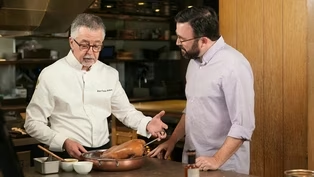
Preview: S4 Ep3 | 30s | Blue Duck Tavern in the West End, Dawa in U Street Corridor, Mallard in Logan Circle. (30s)

Watch Chef Eric Adjepong's New Take on a Duck Confit at DAWA
Video has Closed Captions
Clip: S4 Ep3 | 5m 17s | Seth visits Dawa where Chef Eric prepares a tamarind duck confit with Ghanaian jollof rice. (5m 17s)
Providing Support for PBS.org
Learn Moreabout PBS online sponsorship

- Food
Christopher Kimball’s Milk Street Television
Transform home cooking with the editors of Christopher Kimball’s Milk Street Magazine.










Support for PBS provided by:
Signature Dish is a local public television program presented by WETA