
December 19, 2025 - PBS News Hour full episode
12/19/2025 | 57m 46sVideo has Closed Captions
December 19, 2025 - PBS News Hour full episode
December 19, 2025 - PBS News Hour full episode
Problems playing video? | Closed Captioning Feedback
Problems playing video? | Closed Captioning Feedback
Major corporate funding for the PBS News Hour is provided by BDO, BNSF, Consumer Cellular, American Cruise Lines, and Raymond James. Funding for the PBS NewsHour Weekend is provided by...
December 19, 2025 - PBS News Hour full episode
12/19/2025 | 57m 46sVideo has Closed Captions
December 19, 2025 - PBS News Hour full episode
Problems playing video? | Closed Captioning Feedback
How to Watch PBS News Hour
PBS News Hour is available to stream on pbs.org and the free PBS App, available on iPhone, Apple TV, Android TV, Android smartphones, Amazon Fire TV, Amazon Fire Tablet, Roku, Samsung Smart TV, and Vizio.
Providing Support for PBS.org
Learn Moreabout PBS online sponsorshipGEOFF BENNETT: Good evening.
I'm Geoff Bennett.
Amna Nawaz is away.
On the "NewsHour" tonight: The Justice Department releases a long-awaited trove of documents related to the late sex offender Jeffrey Epstein.
What we know about the Brown University shooting suspect who was found dead after a days-long manhunt.
And we speak with a relative of an immigrant with no criminal record who's being detained by immigration authorities.
GENE SMITH, Family Friend of Fatima Issela Velasquez-Antonio: She did exactly what the government asked her to do.
She graduated from high school.
She got a valid work permit, Social Security card.
She pays taxes.
She had gainful employment.
(BREAK) GEOFF BENNETT: Welcome to the "News Hour."
Late this afternoon, the Justice Department began releasing thousands of pages of files and communications related to the late convicted sex offender Jeffrey Epstein.
The new documents include photos, call logs, court filings, and more, many of them heavily redacted.
Our White House correspondent, Liz Landers, joins us now.
So, Liz, you and our team have been reading through these documents.
What stands out so far?
LIZ LANDERS: Well, there are thousands of documents that have been released today.
That is far fewer than the attorney general, the deputy attorney general, Todd Blanche, had said.
And he has said that this will take a few weeks.
What we have noticed in today's release so far is that this is divided into several different categories.
And much of the new information is coming out in what is the Department of Justice disclosure category.
We have seen a redacted masseuse list with more than 250 names, all redacted.
We have also found at least one of the grand jury documents in there from the United States v. Epstein.
That is key.
We have not gone through that document yet, but that is certainly something we will be looking through.
There are tons and tons of photos in this.
That's really what is the bulk of what's in today's release, many more pictures showing Jeffrey Epstein and his lifestyle, including his former girlfriend, Ghislaine Maxwell.
Also, former President Bill Clinton is in a number of these photographs.
He's traveling with Ghislaine Maxwell in one of these pictures.
They appear to be in a foreign country.
There's another photograph of them in a swimming pool.
And then there are another several photos of the former president with women whose faces are redacted.
Now, former President Clinton is not accused of any wrongdoing in relation to this Jeffrey Epstein relationship that he had.
And these are undated photos, so we don't know when these pictures were taken of the former president.
A lot of what we have seen today too, separate images, include sexual innuendo or nudity.
And I just want to note too that these photographs that we have seen today do not seem to include any photos that we have seen so far of President Trump.
GEOFF BENNETT: The DOJ, as you said, makes clear that what they're releasing today is really only part of what they have.
More to come.
Still, what appears to be missing so far?
LIZ LANDERS: So we're looking for more of those grand jury documents.
Of course, that is key and what many members of Congress have been asking for over the last few months and years.
We're also looking for any more photos.
And there's also a list that some members of Congress say may have some of these sexual accusers who may have done -- committed acts against these minors.
There's potentially a list in there of those names.
So those are the things we have looking for.
Deputy Attorney General Todd Blanche said that they're going to release these in the coming weeks.
So we will be going through this for potentially weeks to come.
GEOFF BENNETT: And, Liz, as you well know, the Trump administration initially resisted releasing these documents.
Remind us how we got here.
LIZ LANDERS: Well, the document release today comes after Congress passed and President Trump signed a law last month requiring the Department of Justice to do so.
One of the chief authors of that law is Democratic Congressman Ro Khanna.
And he joins me now for reaction to what has been released today.
Congressman, we just got these documents within really the last two hours or so.
Reading through this, what is your reaction to what you're seeing in these documents and what is not in this release today?
REP.
RO KHANNA (D-CA): Well, the survivors were approaching today with such anticipation.
And I'm glad that they're actually releasing documents and abiding in that way with the law.
But I have got to tell you, I have been very disappointed with the partial nature of the release.
One of the documents, 119 pages that a federal judge wanted released, is totally redacted, and there's no explanation for the redactions.
We also so far have not seen the draft indictment and a lot of the witness interview memorandum that would explain, who were the rich and powerful men who abused these young girls or who were at parties covering up the abuse?
So there needs to be a lot more that comes out in the days ahead.
LIZ LANDERS: Congressman, speaking of those rich and powerful men, your co-author of this bill, Congressman Thomas Massie, said yesterday that at least 20 men accused of sex crimes are in the FBI's Epstein files.
He said that if this release doesn't include some of the names, that that is an indication that not all of the documents have been produced.
Do you agree with that?
And do you know when and if that list will come out?
REP.
RO KHANNA: Well, he's right.
And he's right because he's talked to the survivors.
He's talked to the survivors' lawyers.
They have said that there are other rich and powerful men who engage in either sex trafficking, paying for sex with young women, engaged in abuse of underage girls, or were present at parties where 16- and 15-year-olds were paraded and just watched and did nothing.
And the reality is, that's what we want to see come out.
It's less about, is this a full release, and more about the quality of the release and what are they hiding?
Why are they not having the draft indictment come out, which has some of this information or leads to this information?
Why are they not having the witness interviews come out?
That is really what the survivors want out and what we're after.
LIZ LANDERS: The Department of Justice has said in the letter sent over to members of Congress like yourself that they have not fully released this.
We know that at this point.
What can you do to compel the Department of Justice to release all of these documents?
What are the tools at your disposal?
REP.
RO KHANNA: Well, first of all, the Department of Justice, six months ago, Pam Bondi said they have released everything.
And now they're releasing more.
So, obviously, they weren't being fully truthful back then.
We can have the survivors come back to the Hill to demand a release.
That is what moved public opinion in the first place.
That is what got my bill to pass the House and the Senate and the president to sign it.
There are also, of course, punitive actions.
Thomas Massie and I have discussed possible impeachment, referrals for criminal prosecution if people aren't complying.
And folks say, well, how is the Justice Department going to prosecute their own people?
But there's no statute of limitations that runs out when we have a new administration.
We could hold them in inherent contempt of Congress.
So there are many options, including lawsuits against the Department of Justice.
But my interest is not punitive against Pam Bondi or the deputy attorney general or Trump.
It's to find justice.
And I want to see what we can do to get more of these documents released.
LIZ LANDERS: Congressman, have you spoken with any of these survivors or the families today?
And how are they feeling about this?
REP.
RO KHANNA: I have spoken with some over e-mail and text.
I have spoken with the lawyers of the survivors.
They were very hopeful for today.
They finally felt seen and heard when the Congress passed this bill.
And I don't know what the reaction is of the survivors themselves, but I will tell you, the survivors' lawyers believe that there's a lot more that needs to be released, that maybe this is an initial step, but a lot of the key information has still not been released.
And we expect that that will be released in the coming weeks.
What I hope would be -- would happen is that Pam Bondi or the deputy attorney general would stand in front of the American public, explain what they're redacting and why, explain the timeline for what they're going to release, and be transparent in answering people's questions.
LIZ LANDERS: Congressman, we just have a few seconds left.
But you and your Democratic colleagues on the House Oversight Committee have been, I think, cherry-picking and releasing some of the images from the Epstein estate.
Is that fair to the survivors?
REP.
RO KHANNA: Well, I believe they all need to come out.
And, now, I'm not involved in the disclosure of those.
It's Ranking Member Garcia.
And he's done a good job.
But my recommendation is, just release all of them as soon as the lawyers go through them.
I don't think they should be cherry-picked.
LIZ LANDERS: Congressman Ro Khanna, thank you so much for joining us tonight.
REP.
RO KHANNA: Thank you.
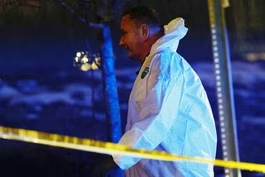
GEOFF BENNETT: Investigators are still trying to determine the motive behind two shootings in New England after the suspect was found dead last night.
The man who killed two students and injured nine others at Brown University was located in New Hampshire last night following a manhunt that ended at a storage facility.
Authorities say they were able to link the suspect to the murder of an MIT professor who was killed in his home on Monday.
Stephanie Sy has the story of how one anonymous tipster changed the course of the investigation.
PETER NERONHA, Rhode Island Attorney General: He blew this case right open.
He blew it open.
STEPHANIE SY: A crucial tip from a Reddit user is what led authorities to identify the gunman, bringing almost a weeklong manhunt to an end.
LEAH FOLEY, U.S.
Attorney: Law enforcement collectively believe that we have the person -- that we identified the person, and that person is dead, and that he was the person responsible not only for the Brown shootings, but for the Brookline shooting.
STEPHANIE SY: The Reddit tipster, known as John, told police he had suspicions about a man he'd seen hours before the shooting in the bathroom of the engineering building.
We now know that man was Claudio Valente.
John said he followed Valente after he left the building to a Nissan with a Florida plate.
The police affidavit describes an interaction between them, with John describing Valente as saying: "I don't know you from nobody.
Why are you harassing me?"
Hours later, the suspect killed two students and wounded nine others in the engineering building.
John's observations enabled police to tap into a network of over 70 street cameras around the city.
PETER NERONHA: When you do crack it, you crack it.
And that person led us to the car, which led us to the name, which led us to the photographs of that individual renting the car, which matched the clothing of our shooter here in Providence, that matched the satchel.
STEPHANIE SY: Police tracked Valente to a storage unit in Salem, New Hampshire, where he was found dead from a self-inflicted gunshot wound.
He'd been dead for two days.
Because the same Nissan was spotted near another crime scene, Valente is now believed to have also killed MIT Professor Nuno Loureiro, who was murdered in his home in Brookline, Massachusetts, on Monday, two days after the mass shooting at Brown.
Loureiro is believed to have crossed paths with the suspect when he lived in Portugal.
His former employer, the Institute for Plasmas and Nuclear Fusion, described Loureiro as a brilliant scientist whose presence -- quote -- "profoundly marked all those who worked and interacted with him."
Between 1995 and 2000, Loureiro attended the same academic program as Valente, a Portuguese national.
Valente then moved to the U.S.
on a student visa in 2000, enrolling as a physics graduate student at Brown.
He took a leave of absence from the program in 2001 and never graduated, becoming a legal permanent resident of the U.S.
in 2017 and living in Miami.
Hours after details of the suspect came out, President Trump said he would pause the diversity visa program Valente used to gain permanent residence.
Meanwhile, after a week of heightened fears in the Brown community: BRETT SMILEY (D), Mayor of Providence, Rhode Island: Our Providence neighbors can finally breathe a little easier.
CHRISTINA PAXSON, President, Brown University: Nothing can really fully bring closure to the lives that have been shattered over the past week, but this may allow our community to move forward.
STEPHANIE SY: The tipster is being hailed as a hero and is, according to FOX News, homeless.
For the PBS "News Hour," I'm Stephanie Sy.
GEOFF BENNETT: And we're joined now by Juliette Kayyem, a former assistant secretary at the Department of Homeland Security.
She's now at the Harvard Kennedy School of Government.
Thanks for being with us.
We appreciate it.
JULIETTE KAYYEM, Former U.S.
Department of Homeland Security Assistant Secretary: Thank you for having me.
GEOFF BENNETT: So what more should we know about this tip from someone using the social media platform, Reddit, that ultimately led authorities to the suspect?
JULIETTE KAYYEM: Yes, so Reddit is a platform where lots of casual information is shared, where people learn how to fix a car, to really bad information.
It's not generally -- this is very unique.
Let's just put it that way.
What we know now is that there is a person, his name basically -- we didn't know who he was.
His name is now described as John, who encounters the killer at a couple of moments, a couple hours before the mass shooting, encounters him near the car.
This John decides to go on Reddit and urge the police to follow the license plates, says, this guy was suspicious, we had an interaction, but doesn't immediately tell the police.
We later learned that John had been at Brown a long time ago.
He's been homeless for some period of time and may not have felt confident going to the police.
The police then see this, and there's some sort of interaction between this John and the police.
That is what the police say sort of blew the case open in a good way, because now they had a car and a license plate, and then, by then, then they could figure out who had rented the car, who he might be.
They had a name, they had a picture and things unfolded very quickly after that.
GEOFF BENNETT: This case is as unusual as it is unsettling and tragic.
What stands out to you about it?
JULIETTE KAYYEM: I mean, there's two pieces.
I mean, one is just the nature of the killings.
One is a mass shooting in a classroom, sort of anonymous.
It's sort of against an institution.
And the other one against the MIT professor looks more like a targeted assassination.
In this world of sort of this kind of violence, you don't get the same person generally doing those two types of things.
So this was odd.
And I will admit that I was skeptical about the connection between the two killings until you started to see more evidence.
I think the second piece is, of course, just the grudge factor.
We don't have a specific motive, but I think rational people can look at the evidence we now have and see that this was -- Brown was a university that he did not succeed at.
And the MIT professor was a person who he overlapped with in Portugal.
And then he became an MIT professor and heralded as a leader in nuclear theory, while the suspect or the killer sort of did not amount to much.
That length of the grudge, the sort of that long-term stewing, where no one is -- no one around him is sort of capturing that, that is very, very odd, as you said, sort of disconcerting.
And I don't know how one stops that.
Like, I mean, just it was a multidecade grudge.
GEOFF BENNETT: We know that President Trump has suspended the green card lottery program that allowed the suspect to come into the country.
What do you make of that move?
JULIETTE KAYYEM: So, Valente came in two different periods in his life.
One was as a student visa when he attended Brown.
He then leaves.
There's then these, like, gap years.
But then, in 2017 -- so, remember, this is during the Trump first administration -- he comes on what's called a diversity visa.
It's just a way of describing visas that are given to people who lawfully can enter this country, stay in this country, have no criminal record, but they're from countries that we don't get a lot of representation from, Portugal being one of them.
He has no -- Valente had no criminal record, no suspicion of incitement, nothing.
I mean, he's just sort of -- as I said, he's just sort of stewing there.
One could, as the Trump administration often does, sort of make a sweeping generalization about this status visa or other status visa.
But I have to admit, the Trump administration has been against the diversity visa for a long time.
This may just be a sort of way for them to have a compelling reason to close the program down.
It's a relatively small program.
But, of course, closing down this immigration program doesn't really solve -- doesn't really solve violence in this country.
I mean, in other words, just because you're reacting to one incident with one immigrant, we have lots of violence in this country committed by all sorts of people.
And I'm not sure that a sweeping condemnation of everyone who comes on the diversity visa program is a solution to the violence problem.
It is, for the Trump administration, a solution to their long-term animosity towards this visa program and most lawful immigration programs.
GEOFF BENNETT: Juliette Kayyem, thank you for joining us.
We appreciate it.
JULIETTE KAYYEM: Thank you.
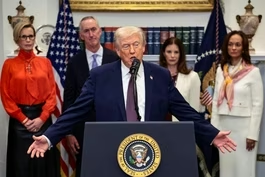
GEOFF BENNETT: In the day's other headlines: Nine pharmaceutical companies have agreed to cut prices on many of the drugs they sell to Medicaid and sell them directly to consumers through the TrumpRx Web site.
In exchange, the companies will get tariff relief and other benefits.
The companies include Merck, Gilead, GlaxoSmithKline, and Bristol Myers Squibb.
All told, 14 companies have now reached such deals with the Trump administration to cut prices.
Today's announcement does not address the high cost of most drugs already under private insurance or Medicare, and it stops short of legally forcing drugmakers to cut prices.
But President Trump says it'll help bring costs more in line with those in other wealthy nations.
DONALD TRUMP, President of the United States: For years, we would just say, no, no, no, as medicine got more expensive for us, we would say -- they said, nope, you can't sell it in this country, let United States pay.
And we had other presidents, all of them, said, OK, we will pay.
So we were subsidizing the entire world.
We're not doing it anymore.
GEOFF BENNETT: Separately, Mr.
Trump said in a phone interview late yesterday with NBC News that he sees no need to repeal the Affordable Care Act, or Obamacare, as he's tried to do for years.
He said he believes Americans will simply stop using it, saying -- quote -- "Obamacare would just repeal itself."
In Syria, the U.S.
military has launched what an official tells the "News Hour" is the largest series of strikes against the Islamic State in years.
Jets, helicopters, and artillery targeted dozens of targets in central Syria.
It follows President Trump's promise to retaliate for the deaths of two National Guard soldiers and a civilian interpreter who were killed by the group last week.
In a post on social media, Defense Secretary Pete Hegseth said -- quote -- "This is not the beginning of a war.
It is a declaration of vengeance."
They were the first U.S.
fatalities in Syria since the fall of the dictator Bashar al-Assad last year.
Russian President Vladimir Putin says his country remains committed to achieving its military goals in Ukraine if Kyiv does not agree to its demands for peace.
Speaking at his marathon annual news conference in Moscow, Putin boasted about recent battlefield successes, saying his forces have seized the strategic initiative.
And while he acknowledged that there are certain signals that Ukraine is ready to talk, Putin insisted that Russia's territorial demands and other conditions be met.
VLADIMIR PUTIN, Russian President (through translator): We do not consider ourselves responsible for the loss of life because it was not us who started this war.
The ball is entirely in the court of our Western opponents, primarily the leaders of the Kyiv regime and, in this case, first and foremost, their European sponsors.
We are ready for both negotiations and a peaceful resolution to the conflict.
GEOFF BENNETT: Russia started the war when it invaded Ukraine in 2022.
Meantime, at his own year-end news conference today, Secretary of State Marco Rubio said there was still a ways to go in negotiating an end to the war in Ukraine.
He also signaled that he may join talks in Miami this weekend between U.S.
and Russian officials.
The Australian government announced a gun buyback plan today following the mass shooting in Sydney last weekend.
ANTHONY ALBANESE, Australian Prime Minister: The terrible events at Bondi show we need to get more guns off our streets.
GEOFF BENNETT: Prime Minister Anthony Albanese says the program is expected to take hundreds of thousands of firearms out of circulation in Australia.
The government also said it's considering new gun ownership laws, though that could face opposition from conservative lawmakers there.
And officials announced that Sunday will be a national day of reflection.
They're calling for a moment of silence to mark exactly one week since the attack that killed 15 people during a Hanukkah festival.
Here in this country, a Wisconsin judge is facing up to five years in prison after being found guilty of obstruction for helping an immigrant evade federal authorities.
But the jury cleared Milwaukee County Circuit Judge Hannah Dugan of the misdemeanor charge of concealing an individual to prevent arrest.
According to court filings, Dugan led a 31-year-old Mexican immigrant out of her courtroom through a private backdoor in April.
Wisconsin state Republicans are calling for her to be impeached.
Democrats say the administration is trying to make an example of her.
A nearly century-old bridge spanning the Mississippi River was demolished today.
As onlookers watched from the shore, the Black Hawk Bridge crashed down into the water below.
The bridge was built in 1931 and connected Wisconsin to Iowa.
It was called the Singing Bridge because its metal grate flooring made a humming noise when cars drove over it.
It had fallen into disrepair and was closed to vehicle traffic back in October.
Construction on a new bridge nearby is under way, and that's set to open in 2027.
Wall Street ended the week on solid footing thanks to gains in some A.I.-related stocks.
The Dow Jones industrial average added nearly 200 points on the day.
The Nasdaq jumped more than 300 points.
The S&P 500 also ended firmly in positive territory.
Still to come on the "News Hour": a "Vanity Fair" reporter discusses the White House pushback against his article about Trump's chief of staff and other top advisers; and David Brooks and Jonathan Capehart weigh in on the week's political headlines.
It was the story that consumed Washington this week, the "Vanity Fair" profile by journalist Chris Whipple built on 11 on-the-record interviews with President Trump's chief of staff, Susie Wiles, offering a rare and revealing look inside Mr.
Trump's second term.
Through Whipple's reporting, Wiles delivers unusually blunt assessments of senior Trump officials, criticizing Attorney General Pam Bondi's handling of the Epstein files, describing Vice President J.D.
Vance as a conspiracy theorist, and offering a striking characterization of her boss, the president.
Chris Whipple joins us now.
Thanks for being here.
CHRIS WHIPPLE, "Vanity Fair": Good to be with you.
GEOFF BENNETT: So, as I said, your reporting is built on 11 on-the-record interviews with Susie Wiles over the course of a year.
How did you build that level of trust and access?
CHRIS WHIPPLE: Yes, really stunning, because, as you know, senior White House officials hardly ever speak to you on the record.
I wrote a book about Joe Biden, so I know something about that.
But from the get-go, in January, almost a year ago, she was remarkably unguarded and open and on the record, except when we agreed mutually otherwise, and those were very few and far between.
And, again, I was just -- I found it stunning that I was able to talk to her for the next -- almost the whole year.
And we talked through every crisis, from the blanket pardon of the insurrectionists on January 6 to the bombardment of boats in the Caribbean in recent days.
So it's not only a profile of Susie Wiles, but a remarkable inside look at Trump 2.0.
GEOFF BENNETT: As many people know by now, she's quoted as saying that Trump has an alcoholic's personality, called the vice president, as we said, a conspiracy theorist, referred to the OMB director, Russell Vought, as a right-wing absolute zealot, said that Attorney General Pam Bondi's initial handling of the Epstein files, that Bondi, in her words, completely whiffed.
As you say, she was unguarded and candid in her assessments.
She's describing senior Trump officials the way that many Trump critics describe them.
The question is, why?
CHRIS WHIPPLE: Yes, and it's a great question.
And I think that really a couple of points I would make here.
Number one, I take her at her word that she felt that Trump had been maligned and unfairly treated, characterized during his first term.
She was bound and determined to see that change in any way she could if she could find a fair hearing.
And I think she thought she would get it from me.
Number two, I think there's something else going on here.
I think that, when you work in a bubble like the Trump White House and you're surrounded all day by like-minded acolytes reading more or less from the same playbook, I think at a certain point, in this insular world, you forget that some of the things you say might sound crazy outside that perimeter, I mean, in a -- on a normal planet.
And I just think that this is the way they talk among themselves often.
J.D.
Vance has confirmed that he's a conspiracy theorist.
Donald Trump has confirmed that he has an alcoholic's personality, so there you go.
GEOFF BENNETT: You also asked her about the president's health, his erratic disposition, his falling asleep in meetings, his verbal abuse of women reporters.
What did she say about that?
CHRIS WHIPPLE: Well, again, absolutely extraordinary.
On the subject of the president's health, she insists, she's adamant that he's OK, he's fine.
She said: "My health is good.
His health is great."
I said, what about falling asleep in these Cabinet meetings?
She said: "No, he's just closing his eyes."
And then I pressed her on the president's increasing -- all these episodes of verbally abusing women.
And she said -- and I specifically asked her about what he said to the Bloomberg reporter when he said, "Quiet, piggy."
And her response to that was: "He's a counterpuncher.
And, increasingly these days, women are doing the punching."
GEOFF BENNETT: After the peace ran, Wiles referred to it as a hit piece.
What do you make of that?
Was she speaking to you believing that she was off the record when she was really on the record?
CHRIS WHIPPLE: Never.
Never.
She understood full well from the get-go that we were on the record.
And, in fact, she commented on a number of times that we were on the record and confirmed it.
So, what this is, is a realization on their part that she was speaking out of school and in trouble for what she had said.
They had to clean it up.
And what's remarkable is that they have failed to -- the White House has failed to challenge a single assertion in the piece or a quotation.
And what that tells you is that the story is rock-solid.
GEOFF BENNETT: She also said, according to your reporting, that she hasn't always agreed with the president's policy decisions, that she was initially aghast at the shuttering of USAID.
She questioned the blanket pardons of all the January 6 defendants, as you mentioned earlier, disagreed on the administration's deportation process.
So, by what measure does she judge her own effectiveness if she has been on the losing side of all of these key debates?
CHRIS WHIPPLE: Yes, it's a great question.
And the answer is complicated.
The answer is that she seems to want to have it both ways.
I think she wants to be regarded the way some of the great White House chiefs in history have been regarded, Leon Panetta, James A. Baker III, Baker under Reagan, Panetta under Clinton.
These were people who could tell the president hard truths.
And yet, at the same time, she, frankly, admits that the battles she has with Donald Trump are over little things, not the big constitutional issues that a White House chief sometimes has to call the president on.
So there's -- I found -- and I also found that there's a fascinating kind of journey that she takes.
In the beginning, she seems to be trying to tap the brakes on some of Donald Trump's successes.
And now it seems to me she's pretty much all in.
GEOFF BENNETT: What does your reporting and your conversations with her reveal about the current dynamics within the Trump White House?
CHRIS WHIPPLE: Well, I think the current dynamics are really interesting and, obviously, the reaction to my piece in "Vanity Fair."
It's 9,500 words.
It's -- there's plenty of context.
It's nuanced.
I think it's quite fair.
And I praise Susie Wiles for many of her abilities.
But what's clear is that, as unhappy as they may be about this piece and the things that she said, she's not going to the doghouse or the woodshed.
She -- her bond with Donald Trump is solid.
And that's one of the fascinating things about this piece.
And it goes all the way back to 2015, when they first met, and Trump was so impressed that she was the daughter of Pat Summerall, the famous sportscaster.
They -- she has a real magic with Donald Trump.
GEOFF BENNETT: Chris Whipple, thanks again for joining us.
CHRIS WHIPPLE: Thanks for having me.
GEOFF BENNETT: Among the tens of thousands arrested in the Trump administration's immigration crackdown are many convicted of violent crimes, but nearly three-quarters of those held by ICE have no criminal record.
That's according to TRAC Reports, a nonpartisan data gathering platform.
Amna Nawaz spoke recently with the family of a young -- one young woman who has been detained by federal immigration officers in North Carolina.
AMNA NAWAZ: Last month, 23-year-old Fatima Issela Velasquez-Antonio was arrested by Border Patrol at her worksite in Raleigh, North Carolina.
This is the video showing that moment shot by a family friend.
Despite having a legal work permit and no criminal record, she remains in ICE custody in Lumpkin, Georgia, today.
After both of her parents died, Fatima left Honduras at the age of 14, entering the U.S.
as an unaccompanied minor and seeking asylum.
Her family is choosing not to do interviews due to fears over their own immigration status.
But they have asked Gene Smith, her aunt's boyfriend, to speak on their behalf.
He joins us now.
Gene, welcome to the "NewsHour."
Thanks for joining us.
GENE SMITH, Family Friend of Fatima Issela Velasquez-Antonio: It's my pleasure.
Thanks for having me.
AMNA NAWAZ: So it's been over a month now that Fatima has been held.
When is the last time you or anyone in the family was able to talk with her?
And what can you tell us about how she's doing?
GENE SMITH: I was able to speak to her over the weekend.
And she was in good spirits.
I know she's been in contact today with her boyfriend and other family members.
And she's just -- she's worried.
She's locked up.
She's confined and she wants to come home.
She doesn't really know her legal future and what's going to happen tomorrow.
So she's really concerned.
And, for the most part, she's worried about her family.
She wants them to be happy and to know that she's -- she knows that they're on her side and they're praying for her.
And she's just supporting them, which is ironic since she's the one that needs our support.
AMNA NAWAZ: Let me ask you about the day that she was arrested back in November, because we have seen federal agents showing up at a number of worksites across the country in different places.
On the day that she went to work, was there any reason to think that the same thing would happen to Fatima?
GENE SMITH: No.
Not on my side, no.
But, that morning, her aunt, which is my girlfriend, she owns a business.
And she said, "Gene," she said, "some of my employees can't make it or can't work today."
I said: "Why not?"
They -- she said they're -- they have a fear of getting arrested by ICE.
And nonchalantly just blew it off, said, if -- "You can't let anyone dictate how you run your business."
And then, a few hours later, five, six hours, she gets a call that says Fatima's locked up.
Now it just hits me broad right in the face.
So I feel really, really ashamed and apologetic.
And what she said to her family that day, she said, crying, she was locked up -- not that day, but when they finally was able to talk to her, she told them, she said: "I'm glad it was me, not you."
AMNA NAWAZ: Knowing her as you do, why do you think she said that?
GENE SMITH: Because she's a good kid and she loves her family.
And if anyone could wear the brunt of this administration's messed-up policies, I think she would be willing to take that bullet for her family.
AMNA NAWAZ: Tell us a little bit more about her, so we know who we're talking about here.
As I mentioned, she came here when she was just 14.
She'd lost both of her parents.
GENE SMITH: Yes.
AMNA NAWAZ: Why did she come to the U.S.?
And tell us about the life that she's built in the years she's been here.
GENE SMITH: Well, as you know, she lost her mom when she was around 12.
I think her mom died of cancer.
Her dad was murdered by gang members around the age of 14.
She sought asylum here in the United States to the only country that she felt secure in, and to her family, which resides in North Carolina.
And since she's been here -- she came as an unaccompanied minor, as you said.
She's created a life for herself.
She did exactly what the government asked her to do.
She graduated from high school.
She got a valid work permit, Social Security card.
She pays taxes.
She had gainful employment.
And she just bought a home with her boyfriend a few months ago.
That is a heck of a feat at age 23.
And so she's just a good kid.
She loves her family, her nieces and nephews, her cousins.
And she just enjoys life.
She's a blessing to be around.
And I think, if anyone deserves a pass, it's this young lady.
AMNA NAWAZ: And I just want to be clear on this point, Gene.
Our understanding is that she doesn't have any criminal record.
She does have a couple of traffic violations, which would be civil infractions, in the years.
Is that correct?
And, if so, what is your understanding of why she was arrested and why she's still being held?
GENE SMITH: That is correct.
She has no criminal history whatsoever, other than minor traffic violations.
ICE came to North Carolina under a sweep, starting Charlotte, and the next day they were in Wake County.
She got arrested in Cary.
They interviewed her that day.
I think the video shows that she has a valid work permit.
That day, she grabbed the wrong one, but she does have a valid one.
And they ruled that, because her paperwork was not correct right then, they're going to detain her.
Since then, we have tried to get her released on bond.
Unfortunately, the Trump administration has ruled that detainees can't get a bond right now.
AMNA NAWAZ: Gene, I have to ask you, because I know from your previous conversations with my colleague that you have supported, and I think -- I understand you still support President Donald Trump, that you did vote for him.
This is someone who campaigned on mass deportations, who said anyone who is here illegally will be removed and deported.
And though she is seeking asylum, Fatima did enter the country illegally.
So I guess the question is, did you not expect that someone like her would be targeted by this administration?
GENE SMITH: I can't fathom that his policies were targeted at someone such as her.
And, unfortunately for me and probably for a lot of Americans, we really don't realize the extent of what the immigration and how that system is broken.
And I didn't.
I certainly didn't.
Now that it's hitting close to home, I see how broken that system is.
I did vote for Trump.
And I still support Trump.
I understand you need -- we have a safe border, sure.
And I will reach out to Trump right now.
President Trump, if you listen to this and then you see this, please release her.
She is a good kid.
I still support you.
And I support your policies.
I think our immigration system is flawed and it's broken.
And we need to fix that, because the only one that's penalizing is young ladies such as her that deserve to be home with their family.
AMNA NAWAZ: Gene, I just have to ask, in saying you support his policies, the administration will say, this is their policy.
It is to arrest and deport anyone who is here without legal status.
What would you say to that?
GENE SMITH: I believe our law says that she's not to be detained while her -- she is waiting adjudication of her case.
She came as a minor.
She hasn't committed a crime.
She did everything the U.S.
government asked of her.
And I don't think that Trump meant for that to take place, for her to be deported.
I do support his policies.
I just don't support this one.
AMNA NAWAZ: Let me just put to you what the Department of Homeland Security shared with us when we asked them about her case.
They said in part that she admitted to officers that she was in the country illegally.
They say: "All of her claims will be heard by a judge.
She will receive full due process."
They also blame the Biden administration for using discretion to, they say, indefinitely delay many illegal aliens," including her case.
They also say, Gene, that she has a choice to either leave voluntarily or be arrested and deported.
Are you worried that she may end up deported back to Honduras?
GENE SMITH: I have faith in God, and I believe that God is in control.
She's not a flight risk.
She's not a danger to society.
So I am hopeful that she will be granted her day in court and be released on bond, and so that she can remain with her family in the community during the adjudication process, so that she can become a United States citizen.
So I don't think she will be deported.
I hope and pray she does not.
If she did get deported, that would be a travesty, in my opinion.
AMNA NAWAZ: That is Gene Smith speaking on behalf of the family of Fatima Issela Velasquez-Antonio.
Gene, thank you for your time.
GENE SMITH: Thank you for yours.
I appreciate you.
Thank you for having me.
GEOFF BENNETT: This week, President Trump attempted to address his sinking approval ratings on the economy.
For analysis on that and more, we turn now to Brooks and Capehart.
That's New York Times columnist David Brooks and Jonathan Capehart of MS NOW.
Good evening, gentlemen.
JONATHAN CAPEHART: Geoff.
GEOFF BENNETT: So, President Trump is taking on affordability after initially saying it was a hoax perpetrated by Democrats.
He addressed drug prices today.
He's taking that message on the road to battleground North Carolina.
And, of course, he delivered that speech to the nation on Wednesday night.
And, Jonathan, this speech comes at a moment when the president's approval ratings on the economy are soft.
If the goal was to reset the political narrative heading into 2026, is this the way to do it?
JONATHAN CAPEHART: No.
No, it's not.
He literally screamed at the American people for, what, 18 minutes, almost 20 minutes.
And I wondered, was -- by screaming, is he trying to convince the American people that what he's saying is true or is he trying to convince himself?
There are a raft of polls that we have talked about on many Fridays that show that the American people think the country is going in one direction, while the president of the United States insists that everything is great and will be greater still if you bought fewer pencils and fewer dolls for your children.
So I don't think he will succeed in convincing the American people that his policies are the way to go to make their lives better, no matter how many speeches he gives, no matter how much barnstorming he does, because, when he does these things, invariably, if the topic is affordability, if that's the prescribed topic, he meanders into other areas that completely muddy his message.
GEOFF BENNETT: Well, David, what would move skeptical voters?
DAVID BROOKS: Lower prices.
(LAUGHTER) DAVID BROOKS: I ran into a CEO who said, when a customer complains to me, and I take it to my team, and they say, no, the customers are wrong, that's just an anecdote, we have data, the CEO said, I always believe the anecdote, because you can't argue people out of their experience.
And you go to the grocery store, and you think you bought nothing, it's $140, like, that's real.
Everybody feels that.
And so that -- rhetoric can only do so much.
People were struck by the anger.
Like, Peggy Noonan wrote in The Wall Street Journal, it felt like he was angry at his words.
And I don't think he's panicked.
Some people think he senses decline and panic.
If you look at his overall approval rating, it's at 42 right now, which is like normal territory for him.
I just think he's getting a lot more bellicose with age or with something, with stress.
He's just a level of bellicosity at everybody and everything, including us, the American people.
GEOFF BENNETT: Well, let's talk more about that, because Republicans spent years telling voters to trust their eyes when it came to former President Biden's age and mental acuity.
Are Democrats now justified in applying that same standard to President Trump?
You referred to his bellicosity.
There is certainly this growing disinhibition.
You look at the TRUTH Social post after Rob Reiner passed away.
You look at the way that he verbally abuses some women reporters.
How do you see it?
JONATHAN CAPEHART: I have said many times at this table, even with -- to questions that had nothing to do with his mental acuity, what about his mental acuity?
If any other president had said what he had said or done what he had done, they would have been hauled out on the carpet, people asking questions, where are the doctors?
Let's see his medical records.
And yet he goes on and does things like this.
What he said in that TRUTH Social post and then before cameras about the murder of Rob Reiner was a low that I didn't even think he could reach.
And yet he's proven me wrong in trying to think that he has even -- just even a scintilla of a moral core.
We should be asking about the president's mental acuity.
We should be asking, because he's 79 years old, is he up for the job?
And you just listen to what he says, the policies that he's pursuing, just tariffs, in particular, and no one seems to be bothered by it.
But I will keep asking the question until more people start asking the question and we get answers from the White House.
GEOFF BENNETT: David, on that point, if this were a corporate CEO, a military commander, the expectations -- for of transparency, the expectations about transparency for one's capacity would be higher than they are for a president of the United States.
DAVID BROOKS: Well, that's been true since 2017 or 2016.
Yes, I worry about his moral acuity.
I mean, he is a narcissist.
But the Rob Reiner tweet was -- and I'd say the events of the whole week, to be honest, he takes his narcissism, which is normally at 10, and he moves up to 15 this week.
And so the Rob Reiner tweet was -- to take a man who was murdered, maybe by his son, and to write a tweet all by yourself, he just cannot contemplate the pain of another family.
And that's a mental problem.
It's certainly a moral problem.
GEOFF BENNETT: Let's shift our focus to the Justice Department, which has started to publish documents from the Epstein files, all the files and its possession about the life, the death, the criminal investigation into the late convicted sex offender Jeffrey Epstein.
Jonathan, now that these files are starting to be released, we expect them to be pushed out over a matter of weeks, do you expect this to finally put to rest the questions, the conspiracy theories about this case, or is there something particular about this that is resistant to closure?
JONATHAN CAPEHART: No, I don't think it's going to put to rest the questions or the conspiracy theories, particularly the documents that come from the Justice Department because of redactions.
The beginning of the show, you showed one particular piece of paper where the entire thing is blacked out.
So whatever is behind those redactions, conspiracy theorists are always going to find a reason to keep the conspiracy alive.
And so until -- unless and until the administration does a proper accounting -- remember, back in the old days, when the attorney general would come before the American people and give a very sober assessment of what they found and the hard work that they put in and pledging that we will be forthcoming and transparent?
We don't have this.
Instead, what we have gone through is a lot of obfuscation.
And, quite honestly, I was surprised when I got the breaking news alert that they had released the documents, because they have conditioned us to expect less and certainly expect them to ignore the law.
GEOFF BENNETT: And, David, we should say there were photos of you included in the House Democrats' release this past week, which you have addressed.
DAVID BROOKS: Yes, I will just clear that up and then go to the larger issue.
So, in 2011, I attended the TED Conference, and there was an adjacent dinner to that conference, which, in my memory, maybe two or three dozen people, different roundtables.
And I was at that dinner.
And, apparently, Jeffrey Epstein was at that dinner.
As far as I know, I did not ever meet him.
I never exchanged a word with him.
We must have been at different tables.
And, in my life -- I went through all my e-mail files -- I have never exchanged a word.
I have never had any contact with Jeffrey Epstein.
The photos are not of me and Epstein.
There's one of me alone, because nobody wants to talk to me at a party, and another with me chatting with Sergey Brin, one of the Google co-founders.
And so the bottom line is, I had no idea who Jeffrey Epstein was in 2011, so I didn't know he was at the party, and I have had no contact with him.
On the larger issue of, when Ro Khanna was talking about all the women who want satisfaction, they want -- I -- obviously, we all hope they get it.
I would like to know why -- the FBI really did investigate this a lot.
If there were 20 men who were guilty of sexual abuse, why were they not tried?
I think that's the question I have at this moment.
Why were they not even indicted?
And there's where justice needs to be served.
GEOFF BENNETT: As we wind up our conversation here, I want to talk about the White House saying that President Trump has renamed -- or, rather -- we should say it this way -- Trump appointed members to the Kennedy Center board, and that board voted, the board says unanimously, to rename the Kennedy Center, as you see there, the Donald J. Trump and John F. Kennedy Memorial Center for the Arts.
It's remarkable, in that the Kennedy Center is more than just a performance space.
It is a memorial to a fallen president.
JONATHAN CAPEHART: Right, a memorial to a slain president.
And yet -- I take this to -- back to the president's mental acuity, although this isn't him being crazy.
This is him being a flat-out, full borne narcissist.
He's already done it before.
It's now the Donald J. Trump Institute of Peace.
He's got an Arc de Triomphe-like thing that's going to go on the other side of the Memorial Bridge.
He -- I saw somewhere that memorials are usually done for people who have left us, either through murder or through death, who have done things that are worthy of note.
We have not seen, at least I haven't seen, a sitting president out there skipping through Washington, slapping his name on anything and everything.
This is not normal.
And I'm glad you described what happened today in the way that you did.
The center cannot be renamed legally by that Kennedy Center board or by the president of the United States.
The fact that his name is now on the building less than 24 hours of this happening says to me that the president does not give a damn about the law on anything, whether it comes to that memorial or whether it comes to boats in the -- off the coast of Venezuela or anything.
GEOFF BENNETT: Are we seeing an evolution here in how President Trump publicly asserts his power?
DAVID BROOKS: Yes, that's well put.
It is an assertion of power.
You think, who else has big porches themselves all over?
Mao Tse-Tung.
Stalin.
Authoritarian leaders know that a certain part of the population likes it when they see the great leader idolized and venerated.
I have a building right by my house on Capitol Hill, and it's Teddy Roosevelt and Donald Trump, gigantic portraits.
And it does remind you of going back to the Stalin era.
And so it is a form of psychological amassing of power to turn yourself into a demigod.
And I think, as sad and pathetic as he makes it, I think that's what he's trying to do.
JONATHAN CAPEHART: Yes.
GEOFF BENNETT: David Brooks, Jonathan Capehart, thank you both for your insights.
JONATHAN CAPEHART: Thanks, Geoff.
DAVID BROOKS: Thank you.
GEOFF BENNETT: Before we go, we want to acknowledge a difficult change for us here at the "PBS News Hour."
Over the past six years, our bureau in Phoenix has provided excellent reporting from that region and produced an updated broadcast for stations in the Pacific time zone known as "News Hour West."
But even strong and successful partnerships sometimes come to an end.
With our partners at Arizona State University, budgeting realities brought about this change.
Some of those on our "News Hour West" team will be staying on with PBS News, while others move on to new endeavors.
"News Hour" correspondent Stephanie Sy has been the anchor of "News Hour West," and she joins us now.
So, Steph, it's great to see you.
Tell us what you and the team are proudest of as you look back on the work you have done there.
STEPHANIE SY: Yes, I have some stuff in the prompter, but I just want to go from my heart here, Geoff.
I mean, this has been an incredible, important, worthy and successful experiment.
For the last six years, this "News Hour West" bureau nightly has updated the news summary for our West Coast viewers, making sure that they have the very latest news.
That has meant that we were on the air when the Russian invasion of Ukraine started.
We were on the air when Justice Ruth Bader Ginsburg died, when Congress passed major legislation.
And we did that all with a surprisingly small and scrappy team.
I mean, there were only four of us on the editorial side at "News Hour."
And what we really depended on from a technical standpoint was our partnership with ASU.
And that meant we were more than a newsroom.
We were a teaching hospital.
That's what we would call ourselves, because we were mentoring and coaching students who were helping to put the program on the air.
I don't know of any other national news program that is nightly put on the air by college students from a campus in Arizona.
So it was an incredible endeavor.
I'm also really proud of the fact that we had 30 interns working with us throughout the last six years, and many of them are now working journalists with this incredible experience of having worked at the "News Hour."
GEOFF BENNETT: So, the news updates are ending, but you are staying.
STEPHANIE SY: I am, Geoff.
And I'm very fortunate to be able to continue to report for the "News Hour."
My heart goes out to all of our public broadcasting colleagues who have seen their positions eliminated.
And I sure am going to miss this team.
All right, guys, come on in.
I just want to bring all of the folks in.
We have our editorial folks here on my right.
I want to name some of them, Phil Maravilla, Madison Staten, Lena Jackson, Vanessa Ruiz.
We have our interns.
And then Gregg Elder, who is behind the camera, but I'm going to say his name -- come on in, Gregg -- who led the technical staff and many of our students and mentored and coached.
I'm going to miss all of you.
You made my job awesome.
And I love you.
Thank you.
GEOFF BENNETT: Well, thanks to all of you there for your hard work over the years and for the terrific reporting you have brought to the "News Hour."
We are most appreciative.
And, Stephanie, we will see you soon.
STEPHANIE SY: Thank you.
GEOFF BENNETT: Well, be sure to watch "Washington Week With The Atlantic" tonight here on PBS.
Moderator Jeffrey Goldberg and his panel discuss how President Trump is rewriting history and redesigning the White House and other major buildings in Washington.
And don't forget to join us for "PBS News Weekend" tomorrow.
That is the "News Hour" for tonight.
I'm Geoff Bennett.
For all of us here at the "PBS News Hour," thanks for spending part of your evening with us.
Have a great weekend.
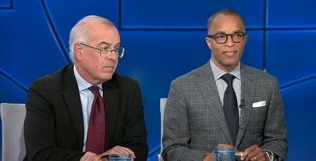
Brooks and Capehart on Trump's favorability, mental acuity
Video has Closed Captions
Clip: 12/19/2025 | 10m 42s | Brooks and Capehart on Trump's approval ratings and mental acuity (10m 42s)
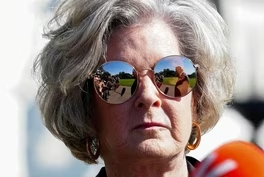
Chris Whipple on the reaction to his Susie Wiles profile
Video has Closed Captions
Clip: 12/19/2025 | 7m 36s | Chris Whipple on the White House reaction to his Susie Wiles profile (7m 36s)
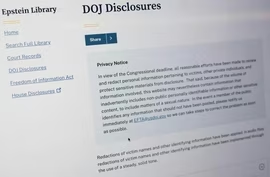
DOJ begins releasing long-awaited Epstein files
Video has Closed Captions
Clip: 12/19/2025 | 8m 15s | DOJ begins releasing Epstein files, with many heavily redacted (8m 15s)
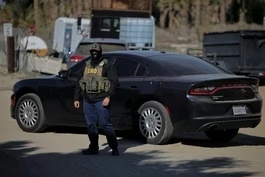
Family of woman detained by immigration shares her story
Video has Closed Captions
Clip: 12/19/2025 | 8m 38s | Family of North Carolina woman detained by immigration officers shares her story (8m 38s)
Investigators search for motive in Brown, MIT shootings
Video has Closed Captions
Clip: 12/19/2025 | 9m 10s | Investigators search for motive after shooter linked to Brown University, MIT found dead (9m 10s)

Video has Closed Captions
Clip: 12/19/2025 | 3m 7s | News Hour West signs off (3m 7s)
News Wrap: 9 companies cut drug prices for Medicaid
Video has Closed Captions
Clip: 12/19/2025 | 5m 24s | News Wrap: 9 pharmaceutical companies cut drug prices for Medicaid (5m 24s)
Providing Support for PBS.org
Learn Moreabout PBS online sponsorship
- News and Public Affairs

FRONTLINE is investigative journalism that questions, explains and changes our world.

- News and Public Affairs

Amanpour and Company features conversations with leaders and decision makers.












Support for PBS provided by:
Major corporate funding for the PBS News Hour is provided by BDO, BNSF, Consumer Cellular, American Cruise Lines, and Raymond James. Funding for the PBS NewsHour Weekend is provided by...