Signature Dish
District of Duck
Season 4 Episode 3 | 29m 8sVideo has Closed Captions
Blue Duck Tavern in the West End, Dawa in U Street Corridor, Mallard in Logan Circle.
Signature Dish host Seth Tillman savors D.C.’s finest duck dishes in this episode, starting at Blue Duck Tavern in the West End, where he joins beekeepers to harvest fresh honey for their signature BDT whole duck. Then, he tastes Ghanaian-style tamarind duck leg at Dawa in U Street Corridor. Last, he visits Logan Circle’s Mallard for a playful Southern-inspired, Pennsylvania Pekin Duck.
Problems playing video? | Closed Captioning Feedback
Problems playing video? | Closed Captioning Feedback
Signature Dish is a local public television program presented by WETA
Signature Dish
District of Duck
Season 4 Episode 3 | 29m 8sVideo has Closed Captions
Signature Dish host Seth Tillman savors D.C.’s finest duck dishes in this episode, starting at Blue Duck Tavern in the West End, where he joins beekeepers to harvest fresh honey for their signature BDT whole duck. Then, he tastes Ghanaian-style tamarind duck leg at Dawa in U Street Corridor. Last, he visits Logan Circle’s Mallard for a playful Southern-inspired, Pennsylvania Pekin Duck.
Problems playing video? | Closed Captioning Feedback
How to Watch Signature Dish
Signature Dish is available to stream on pbs.org and the free PBS App, available on iPhone, Apple TV, Android TV, Android smartphones, Amazon Fire TV, Amazon Fire Tablet, Roku, Samsung Smart TV, and Vizio.
Providing Support for PBS.org
Learn Moreabout PBS online sponsorshipANNOUNCER: And now "Signature Dish" a WETA original series.
SETH: Today on "Signature Dish," welcome to the District of Duck.
We'll first be abuzz with activity... And here it is, the sweet nectar of the bees.
Pairing duck with the most local of flavors.
That is a special treat.
We'll take old school techniques in a bold, new direction.
ERIC: It's crispy on the outside, super tender on the inside.
That's what you need, Seth, that's what you need.
SETH: And head down south for a one-of-a-kind feast.
I'm worried I'm going to run out of room for duck on my plate.
HAMILTON: Just close your eyes and go for it.
SETH: I'm Seth Tillman, WETA producer and DC native, and I love good food.
Nice to meet you!
That's why I'm traveling to restaurants across the DMV.
At each stop, looking for the one thing you just gotta try... That Signature Dish.
Our deep dive into duck begins in DC's West End neighborhood.
Inside of the Park Hyatt Hotel is the Blue Duck Tavern, a stalwart of DC's fine dining scene.
JEAN-CLAUDE: We'll be celebrating our 20 years anniversary next year... We have the crab cakes, we have the apple pies.
Duck, of course, is huge.
To me, as chef, it's a duty.
When you have something seasonal as opposed to getting it from across the globe, it's the right thing to do for the environment.
The flavors are beautiful as well.
It's as simple as that.
SETH: While Blue Duck showcases the bounty of the mid-Atlantic, some ingredients are harvested mere steps away on the hotel's roof.
While Jean-Claude and his team tend to a sprawling herb garden, a DC-based nonprofit, Capital Bee CARE, manages five beehives.
JEAN-CLAUDE: It's about the pollinations.
And then we have a beautiful honey that has hints of lavender.
Going into the garden, getting away from the kitchen, we have the bees in the background and we are clipping a few herbs.
It's just fantastic.
SETH: Chef, good to meet you.
JEAN-CLAUDE: Seth, good to meet you.
SETH: I'm excited about coming to this institution, and obviously, I knew there was going to be some duck.
JEAN-CLAUDE: And here we have it, a beautiful duck indeed.
This is a Rohan duck.
SETH: And it also looks like it's maybe already been cooked?
JEAN-CLAUDE: I know it looks so, but in fact, it has been only cured and cold smoked.
So, the curing process is made with the spices, salt, and so forth.
And after that, we cold smoke.
So, we hang them out to dry and they dry for about 10 days.
So, with that, we're going to have a nice, beautiful, crispy skins once we roast the duck.
So, the next step we're going to use this glaze here, which is made with honey from our rooftop... SETH: And it's amazing, this duck has been aged and dried, and yet I can still pick up the smokiness.
JEAN-CLAUDE: Oh, yeah.
And then our next step is we'll add some spices to it.
And we're going to use honey.
So, Seth, I have a very important mission for you.
Could you go upstairs and meet Sean and Rachel from Capital Bee CARE and they will show you how to harvest some honey.
Very special.
So, I will see you in a little bit.
SETH: See you in a few.
RACHEL: We'll start by harvesting this one first.
SEAN: Yes, yes.
SETH: Rachel!
RACHEL: Hi!
SETH: Nice to meet you.
RACHEL: Nice to meet you also.
SETH: Sean.
SEAN: Nice to meet you.
SETH: And I see some bees buzzing around over there.
What do you guys have going on up here?
RACHEL: So, we have five hives, and we have a partnership with the Blue Duck Tavern where we use these hives for our research projects.
But in exchange, we provide them with a lot of wonderful honey.
SEAN: The herbs that we have planted all around here, that's how we get the different flavors of honey.
SETH: So, we're talking about some top-notch honey coming from this roof.
SEAN: The best.
So, Seth, why don't you join me, and we can pull a few frames of honey.
SETH: Well, I'm excited to do that.
Uh, provided we've got some good protective equipment to work with here.
RACHEL: Yeah.
So, the most important thing is just to relax and stay calm, take deep breaths.
SETH: The bees can sense my fear?
RACHEL: Yes.
SETH: That's not good.
After Sean outfits me with the heavy-duty gear, it's off to the hives to pull a few frames.
SEAN: Okay.
So, I have the smoker, and the smoker will calm the bees.
So, with your calmness and the smoker, we have... SETH: Totally calm.
SEAN: ...twice... SETH: Just calm washing over us everywhere we go.
SEAN: All over us.
SETH: I'm not going to look down.
SEAN: Okay.
Give it a few puffs.
So, first thing we're going to do, we're going to smoke the entrance.
Make sure these ladies know we're coming in.
SETH: We're here to steal your honey.
SEAN: We take the cover off, and this is actually a feeder which keeps the barrier between you and the bees.
So, the next thing we want to do is take this off.
SETH: And how many bees can be in one of these hives?
SEAN: These hives can have anywhere from 60,000 to 100,000 bees.
SETH: Wow!
SEAN: I'm going to go ahead and pull this frame.
So, we want to pry them away just a little, and I'll gently pull it up.
SETH: And everything I'm seeing on the side of this frame, that's honey right there.
SEAN: This is all pure, uncut, honey.
SETH: Beautiful.
SEAN: I'll give them a shake before I brush them because they hate the brush.
SETH: Oh, no.
Let's not talk about anything that angers the bees right now.
SEAN: Yes.
Yeah.
Okay.
So, first, I would just shake them.
So, for the most part, most of them are gone.
SETH: Hearing quite a buzz around me right now.
SEAN: Yes.
And then just kind of brush.
What we want to do is remove the frames one at a time.
SETH: And you guys, you're all getting a sufficient amount of bee-roll?
Sorry.
Someone has got to make the dad jokes around here.
You want me to try my hand at picking one of these up?
SEAN: Yeah.
Yeah.
SETH: What could possibly go wrong?
Right... SEAN: Yeah, break the seal.
Yes.
SETH: So far, so good.
SEAN: Oh, look at you.
You're a pro already.
SETH: A natural.
Okay.
SEAN: Then we give them just a little smoke, and then... SETH: And then the shake?
SEAN: Yeah.
A nice steady one.
There we go.
SETH: Uh oh, here we go.
They found my face.
All right, guys.
SEAN: Gently, yes.
SETH: Nice and gentle.
Back you go.
Back you go.
And then put this away?
SEAN: Yes.
And then you've done it.
So, why don't we just take these two frames and let Rachel show you how to extract the honey.
SETH: Once safely back inside in the Blue Duck basement, the extraction can begin.
RACHEL: So, what did you bring us?
SETH: We picked two frames, and they've got a nice thick white cap on.
And this one looks like there's a lot of good honey on the sides there.
RACHEL: Yeah, that's beautiful.
You did pick a good one.
So, this is called uncapping.
This is wax.
They put on the outside.
SETH: So, just one frame alone, how much honey are you able to get out of one of these?
RACHEL: Oh, a couple cups at least.
Each bee will spend its entire lifetime to make half a teaspoon of honey.
SETH: Wow.
Working hard.
RACHEL: They're working a lot harder than we are.
SETH: After the frames are loaded, the centrifuge is powered up.
SEAN: Yes.
SETH: Within minutes, the liquid gold is ready to be tapped.
RACHEL: We'll see.
SETH: Such a beautiful color.
SEAN: Would you like to taste?
SETH: I would certainly love to taste some of this.
All right, here we go.
SEAN: The moment of truth.
SETH: Wow.
So many nice floral notes, herbs.
I'm not a honey connoisseur, but that's probably the best honey I've ever tried.
So, I guess it's time to wash our hands and see you guys back at the table.
SEAN: See you back at the table.
RACHEL: See you back at the- SETH: Thanks, guys.
SEAN: Thanks.
SETH: All right, Chef.
Mission accomplished.
JEAN-CLAUDE: Thank you.
SETH: A little nerve-wracking, but a lot of fun.
And here it is, the sweet nectar of the bees.
JEAN-CLAUDE: Thank you so much.
That looks fantastic.
Beautiful aroma as well.
So, today we're going to make a gastrique.
By tradition in France, we use sugar, but here, of course, for Blue Duck, we have beautiful honey, and we want to bring that to a nice boil.
And now, we're going to deglaze with a bit of nice vinegar.
If you can pass me that little duck stock here.
SETH: Oh, this is some beautiful-looking duck stock.
JEAN-CLAUDE: It's a beautiful duck stock.
So, this one I made with just some duck bones.
So we will be cooking this down for a few more minutes.
SETH: All right, this has been quite the adventure.
I can't wait to taste the fruits of all of our efforts here today.
But what are we drinking here, Chef?
JEAN-CLAUDE: Well, we're having some bee's knees.
SETH: Of course.
JEAN-CLAUDE: Of course, which is made with a gin and some more honey from the rooftop as well.
SETH: Cheers to that!
JEAN-CLAUDE: Cheers!
RACHEL: Cheers.
SEAN: Cheers.
SETH: Nice and sweet, but still really well-balanced.
I worked up quite the appetite.
I cannot wait to dig in here.
JEAN-CLAUDE: So I hope you are recognizing all those flavors, the honey glaze, the lavender from the rooftop, and the gastrique of course, that we made together.
SETH: Wow.
Getting the sweetness of that honey, nicely balanced with the acidity in that gastrique, and all of that smokiness.
I could smell it when we were preparing it and tasting it as well.
That is a special treat.
JEAN-CLAUDE: Perfect.
SETH: You guys spend so much of your time doing research, science, but to be able to harvest a little honey and then taste it, I mean, that has got to be the best part of the job.
SEAN: Yeah, this is the best part.
RACHEL: We do a lot of research, but to sit down and really enjoy the thing that we have been toiling all year to produce for others, we actually get to enjoy it for ourselves.
SETH: And is the garden and the bees up on the roof is something that's going to just keep going year after year?
SEAN: Yes.
This year, we have about 250,000 bees.
And next year we hope to have about a half million bees upstairs on the roof.
SETH: You're going to have more honey than you know what to do with.
JEAN-CLAUDE: Lots of honey to cook with, so we are happy.
SETH: Having come here and gotten the full Blue Duck experience, I can see how taking classic American dishes, pairing them with these terrific, very local flavors has kept you guys going strong for 20 years, and here's to a couple of decades more.
Cheers.
SEAN: Cheers.
RACHEL: Cheers.
JEAN-CLAUDE: Cheers to that.
SETH: Cheers.
Next up, I'm paying a visit to the U Street Corridor.
Along a busy stretch of 14th Street is Elmina.
The restaurant, along with its more casual takeout option, Dawa, serves up West African flavors from chef Eric Adjepong.
ERIC: My background, my folks came from Ghana in the late 80s to New York City, and I grew up very much in a traditional West African home, but then also growing up in New York City.
I consider myself African American to the fullest extent.
I grew up in a very eclectic neighborhood.
I lived in Ghana when I was young.
I lived in London.
I lived all over the US, so I have like a very global approach to how I think about food.
SETH: Before opening Elmina, Chef Eric made a name for himself on TV through the cooking competition circuit.
ERIC: I love competing just by nature.
Merit wins.
If your dish is good, then you're going to move forward.
Top Chef, you know, I've been a huge fan of the franchise, and from all the seasons that I've watched, from two to 16, I've never seen anybody making food from Africa.
I knew if I had an opportunity that I'd love to take advantage of that, and I did.
I'm doing a West African dumpling called Fufu.
JUDGE: I love Fufu!
ERIC: And I was able to really impart those West African techniques or flavors, and it got me all the way to the finale.
SETH: Building on his television success and his work in some of New York and DC's top kitchens, Chef Eric opened Elmina in early 2025.
ERIC: Elmina is my baby.
It's near and dear to my heart.
Let's start off with the name, Elmina.
It means gold mine.
It meets treasure.
So, I really wanted to bring that here to Washington, DC, with this modern sort of take on Ghanaian West African food, and to celebrate that sort of treasure with obviously, the music, the food, but the decor as well.
SETH: The takeout-only Dawa is also run out of Elmina's kitchen.
ERIC: Dawa in West Africa, it is an ingredient.
It's short for Dawadawa.
Dawadawa is a fermented locust bean.
So it's funky.
It has so much flavor, so much depth, and that's really the spirit of our fast casual concept.
If you don't have, you know, two and a half hours to eat a really beautiful dinner, we can definitely have a more stripped-down version, made with the same heart, made with the same soul, with Dawa.
SETH: Chef.
ERIC: Hey, Seth!
Welcome in.
How are you?
SETH: I'm doing great.
ERIC: Good to see you.
SETH: And West African flavors are calling my name.
ERIC: Yes, sir!
SETH: What are you making today?
ERIC: We have this amazing dish that's very near and dear to our hearts.
It's our tamarind duck leg with our jollof rice.
SETH: Ooh, jollof rice.
And a beautiful duck leg right here.
How are we treating this?
ERIC: So, we're going to go confit.
A great way to preserve duck back in the day, before refrigeration, was actually cooking in its own fat, right?
So, we're going French style, but obviously, adding in our West African Ghanaian flavors.
So, we're going to take our mix of salt, a little bit of black pepper.
There's a little bit of alligator pepper that has been blended in there as well.
And then we have this amazing green seasoning that we take scallions, and thyme, and celery and ginger, and garlic.
We actually have one that we've marinated the night before.
SETH: Beautiful.
ERIC: Right?
We vacuum seal it just to sort of really impart that flavor.
So, this is the day two.
So after we take it out the bag, I'm going to go ahead and start to get ready for the confit process.
So beautifully marinated right there.
So, we're going to go ahead and add in our aromatics, some fresh bay leaves, black peppercorns, and we take that beautiful duck fat right there.
SETH: Oh, taking a little duck fat bath.
That is beautiful.
ERIC: Isn't that gorgeous?
SETH: You can do no wrong with duck fat.
ERIC: I really can't think of anything.
I mean, how are you mad right now?
So, we'll take that, tent it with the aluminum foil, and this goes straight into the oven.
And we go really low and slow until it's really, really nice and tender.
But I do want to show you what a finished confit product look like.
So, after it's out of the oven, we let it cool in its own fat, and it's ready just to be pan-seared.
SETH: It's done with its bath.
Ready to eat.
All right.
ERIC: Yes, sir.
But really, I'd be remiss if we didn't talk about the jollof rice.
Jollof rice actually speaks from the heart.
It's a culture dish.
So, we'll take a little bit of neutral oil, and then we're going to take some really thinly sliced onions, julienne.
Really want to get those aromatics sweated out as much as possible.
SETH: And is there something about Ghanaian jollof rice that makes it the best?
ERIC: Um, I mean, you said the first part.
It's Ghanaian, right, like, it's, it's... Honestly, no matter where you go, you're going to grab a really delicious version of this dish, whether you're in Togo, whether you're in Nigeria, whether you're in Ghana.
I say, though Ghanaian jollof rice is the best.
I think we use the perfect ratio of the warm spices, the more heat spices.
And I think how prideful we are about it, like it's a big deal.
SETH: Yeah, no, I know there's a lot of pride when it comes to jollof.
ERIC: It's massive, man.
So these onions get sweated out, and you start to concentrate a little bit of those sweetnesses, the starches, the sugars.
SETH: And it's smelling pretty good in here.
ERIC: It's smelling really good over here.
So, this is the long-grain rice.
We're using jasmine, and we rinse it a few times.
Super important.
We want to remove the starch from the rice.
You'll see it's white and chalky and milky.
We want to remove as much of that as possible to help make sure that each rice cooks individually perfectly.
So, go ahead and add in that beautiful rice.
SETH: And I love when rice gets a little sear in the pan.
ERIC: Yeah, absolutely.
SETH: Just gets a different texture than you get when you steam it.
ERIC: 100%.
That's a great call.
Yeah, you're almost like toasting the rice, right?
You're kind of priming for all of the beautiful love and goodness that we're going to throw in here with that jollof stew.
SETH: Snap, crackle, and pop right here.
ERIC: That's exactly it.
So, Seth, we're going to add in our mother sauce in West Africa, our red stew.
So, we take peppers, onions, ginger, garlic, blend that all down.
Spices that we love, curry, powdered nutmeg, paprika, almost like a vegetable smoothie, and then cook it down.
Very similar to like a marinara sauce.
After about an hour or so, you get this really beautiful concentrated red stew.
And then last but not least, Seth, we're going to go ahead and add in our chicken stock.
SETH: Ooh, so, all of that flavor is going to get into the rice itself.
ERIC: Absolutely.
We you want to bring this to a simmer, and then we'll grab some aluminum foil.
SETH: Trap all that flavor inside.
ERIC: Trap all of that flavor inside, absolutely.
SETH: Right.
ERIC: And then this itself goes back in the oven.
So, once it's in the oven is going to cook for about another 30, 40 minutes.
So up next, we're going to sear our confit duck leg.
And after that, it's time to plate.
So, we're going to take the duck leg, brush it with our beautiful tamarind glaze sauce.
Tamarind gives us a little bit of sour, a little tang, a little sweetness.
And then we'll plate off the jollof with the duck, roasted tomato salad, and then we'll be ready to chow down.
SETH: All right, Chef.
I'm loving the colors on this plate right here.
ERIC: It's a lot.
It's vibrant.
You know what we put the roasted tomato salad on.
It's absolutely delicious.
That's what you need, Seth.
That's what you need.
SETH: Wow, that is phenomenal.
ERIC: It's not too bad, right?
Yeah.
SETH: Not at all because with the duck confit, you get the tenderness, you get that silky texture.
But you still get a little bit of crispiness, too.
ERIC: Absolutely.
You sear it up, and then you just let the tamarind glaze sort of just lacquer that skin, so it stays crispy, but it has a beautiful sort of flavor profile to it.
SETH: And Chef, it looks like you added a little dollop of... we're talking Ghanaian hot sauce right here?
ERIC: Absolutely.
Good call.
So, we have our shito sauce, shrimp powder, ginger, garlic, tomato paste, a little chili, a little bit of crayfish powder.
What's it doing for you right now?
SETH: That gives such an extra depth to what is already a phenomenal bite.
ERIC: Adds a ton of umami to it.
And I think it just adds that last beautiful layer to this dish.
SETH: Right, because it's not heat.
It's not real spice, but it's just flavor.
ERIC: It is flavor, man.
It's just depth of flavor.
SETH: It's just really bold flavor.
ERIC: Exactly.
Yes, sir.
SETH: And Chef, I like, too, with the duck, you get a little bit of the gamey flavor, but it's good.
ERIC: That's right.
It's delicious.
In West Africa, it's not unusual to see game all throughout.
There's guinea foul, we call it akonfem.
There's, you know, there's duck around, there's goat.
So, we're used to that sort of gamey profile to a lot of our dishes, and adding that layer of gaminess to it just kind of makes this a really well-rounded dish.
SETH: All right.
But it's jollof time.
ERIC: Yes, sir.
Dig in!
BOTH: Mmmm.
ERIC: Did that at the same time.
My bad.
SETH: Oh, there's a little smokiness to it.
Just the tiniest little hint of sweetness.
ERIC: Yeah.
Those onions that we caramelize, super subtle, but the perfect background singer.
You know what I mean?
SETH: Well, I'm not taking sides in the jollof battles, but it'd be hard for me to imagine it topping this.
ERIC: You know what, man, wise move to stay out of the battle.
It's a pretty contentious one.
But no, man, this is what I grew up eating.
It's what I'll eat forever.
There are so many different versions of it, but what we do over here in Elmina and Dawa is something very special to us.
SETH: And I'm curious, for you, born and raised in the Bronx, spending a lot of time in Ghana, but now here you are in DC... ERIC: Yeah.
SETH: ...why do you think that this concept works so well in this town?
ERIC: DC is just primed for it.
It's eclectic.
DC is a great space to have folks who are familiar with the dishes.
People who are also curious and never had it before.
And I really think that DC is the mecca for African food, period.
You have East African restaurants, you'll have West African restaurants, in a very small confined space.
SETH: Well, I think this is a great addition to that space.
ERIC: Thank you, man.
SETH: And this duck confit, probably going to be in my dreams tonight.
ERIC: Ah, Seth, man, I appreciate it.
SETH: Thanks, Chef.
ERIC: Thank you.
Appreciate that.
SETH: To wrap things up, we're staying on 14th Street, about a mile further south in Logan Circle.
It's here you'll find Mallard, a love letter to the low country from Chef Hamilton Johnson.
HAMILTON: I'm from South Carolina, from Inman, a small town.
I cooked with my parents, just helping out in the kitchen, and then just fell in love with it.
I love to draw and paint, so I guess you could say food is another medium.
I went to culinary school in Charleston, and then working in Charleston, and coming up in those epic Southern restaurants, I just fell in love with the whole fast, it's crazy, you're on the edge.
You have one shot, you know, people come in, and they give you one shot, and if it's good, they'll come back.
If not, then they're like, "See you later."
So, it's a lot of pressure, and I think I do well under that.
SETH: In 2008, Chef Hamilton moved to DC to work at the legendary Southern restaurant, Vidalia.
After eight years behind the line, he moved to the fine dining hotspot, Gravitas.
HAMILTON: So, when I was at Gravitas, my father passed away.
He carved decoys and ducks and fish.
He carved all kinds of stuff.
So, when he passed away, I took a little time off, and falling in love with cooking kind of started with him.
So, I thought, why not do a little ode to my pop?
And I think duck is so versatile.
It's my favorite, obviously, you know, it's like, it just lends itself to so many preparations.
The duck fat, you can use in everything.
I think people have this idea of Southern food being just heavy and just everything is fried and everything is just over the top, and you want to take a nap.
But I think there's one or two things that are like that because it makes sense, but we like to take a more fresh, lighter approach on some things.
My father loved cooking for people and making people happy with food, and I love to do the same thing.
So, at Mallard, it's kind of like that party vibe.
It's a way to get away from everything that's going on out there, and just kind of step into the South a little bit.
We have classic rock playing, Bob Seger, we have Led Zeppelin, and it's just really fun.
SETH: Chef.
HAMILTON: Hey, how's it going?
SETH: Good to meet you.
HAMILTON: Nice to meet you.
SETH: We're looking at a whole duck here.
What are you making?
HAMILTON: So, we're doing our signature dish, half-roasted Pekin duck.
SETH: All right.
Pekin duck, is that a, uh, special type of duck breed?
HAMILTON: Yeah, it's a special type that is just bred for their fat cap and more meat per portion of breast.
So, we have our double duck breast.
You have the tenderloin.
We go through a lot of ducks, so we save these, and then we'll use them for pâtés.
But we have the double breast and what we like to do is we'll trim the fat, but you want the fat just a little bit bigger than what the actual breast is, because as it cures and cooks, it's going to shrink a little bit.
SETH: And there's still going to be plenty of fat left on the top of it.
HAMILTON: Trust me, yeah.
Absolutely.
You're kind of left with this very thick... SETH: That is a substantial fat cap right there.
HAMILTON: All flavor.
You know, it's delicious.
A lot of people, they'll tend to score their duck breast with a knife.
So, we got this meat tenderizer.
We hit the skin with this, right?
So we go down to far enough, but as you cook it, all the fat comes out, but you still have that crispy skin.
Okay, now that we're going to go ahead and season it.
We have fresh coriander.
We have lavender, pink peppercorns, we have fennel seed, star anise, and then we start first with salt.
So, we have our mix that we've ground up, and don't be shy with it.
SETH: Why be shy?
HAMILTON: Yeah.
And then we just let that sit.
Before we head over to the stove, I want to show you the other key part of the whole dish.
We have our duck confit, which we take the leg, and we actually take the same spice mix.
We're going to treat this like chicken and chicken fry it.
SETH: Chicken fry.
HAMILTON: I know, right?
I'm going to put this down, grab this breast.
We're going to go over and sear it in the cast iron.
Why don't you come follow me?
SETH: All right, let's do it.
All right.
Got a nice hot stove here.
HAMILTON: Hot stove, but we have a cold pan.
SETH: No sizzle.
HAMILTON: No sizzle.
You want to start it in a cold pan so the fat cooks evenly, so it has time to render out.
SETH: And obviously, no oil or butter needed because this thing's coming equipped with plenty of fat.
HAMILTON: Comes naturally.
As it starts to render, you'll see the fat start coming out.
SETH: Oh, and now I'm hearing that nice little crackling.
HAMILTON: Yeah, you're starting to hit a little sizzle.
Nice and quiet, and slow.
And then you move it around, there's going to be different hot spots.
SETH: And cooking at a low temp, I mean, that's kind of low country style cooking right there.
HAMILTON: Yeah, low and slow, worth the wait, you know?
So, as you can see, your fat is starting to build up a lot, right?
And then you don't want to fry it.
So, we want to take some of that fat, pour it off, save that, and then you're back to kind of a clean pan.
So, it's kind of constant steps of touching it, you're starting to see it get a little bit of color on there.
So, now once we kind of strain the fat again, it's going to cook for about 10 to 12 minutes until it's ready to flip.
Now that it's been 10 minutes... SETH: Looks nice and crackly.
HAMILTON: So, we use fresh sage, fresh thyme, get a little pop, then we take fresh butter.
SETH: Butter?
HAMILTON: More fat.
SETH: All right.
Duck fat wasn't enough.
HAMILTON: More fat, more flavor.
You can smell the herbs and sage and everything.
SETH: Oh, wow.
HAMILTON: And it just melds really well together.
SETH: Brown butter and duck fat are making a good pairing right here.
HAMILTON: Good wedding, right?
Meant to be together.
And then we're going to baste this for a few more times, about a minute or so, and we're going to take the duck off and let it rest, and then we're going to plate it up.
And then we take the confit leg, then our seasoned flour, and then we put in a little buttermilk, we fry it until it's super crispy.
And then to finish our duck dish, we slice it, do a seasonal garnishes for it.
So, we're going to have a squash puree, braised collard greens, then an apple cider jus.
And then we have our confit leg that we chicken fry.
And we'll just dig right in.
SETH: All right, Chef, the plating is just gorgeous.
What are we pairing with this duck?
HAMILTON: So, for this, we have a raspberry sour to help cut through the richness of it.
And I'm having an NA dragon fruit beer, and it just seems to work really well.
SETH: Cheers.
HAMILTON: Cheers.
SETH: I do love sour beers.
All right.
I'm going to go for a little breast to start.
HAMILTON: Yeah.
SETH: Can I serve you as well, Chef?
HAMILTON: Sure.
SETH: There you go.
HAMILTON: Thank you.
SETH: All right.
Outrageously good.
HAMILTON: Yeah.
SETH: I mean, I knew it would be, but that skin is crisped up so nicely on top, but there's a good amount of fat left.
You know, when you bite into it... HAMILTON: Rich.
SETH: Kind of pops out there, and it looks like there's some seasonal vegetables underneath as well?
HAMILTON: Yeah, we have some braised collard greens in there, and then a little fall squash puree.
SETH: And a little hint of sweetness, too.
HAMILTON: Right.
SETH: But you know, Chef, I see a beautiful chicken-fried duck confit leg... HAMILTON: Yes.
SETH: ...just calling my name.
Can I just have this one all to myself?
HAMILTON: Absolutely.
It's all yours.
SETH: Do you recommend eating this with your hands, or a knife and fork, or how do you... HAMILTON: I think just dig in.
You just close your eyes and go for it.
SETH: All right.
I'm doing it.
(crunch) HAMILTON: Hits all the notes.
SETH: That's just not fair.
And I think paired with some more sweetness, too, with this drizzle on top.
HAMILTON: With a little hot honey on there just to get a little more Southern flair.
SETH: All right, I'm worried I'm going to run out of room for duck on my plate, but it looks like our duck feast just continues.
HAMILTON: Yeah.
So, we have duck wings here, which we treat just like the duck legs, and we cure them, and confit them, and then we fry them, toss it into RC Cola and grape jelly barbecue sauce.
SETH: Oh, come on.
And some of those sweet notes, whether it's the fruitiness of that sour beer, the hot honey glaze, the RC Cola marinade, none of them are overpowering.
I mean, they all play really nicely together.
HAMILTON: Yeah, you got the acid, and you got the sweet, and it just... especially with the fat from the duck, it all works out together.
Then the last thing I want you to try is our duck fat saltines that we serve with a Sea Island Pea hummus.
SETH: Duck fat saltines?
HAMILTON: Yeah.
So, we take saltines, and we take the duck fat, and then we let the saltines soak in that fat for a few hours, and then we toast it in the oven.
SETH: So, when your biggest problem is you just have too much duck fat.
HAMILTON: Yeah.
SETH: You just find things to soak it in.
HAMILTON: Now, we have to come up with new processes for it.
SETH: Oh, right on.
This is a feast I could come back for... HAMILTON: Absolutely.
SETH: ...time and time again.
Thanks so much, Chef.
HAMILTON: You're welcome.
ANNOUNCER: To find out more about great food in the Washington Metro area, visit weta.org/signaturedish.

BLUE DUCK TAVERN Harvests Honey On Their Rooftop for a Savory Rohan Duck
Video has Closed Captions
Clip: S4 Ep3 | 7m 25s | Seth visits Blue Duck Tavern in Georgetown and helps harvest honey for a savory rohan duck dish. (7m 25s)

Half‑Roasted Pekin Duck at MALLARD: Step‑by‑Step with Chef Hamilton Johnson
Video has Closed Captions
Clip: S4 Ep3 | 4m 54s | Seth joins Mallard Chef Hamilton to learn the process behind his signature half‑roasted Pekin duck. (4m 54s)
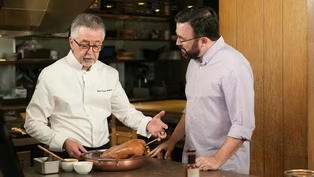
Preview: S4 Ep3 | 30s | Blue Duck Tavern in the West End, Dawa in U Street Corridor, Mallard in Logan Circle. (30s)

Watch Chef Eric Adjepong's New Take on a Duck Confit at DAWA
Video has Closed Captions
Clip: S4 Ep3 | 5m 17s | Seth visits Dawa where Chef Eric prepares a tamarind duck confit with Ghanaian jollof rice. (5m 17s)
Providing Support for PBS.org
Learn Moreabout PBS online sponsorship
- Food
Christopher Kimball’s Milk Street Television
Transform home cooking with the editors of Christopher Kimball’s Milk Street Magazine.








Support for PBS provided by:
Signature Dish is a local public television program presented by WETA