
Gen Z, Voting and the Future of Democracy
Episode 4 | 26m 46sVideo has Closed Captions
Gen Z weighs in on voting, political trust and the future of American democracy.
Gen Z came of age amid political division, a pandemic and a rapidly changing media landscape. In this episode of Impact Michigan, young Michiganders share their views on voting, political trust and civic engagement. Are young people losing faith in democracy, or redefining what participation looks like?
Problems playing video? | Closed Captioning Feedback
Problems playing video? | Closed Captioning Feedback
Impact: Michigan is a local public television program presented by WKAR
Gen Z, Voting and the Future of Democracy
Episode 4 | 26m 46sVideo has Closed Captions
Gen Z came of age amid political division, a pandemic and a rapidly changing media landscape. In this episode of Impact Michigan, young Michiganders share their views on voting, political trust and civic engagement. Are young people losing faith in democracy, or redefining what participation looks like?
Problems playing video? | Closed Captioning Feedback
Where to Watch Impact: Michigan
Impact: Michigan is available to stream on pbs.org and the PBS app.
Providing Support for PBS.org
Learn Moreabout PBS online sponsorship(music playing) We hear a lot about young people checking out of politics that they don't trust institutions, that they're tired of division, and that they're losing faith in democracy.
But what if we're looking for their participation in the wrong places?
For Gen Z, democracy, isnt happening only at the ballot box.
It's happening on college campuses, in community conversations and online, where a single voice can reach millions.
So maybe the question isn't whether Gen Z is giving up on democracy.
Maybe it's whether they're redefinin what participation looks like.
I'm Sherry Jones and today on Impact Michigan, we're talking about trust, political power and what democracy looks lik to the generation inheriting it.
But first we went to the Michigan Student Vote Summit at Michigan State University to ask young people what democracy looks like to them.
A lot of Gen Z. We just know like intense political divisiveness for most of our lives.
And I remember when I started taking history classes, we were required to watch past presidential debates.
And just watching them, I'm like, man, these guys like, look like they actually respect each other.
And I have never known such a thing.
The event that I'm at today is the Michigan Student Vote Summit at Michigan State University.
I mean, we still have technically a democracy like we can we still have our rights to vote.
We still, you know, have most of the rights guaranteed to us by our Constitution.
But right now, it just doesn't feel like it's working because so much of us is struggling.
Right now, we don't even feel like we can have the drea of ever owning a house someday, because mortgage rates are too high and houses are so damn expensive.
There's just a lot of disillusionment, too, with how much corruption that people are seeing in government and young people are like, well, if there's so much corruption, the can I even do anything about it feels like at me as one perso can't really do much about it.
So why even try?
And just a lot of discouragement with that.
I thin democracy and social literacy, they go hand in hand, you know, and so I believe that with the digital age, we have so much informatio being thrown at us all the time.
And even with the algorithm being tailored to the things that we like in our interests and even sometimes our political beliefs, we don't know what's true and what isn't.
I've known families, you know.
You know, family members will cut off certain family members if they vote the different way and so I think that's a lot of concern like with the political devices, this like you vote one way that you're going to lose family and friends and you know, you're scared that, oh, if I vote the certain way, I don't want to become more socially isolated than I already am.
It's just really sad.
Like for Gen Z voters, like the political divisiveness has gotten so deep that you lose people over it.
It feels like we're not gaining the skills of having interpersonal connection.
I know I've struggled a lot with that, like learning how to make friends in adulthood.
That's been a lot of struggle amongst students, too, and feeling like we're alone and we don't know how to, you know, talk to other people about this stuff, especially politics, like being very divisive right now.
It feels scary to do so.
I absolutely believe in democracy, but democracy only works when a collective group of people actually mobilize.
And so in order for us t actually materialize any change, we have to stand together and focus on ways that we can actually address some of the issues that affect us.
I am a part of the Gen Z group.
We are going through a difficult time right now, whether that's gas prices, schooling.
I'm very religious and being like involved in my community reall helps me help others understand.
One of the things that we've realized is really productive is just asking the question, what do you care about right now?
And giving a student the time to generally answer that is really important, to not make the conversation seem transactional, and to actually have something meaningful happen.
After that conversation.
We are doing presentations in our class, but we're writing up in a handbook, and the goal is to print this handout and hand it out to students so that they have, like all o this information on the ballot.
And they know, like the information on every single candidate and make it their own decision from their.
I'm really grateful that at Oakland University, we do have resources that not only inform students about what voting is and how important it is, but they are trying to fi political polarization on campus so that students that do disagree know how to go about it, and know how to participate in civil discourse.
People in Gen Z want change to come immediately.
However, our systems, as it stands right now, take a very long time for us to see even a small change like a pothole getting fixed.
But these issues requir so much time, people and effort.
And honestly, most of all a commitment.
I would also like to see candidates when they're running, you know, say, hey, I am seeing this issue here is like a bullet point list of what I am going to do about i once I'm in office and then once if they do get elected, I'm going to be like watching them and saying, okay, so you said you were going to do these things.
I'm going to be watching you and making sure I'm holdin you accountable to these things.
And I think that would encourage political candidates to actually follow through.
It is hard.
You know, I get sad and frustrated as the people around me do.
But that's where we take all that.
We come together, we unite our ideas and try to think of a better solution to help us all.
Democracy especially in the United States, is having a choice to vote on and to make a decision that will not only impact me, but impact the community that I live in.
I mean, democracy is what built this country.
And I would like to welcome our panelists to Impact Michigan.
We have Tega Orhorhoro.
Thank you so much for joining us.
You are a content creator and storyteller.
Welcome to the conversation.
Thank you for having me and Liam Connor.
You are actually the founder of MSU Middle Ground, bringing voices together to find some commonality in this political spectrum.
Welcome.
Thank you for having me.
Yes.
And Joey Skerbeck.
Michigan State University journalism student.
Wonderful to have you.
And to this conversation as well.
Thank you.
Sherry.
Yes.
So as you saw in that story, which I always like this as a framing ability to tal about what we're going to talk to, a lot of frustration among our Gen Z people, and that is who you are in this community and in this time of your life.
But what if your engagement is not because you're disenfranchised, but that you're actually paying attention?
I know that you have Tega, 4 million followers online and are your followers engage in the political conversation?
They're always engage in the political conversation.
What I understand from this conversation in general is that skepticism does not stop apathy, like they actually genuinely care.
They're gathering in comments sections telling what's going on, actively sharing like who they think they want to vote for, what policies are impacting them, what struggles they're having.
It' the one thing about social media that's really important is building community, right?
Building community.
People you don't even know are your next door neighbors.
You don't know who are, you know, the person who's down the street, who you could go and reach out to in person?
Do you feel the same way, Liam, and in the groups that you're created at Michigan State?
Yeah, I think people really want to talk about politics in a conversational way, not in a debate wa or way for clicks or anything, but just to hear what a conservative or a democrat has to say, how they're thinking about this election.
And I think social media has kind o inhibited that civil discourse, because when I'm talking to you, I see your face, I see your reaction, and yo might think differently from me.
But when I say a democrat or a conservative, people have a certain image or a certain stereotype.
And I think social media can sometimes exacerbate that stereotype.
How about you Joey in on campus?
I know you've been to a couple of rallies here at the university.
What are you seeing?
Yeah, I agree with Liam in the sense that I think that social media is kind of a mirage for Generation Z in the sense that there's an algorithmic program that is based off of patterns that determines what output you should.
You know, eventually view.
And I think it's kind of interesting in the sense that at what point are we passive consumers of new versus active consumers of news?
And that's an important distinction we need to make.
What do you think the older generations misunderstand about Gen Z?
And they're they're intrigued with politics.
Any one of you I can start I think I think they they think we want government handouts or we want a lot of help from the government.
And that's not true.
We just want a fair system, a fair game where, you know, we're a self called meritocracy, the U.S.. And we, Gen Z wants a meritocracy where people who work hard will be inhibited.
And in doing that, you have to recognize tha there are structural barriers, and histories that inhibit certain certain demographics.
We just want a fair system that rewards people and sometimes the governmen needs to reform current systems to allow for an equitable, equitable game.
I think to add to that, Gen Z also wants to be able to build trust.
I think there's an understanding of like, we want to be educated about the systems that are in place and be able to trus those systems that work for us.
The leaders who we elect.
And so I feel like that's a big misunderstanding there.
It's like we want to learn, we want to know how to be active participants, and we want to know that when we vote the things that we're voting for are actually happening in ou communities actually happening.
affecting policies, the costs and things are going down.
We are able to afford housing, we're able to afford student loans, and even going to college basically.
And we heard that in our report.
Right?
The frustrations that one young woman we talked to said, I want a checklist.
And if you say you're going to do this, I want to hold you accountable to that checklist to make sure that the people that we elect are doing what we're talking.
And I think that goes to your point.
How about you, Liam?
You're responding to what that person said it.
It's hard to hold a representative Democrat responsible when you go to Congress.
In the Senate, you're fighting with 99 other people in the House.
You're fighting with like 400 other people.
So if you give a person a checklist, 99 times, they're not going to accomplish that.
But what I look for is, are they working with other people?
Are they trying to make fair deals in front of the public that can get some sort of legislation done, or at least put a Band-Aid on a solution?
So it's not certainly a checklist, bu effort goes a long way with me.
Or are you there to get clicks or try and gear up for a presidential run?
Yeah.
You know, we talk a lot about your, the Gen Z having political influence, but do you have power and how can you get that power, influence and power a little bit different?
Joey can you speak to that?
Yeah, I think it's interesting in the sense that it brings up this question of where does authenticity and trust play a role?
And respected journalism?
So, for example, on the Michigan State student and I'm learning the values of traditional journalism and what seems to be a world that completely disregards all the values of traditional journalism, content at its forefront is entertaining.
And I think for Generation Z, when we take a look at what we're seeing online, Gen Z recognizes that opinions are going to be biased.
From the people who give it to them.
What they're looking for, though, is this idea of transparency.
They want to make sure that the content creator is someone who maybe they have their own view, but they're transparent about their view, and they still give you the facts.
And I think that's kind of a determining factor for Generation Z. More so in a sense than are, you know, previous generation before us have had to deal with.
I think it's really important of we all have biases.
But just to admit, like everyone here has a bias when they look at stuff, but just to admit, okay, this is how I was raised.
And so I think about stuff.
This is my bias.
This is why I think that certain way, you know, and even for news outlets to be kind of biased, to be like, you know, when you read Fox News is going to lean conservative when you read MSNBC or CNN, it's going to be Democratic.
And that's fine.
That's going to exist.
But just knowing that is great, and then you can compare news sources.
And to add to that, social media is like a part of Democracy Now.
It's being embraced, I think as a content creator, I hold it upon myself to spread the correct information.
We live in such a big world of misinformation that's been talked about, and so I hold myself to that standard.
I know majority of the creators I work with also hold themselves to that standard.
Right?
With so much negativity out in the world, sometimes you have to be the light, sometimes you have to be the positivity in.
Sometimes you have to be the hope for Gen Z. Have you seen any of that turn into change?
Yeah, actually about that has seen a lot of that turn into change.
Funny enough, there was a story where I kept making voter content.
I was saying, get out to vote, find your absentee ballot.
Where's your location?
I got a call from my cousin.
He's like, your videos consistently were playing on my feed to get out to vote.
He made sure he registered to vote and is voting in this election.
So those are reminders of consistently voting, knowing who your candidate is knowing what the policies are, knowing what elected leaders you will have options for.
It really is something that Gen Z wants to see our communities want t see, my community wants to see.
And I'm getting that feedbac not just from my family members, from other people watching my content, but my content doesn't just stay on one app.
It's everywhere.
Right?
With the, sayin that you have to be everywhere in this political landscape in this social media landscape, it's making sure that you are also sharing that correct information as well.
In Liam and bringing both sides together.
And what we've talked about community and common language.
What have you seen, how how the activism has actually made change?
I've seen like with the No Kings protests, you know, those have been huge.
People have come together.
Gen Z is participating in politic in a way that I didn't realize.
When I go to middle ground meetings, I hear people really informed and want to listen to each other, and they walk out of those meetings, me like, okay, I' going to do something about it.
And social media can really aid in that.
In those small conversations of 15 to 20, people might not be as impactful as a whole community online.
So I think social media can really help with participation and building social movements that cause change, because it's hard to feel you can feel alone, that you can't do anything.
But with social media the benefit is over.
Community.
We're going to build the social movement and create change, and we're seeing that I think a lot this election cycle.
And Joey with your storytelling, making sure that both sides are heard in that.
And then once you post your story, what have you seen after that?
Yeah.
And to bring that back to this idea of being fair and balanced, it was really interesting.
Just the other day, AG Sulzberger came to the MSU's campus and he made this really interesting point of saying, you know, it's not exactly about neutrality, it's about independence.
And taking that back to journalism, it's very difficult in our modern media landscape to have that sense of independence.
When a lot of the information is very curated and personalized to us.
Now is a word that was brought up in the package we watched in the beginning.
And I think as a journalist especially in today's landscape, if you're an independent journalist such as Dylan Page, is a big one on TikTok, it's about being very transparent about the biase in the first place that you may have as a content creato and the stories that you cover.
And I think it's important as modern day journalists to recognize as well, you know, every story I'm going to address is going to have these different element that will appeal to a different, you know, category of people who are my viewership online.
How can I, you know, in som sense appeal to the viewership but remain very hones and what is actually going on?
And, you know, honesty in the sense that I'm independent, I'm looking for things on either side of the spectrum or aisle that might influence how the story could be interpreted to the viewer.
One thing that I think Gen Z has to deal with, that no other generation has dealt with is that we are getting content all the time about politics and there isn't time for us to just sit down in my own thoughts and think, here's an issue.
Why do I think about what do I think about this?
We're constantly having someon tell us how to think, and other generations have kind of ha that silence in between classes or just in the weekends, to just think about stuff.
And Gen Z needs to emphasize especially this election cycle, to turn off the phone and just think about issues.
What do you thin about the most pressing issues?
The economy, immigration?
What just you have to sit down and think about it and find your conclusions in the silence of your own thoughts.
And to your point, I read an interesting story just the other day.
The amount of information that Gen Z gathers in 20 minutes through social media feeds.
It's about the same as they could have, you know, back in the olden days, in a week reading newspapers and television, I think a child sees like 30,000 advertisements until they're like, till they're ten, which is crazy.
Yeah.
Well, and that's perfectly goes right into the next question about clutter cutting through the clutter.
And when does a content creator, of course, like Tega having 4 million followers when you are actually more credible than someone, a news anchor or even a politician, and keeping that information, as you said, I want to be factual and I will be honest.
How do you keep that at the forefront so that when people do take in all the information and then pause and think?
I think for me it's a mix like my platform is not overtly political all the time, right?
I think people come to my page for a bunch a plethora of different things.
So I think when people are o my content or seeing my content, they're seeing a mix of different things where they can take a second to pause.
I could be talking abou a movie, and then the next day I'm talking about, have you registered to vote?
Right?
But at the same time, I'm giving my community.
I'm giving my platform a little bit of a break in between what is important, in this political landscape.
Because we were talking earlier about that before we started the show.
Can we pick up on tha conversation just a little bit?
Yeah.
I get all my news pretty much from the Wall Street Journal.
Like to read the Wall Street Journal, but with social media nowadays.
My professor said everyone's a reporter, everyone's voice has equal weight.
And with all this noise, it's really hard to determine what's true and what's not true.
And if I'm watching your content and I don't like it, I don't want to.
Here at the other side is saying that I can just scroll.
I don't have to listen to it.
And it's really important to listen to people you disagree with.
And social media can unfortunately take away that that time.
But it's great that there is the noise where people can find it if they want to.
And there's an algorithm plays a big part in that as well.
Just to add to that, I think the algorithm will tell you, if you keep liking a specific type of content, you keep getting that specific type of content.
Like right now I'm getting content about, remodeling a bathroom.
Am I remodeling a bathroom?
No.
But would I like to see that content?
Of course.
Right.
So I think at a certain point like as your content gets mixed in, really focus on, when I'm liking something and spending a lot of time specificall watching that piece of content, it will keep coming back in different forms.
So if you want to reach that balance point of view, maybe like a bunch of different types of content to build your algorithm your own way.
As Gen Z says, I'm buildin my for you page, brick by brick.
You know what I would also argue, though on one hand, it's kind of a dangerous thing.
At the same time.
I mean, you're talking about an algorithm that's recognizing patterns in milliseconds, right, of this cognitive, the friction you have when you view a content, you know, maybe if you see something you agree with, you don't take as much time to process and you just scroll.
But if you see something that might be slightly incendiary, you know, it just takes you an extra, you know, a millisecond to kind of click.
Then the algorithm recommend more of that content and leads to this idea of a very strong emphasis on national politics and very little interes or emphasis on local politics, because you're trying to see the most, you know, the most impact driven thing.
That' what the algorithm is pushing.
So it puts, you know, voter in a very interesting position because they might be very under informed on the things that, you know, would make the biggest difference in their lives, like the local politicians that are running in this upcoming midterm election.
A lot o times we're saying, okay, Gen Z, you have to get involved, you have to participate.
But what is democracy saying to do to users that you want to participate, like change the change the narrative on that?
I think it's meeting Gen Z where they are.
Right.
I think it's meeting them in the classroom.
I think it's meeting them at rallies.
I think it's meeting them online.
We have to meet Gen Z where they are.
We have to listen.
I think that's the biggest thing.
Gen Z wants to feel heard when they voice these issues.
So I think meeting Gen Z where they are exactly or close to and building tha trust and relationship with them is good for the longevity of this democratic process.
Yeah, I would say democracy is not doing enough because I don't feel heard when I say my, you know, share my opinions or my voice and social media people, as you get more followers, you might start to feel like your voice isn't being heard either, because there's so much.
So I it's just there's got to be a platform for conversations between people in real time to feel heard and hear what other people are saying.
I don't know what democracy can do to help that, but I feel lik it's not doing enough to meet us where we're at.
And as we saw in the story, a lack of trust, right?
Yes.
So maybe it starts there, right?
Yeah.
Joey?
Yeah.
And I would 100% agree with, both opinions that we just, you know, address there.
It's it's very difficult.
It's very difficult because the news environment, the news diet that we are, you know, as Gen Z receiving is very customized and tailored and it's very difficult to look at it with an objective lens and think, okay, well, what could the actual nuance in this issue be?
You know I see this kind of incendiary, inflammatory part of it.
Let me think deeper.
You know what is the actual law or bill?
Why was it written the way it was written?
Who supports it?
Who does not support it?
And what do they have in common?
And to your point, with the middle ground, I mean, that's got to be huge.
Yeah.
I think what a way we could feel democracy kind of meet us.
Where is that?
And I don't think this will happen.
That shows that is having a candidate come to a middle ground meeting, sit down, no cameras and just talking to voters about what they think in an honest conversation, not for attribution.
And I just don't see a candidate doing that.
And because rallies are a speech, it's a way to gather your voters, not talk to other people and really convince other people.
And just to add to that I agree.
I started a podcast earlie this year to give an opportunity where these candidates can come to me and my audience, right.
The one thing that was really great about it is like in real time, I could see where people are having conversations, where there's two candidates in the specific race.
And I was like there's two great leaders here.
Like, you have a choice.
No listen to what they have to say.
Based on the questions that I'm seein you ask in my comment section.
Definitely going to keep that podcast going, because I think people really miss those conversations that have been had.
So I think as a content creator, it's like adapting to what your audience also needs, to meet the moment, to be heard, to feel supported, as they make choices about what's going to happen for their futures.
Yeah.
I just love to talk to William Lawrence or Tom Barrett just in person.
Just sit down in a conversation, you know, closed door and just talk to them.
Get to know them on a personal level.
Two what is Tom Barrett like to do on the weekends?
What does Will Lawrence do on the weekends?
And the how do they think about things, you know, when the cameras are off.
Yeah, I would say, you know, it's surprising how much Tom Barrett and William Lawrence have in common, especially considering they're very different ideologically.
For example, with artificial intelligence.
I mean, William Lawrence wants to have a 12 month suspension on the building of new AI data centers.
And Tom Barrett, on the other hand, he's kind of in agreement, but in a different way.
He wants it to be passed down to local jurisdictions to make that decision.
But he personally is not really in favor of it.
He thinks that they should take, you know, the action and bring it back down to the local community.
I don't think a lot of people realize some of the things that these politicians have in common, especially when all this on social media is very you know, kind of fine talking points that they always try to bring up.
That brings up something I'm very fascinated with with it, which is political socialization the way people conclude on such.
And that's what middle ground is all about, is gaining empathy for the other side.
Just talking with conservatives and Democrats, I was talking earlier of I can be neighbors with someone in the same tax bracket, same religion will grow up and have completely different, political views.
And it's really important to try and sit down and figure out why.
So yeah, and there's in my class, actually yesterday we were talking about we're not as different as we think we are.
They were showing polls from Wall Street Journa of where people sit on issues, and there really isn't that much difference.
It's just the dogs that bark the loudest are the ones we hear the extreme sides.
But everyone else just kind of, you know, there's a little bit of issue and we need a louder voice for the middle of what the American people actually think compared to the extremist talking the loudest.
In the last 30s when you look ahead ten years, what do you hope Gen Z does for democracy?
Just in a couple of words, so we can wrap You go first.
Expand civil discourse and gain empathy for the other side.
Very nice.
I would say recognize what information you're consuming and be deliberate with what information you're consuming.
I mean, really, really kind of take the tim to analyze and think about it.
That when you share your voice, your voice will be listened.
Either on your keyboard or your out on the doors.
Your voice will be listened.
Okay.
Thank you.
Tega, Liam, and Joey.
We appreciate you very much.
Well, the conversation aroun Gen Z and democracy is forever changing, and it's eas to see frustration with politics and assume that young people are disengaging.
But participation may not look the same for this generation.
For Gen Z the question may be less about whether they believe in democracy and more about how they want to shape it.
I'm Sheri Jones, and thank you for joining us on Impact Michigan.
(music playing) (music playing)
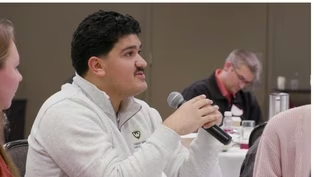
TRAILER | Democracy, According to Gen Z | Impact Michigan
Video has Closed Captions
Preview: Ep4 | 30s | PREMIERES Fri Oct 30 6:30pm ET on WKAR TV | Democracy, According to Gen Z (30s)
Providing Support for PBS.org
Learn Moreabout PBS online sponsorship New Episode
- News and Public Affairs

Top journalists deliver compelling original analysis of the hour's headlines.
 New Episode
- News and Public Affairs

Today's top journalists discuss Washington's current political events and public affairs.
 New Episode

 New Episode
 New Episode
 New Episode
 New Episode

 New Episode
 New Episode



Support for PBS provided by:
Impact: Michigan is a local public television program presented by WKAR