
Illinois House Republican Leader Recaps the Spring Legislative Session
Clip: 6/3/2026 | 9m 40sVideo has Closed Captions
Tony McCombie talks the Bears stadium, new taxes, the focus of state spending and more.
The Illinois General Assembly wrapped up its spring session Monday — but questions remain about the Bears stadium, the fate of new taxes and the focus of state spending. Tony McCombie joins "Chicago Tonight."
Problems playing video? | Closed Captioning Feedback
Problems playing video? | Closed Captioning Feedback
Chicago Tonight is a local public television program presented by WTTW
WTTW video streaming support provided by members and sponsors.
Illinois House Republican Leader Recaps the Spring Legislative Session
Clip: 6/3/2026 | 9m 40sVideo has Closed Captions
The Illinois General Assembly wrapped up its spring session Monday — but questions remain about the Bears stadium, the fate of new taxes and the focus of state spending. Tony McCombie joins "Chicago Tonight."
Problems playing video? | Closed Captioning Feedback
How to Watch Chicago Tonight
Chicago Tonight is available to stream on pbs.org and the free PBS App, available on iPhone, Apple TV, Android TV, Android smartphones, Amazon Fire TV, Amazon Fire Tablet, Roku, Samsung Smart TV, LG TV, and Vizio.

WTTW News Explains
In this Emmy Award-winning series, WTTW News tackles your questions — big and small — about life in the Chicago area. Our video animations guide you through local government, city history, public utilities and everything in between.Providing Support for PBS.org
Learn Moreabout PBS online sponsorship>> The Illinois General Assembly wrapped up its spring session in the wee hours of Monday morning with a 56 billion dollar budget and some key legislation passed.
But questions still remain about the Bears Stadium.
The fate of new taxes, the focus of state spending and much more.
Joining us tonight to look back on the session is Illinois House Republican leader Tony Macomb.
Be welcome back to the program.
Thanks for having me.
So Bear Stadium, as you know, even better than major topic this past session, House passed that mega projects bill in April, allowing payments in lieu of taxes 3.30, Monday morning Senate passes a different bill allowing municipalities of 70,000 or more to create these local stadium authorities.
What was your reaction to that last minute change?
>> Well, it was just bad, a last-minute change.
I think it certainly would have been out what the Bears were possibly looking for more so than maybe the mega project.
But back to the mega project, I think it's, you know, that was more of a statewide initiative which would be bring investment into the state, which is pretty important.
Bears were kind of secondary on that.
Probably why they didn't like it so much.
But I don't know that we have much time.
I think if we would have had the Republicans and Democrats or even just the Democrats from the House, the Senate and the governor's office with a bear sitting in a room, we might have had a deal, but they weren't able to get that down.
>> From what you hear from the folks in your caucus is keeping the Bears in Illinois a priority.
>> As long as it doesn't hurt the property tax payer.
We want some protections in place and we believe that the mega project bill that was passed out of the House would have had that picks in there.
Yeah.
>> So House Speaker Chris Welch joins us on the program last night.
And he talked about bipartisanship during the budget process.
Here's a little bit of what he had to say.
>> We've gotten better every year since I've been speaker.
You leader Macomb be said earlier on a radio show that, you know, she enjoyed the conversations with me her budget 2 years with my budget.
Here's there's a lot of coordination.
Are we going to agree?
We're going to disagree probably more than we agree because of the differences in the parties.
But, you know, we can do better.
We can always do better.
And I'm committed to that.
>> What do you make of the speaker's comments?
You think Republicans were meaningfully involved in budgeting this year?
I would say collaboration is a push, but certainly I did appreciate the conversation and we we have miss that.
We haven't had that on my first years later, which was this is my 4th year.
We did speak regularly this is the first year.
We've kind of got back to a conversation.
So I'm hopeful that that will continue and hopefully it'll grow the rank and file do it much better than he and I do so.
Hopefully they continue conversations.
But collaboration as much as a little bit of a push.
Yeah, but it does feel like it's better compared to previous years.
Yeah, quite honestly, it's helpful for our staff.
And, you know, the day of the budget on our Sunday, I guess I should say that's what's helpful to them.
Our staff on both the House in and then the Senate are there for, you know, today, sleeping 6 hours and to have a conversation with their staff, especially in the budget.
Here's to know what's coming really is helpful to them as well, which is the more important piece collegial, if not necessarily collaboratively.
Yeah, but we didn't even have hearings.
We had subject matter.
And that's certainly not transparent for the public.
And and we've had advocates and taxpayers down for 6 months fighting and then for them not even to have an option to, you know, way.
And that's not that's not right.
That's not good government.
Speaker Welsh also addressed criticism that the House and Senate weren't coordinating well, in particular on things like scheduling.
He called that a false narrative.
Here's a little bit of what he had to say.
>> Chambers are very different line is double the size of the Senate.
The second year of a GA involves election year.
There's a lot of needs of members to be back home in their districts.
Our our needs are different from the Senate needs.
And so one sitting down to the calendar that had to come into play.
What's your reaction to that comment?
>> Well, I'm I'm not the speaker for the president, but I feel that I was I certainly would have conversations.
Collaborate is again to have the advocates comedown.
Also when we're not in the same building together, how are we going to have conversations so if that was if that was the case, he says he's the listener of the house and that the speaker, he should listen to everybody.
>> This budget includes a number of new taxes.
Things like social media companies, digital ads.
Where would you have looked to to to balance the budget in terms of some of items in there?
>> Well, I'm may or may not be popular with some of your viewers, but certainly to have health insurance for illegal noncitizens is it is a cut where we certainly would have been interested in that real property tax reform.
When you're talking about a housing issue, lower our property taxes and more people are going to move into our area.
So if we have more higher tie tax base, not going continue to raise our tax rates.
But that would be the most obvious.
>> What do you make of the idea of a tax on high income earners?
The so-called millionaires tax that was floated but didn't go anywhere.
Yeah.
It would have been up to the voters.
It would have been interesting to see how it was worded, but >> millionaires have the ability more so than you and I to leave the state.
And you saw that with Ken Griffin with He took hundreds of millions of dollars that used to help our most vulnerable.
>> Do you expect some of these new taxes that have been enacted in this budget to produce the promised revenue?
>> No, and I don't think they do either.
And there was several of the tax is a social media one.
You know, I a brainiac idea from Mayor Johnson to it.
We can't even they can't even implement that.
So I think that's why they weren't really counting on that revenue this budget.
They want to go ahead and and wait to the next budget.
See if how it works and you know, that's going to cost taxpayers, you know, in the courts.
>> The Speaker Welton and others on the Democratic side said, you know, federal funding cuts as part of last year's one big beautiful bill.
Also complicated this year's budget.
Was that something that you saw?
>> I think it's something that they're certainly talking about.
You hear the word 8 billion dollars.
But we you know, the most apparent thing they talk about is people losing their snap benefits the best way for us to not have people lose their snap benefits is to fix our error rate.
So the governor has to take care of that.
That's an agency mismanagement issue.
It was about 6% when he came into office and now it's over 11%.
He gets back down to 6%.
We won't lose federal funding.
>> Now you Chicago Mayor Brandon Johnson likely not in alignment on a lot of issues, but you are both part pretty big group of folks advocating against cuts to the local government distributive fund for people who aren't familiar with that funding.
It's a little bit of a clunky name, but it's an important source of revenue.
Why was that important for Absolutely once the mayor of a small town very different than Chicago.
But >> 1968 1969.
It was an agreement that portion of the income tax would be returned to municipalities and villages at 10%.
We have not been at that 10% for years.
The governor's proposed budget was to cut that by 60 million and he'd he decided not to do that.
So took it up to 6.4, 7%, which is not still that 10%.
You want to lower property taxes rather than blame the local officials and the local school boards bring that back up to 10%.
>> Funding for K 12 education through the evidence.
Base funding formula went up by 350 million dollars still far below the target for many districts.
It is the increase in this current budget enough.
>> That's the promise.
And I'm glad they're keeping it.
They didn't do that.
Last year.
They took away the 50 million for the property tax relief for schools.
So was glad to see that restore this year.
>> you know, when we're looking for the needed revenue to try and, you know, reach reach these targets for districts.
Where do you think that education funding should be coming from?
>> Well, one of the things I think's important that we've had the evidence base funding model in place now, I think since 2018 and we need to reevaluate to make sure that it's working the way it's supposed to.
So rather than just extending the sunset to see if we are funding properly, we should probably re-evaluate that.
That's one of the things government does.
Illinois certainly not alone start a program and doesn't check to see if it's still working efficiently.
So I'd like to see that first before I can give a a real good answer.
>> There are also some fairly high-profile items that the governor brought up early in the session.
Things like zoning reform, you know, regulations on data center expansion.
Those didn't end up going anywhere in the spring to expect we might see those come back up in the veto session in the fall or in the lame duck or early next year.
>> Yeah, and I think he could an paused the data-center incentives if you wanted to just by saying so.
So we'll have to see.
Can I actually agree that they should be bringing their own energy?
I think the technology is changing.
So it helps with protections of water.
So we'll have to see what he decides to do.
There.
But time will tell.
>> There was another area of a pretty wide bipartisan agreement this year, which is on AI regulation.
Why is that something that's important for lawmakers to tackle?
>> It's important, but we also have to be careful because is this something better to do on federal side and some, including myself would say yes, but this here was really brought by AI companies, you know, wanting a 3rd party to audit to make sure that it is safe.
So I think that's certainly important.
And I was glad to see that piece of legislation passed.
>> We're almost out of time, but I want to ask, what are the priorities for your caucus moving into the summer months?
>> Yeah, we really spent a lot of time with our constituents.
The best part of the job is when we're outside of the dome, quite honestly, but really to continue some conversations.
We've we had a lot of good conversations with rank and file on a lot of different topics.
So certainly to continue those those conversations and reach out across the state.
always nice
 New
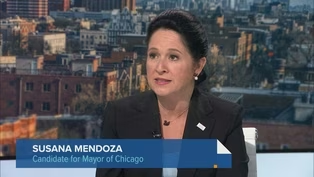
NewIllinois Comptroller Susana Mendoza Launches Chicago Mayoral Campaign
Video has Closed Captions
Mendoza announced her second run for Chicago mayor, having first made a bid in 2019. (9m 45s)
Providing Support for PBS.org
Learn Moreabout PBS online sponsorship New Episode
- News and Public Affairs

Top journalists deliver compelling original analysis of the hour's headlines.
 New Episode
- News and Public Affairs

Today's top journalists discuss Washington's current political events and public affairs.




 New Episode
 New Episode
 New Episode
 New Episode
 New Season
 New Episode
Support for PBS provided by:
Chicago Tonight is a local public television program presented by WTTW
WTTW video streaming support provided by members and sponsors.