
July 17, 2026 - Rep. Matt Hall | OFF THE RECORD
Season 56 Episode 3 | 27m 45sVideo has Closed Captions
Topic: Primary campaign trail. Guest: Rep. Matt Hall.
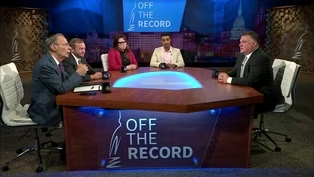
This week the panel discusses the current primary campaign trail and irregularities in voting in Michigan. The guest is House Speaker Matt Hall. Craig Mauger, Lauren Gibbons, and Colin Jackson join Senior Capitol Correspondent, Tim Skubick.
Problems playing video? | Closed Captioning Feedback
Problems playing video? | Closed Captioning Feedback
Off the Record is a local public television program presented by WKAR
Support for Off the Record is provided by Bellwether Public Relations.
July 17, 2026 - Rep. Matt Hall | OFF THE RECORD
Season 56 Episode 3 | 27m 45sVideo has Closed Captions
This week the panel discusses the current primary campaign trail and irregularities in voting in Michigan. The guest is House Speaker Matt Hall. Craig Mauger, Lauren Gibbons, and Colin Jackson join Senior Capitol Correspondent, Tim Skubick.
Problems playing video? | Closed Captioning Feedback
Where to Watch Off the Record
Off the Record is available to stream on pbs.org and the PBS app.
Providing Support for PBS.org
Learn Moreabout PBS online sponsorshipGreat to have you with us on OTR.
House Republican Speaker Matt Hall is our guest.
The president wants to reinvestigate alleged voting irregularities at Michigan.
Our lead story.
So sit in with us as we get the inside out.
Off the Record.
Production of Off the Record is made possible in part by Bellwether Public Relations, a full service strategic communications agency partnering with clients through public relations, digital marketing and issue advocacy.
Learn more at bellwetherpr.com.
And now, this edition of Off the Record with Tim Skubick.
Thank you very much.
Welcome back to studio C on this smoky weekend that we got going on in our state.
Lots of politics being played.
Let's start with the president's speech last night.
What did you make of that?
I think it was setting the tone for what's going to come in the next couple of months, which is we're going to hear a lot about the 2020 presidential election.
And I think there's a few reasons for that.
One, Republicans are looking for some cause to try to change election policies or bolster their efforts to change a bunch of voter ID requirements.
And two, be they've got to energize their base.
They've got to find a way to get those voters who will come out to vote for Donald Trump to come out in this mid year election year, where it looks like the polling against the GOP right now and their base is not enthused for a variety of reasons.
Yeah, I think it's difficult right now to run on economic affordability issues for the GOP since they are the party in power.
Unless something major changes between now and the election, that issue is disgruntled voters, especially a lot of the independents that need to be won over.
So rallying the base is not, is not a bad move by the GOP if they want to combat some of those national headwinds.
I do think it sets the tone to a certain extent.
We already saw the Justice Department announced it will be sending monitors to Michigan to monitor the state's elections in certain cities.
I think that, you know, it's to some extent that could be a cause for concern that we're going to see a repeat of a lot of election lies and denial that we've seen around 2020.
And we're seeing that already start to research.
So I think that that's something to watch.
Well, are is the general electorate in Michigan just up in arms about the outcome of the 2020 election?
No, they're not.
But there's a faction of Trump's base that is still focused on that.
And it used to be a few years ago, a lot of Republican candidates, when you would ask them about the 2020 election, they would say, why do you keep asking me about that?
But if you listen to them carefully, they have pivoted away from that type of answer, and now they are often the candidates saying the 2020 election was rigged.
You know, John James is running for governor, says that Mike Rogers, who's running for the U.S.
Senate, he's out there questioning what happened in the 2020 election, suggesting that there is some type of widespread fraud in Detroit.
They are openly talking about this now, and I think the reasons are that they're echoing the leader of their party, President Trump.
But also that's where the base of the party wants something done.
Major on election changes, election reform, something done.
They want to see in action.
Maybe it's, maybe it's what President Trump is talking about, the policies that would, require voter ID to vote.
I mean, that's one possibility, but they want action.
And I think they've got to talk about it to keep their base interested in this, in this vote coming up.
Yeah, I think it's gone from it's gone from.
Why are you bringing this up?
Please don't bring this up to.
Why aren't you bringing this up?
Bring this up at every opportunity.
But let's assume that they drive the entire base in the general election to the polls.
They still lose.
It's a possibility.
I mean, it's possible they die 5% of them.
They've got to figure out how to get their base to turnout and to change the pattern of what's happening with independents.
And I think that's kind of the dual language we're going to hear.
Here's some things for independents that we're trying to do on property taxes and bring down costs.
And here are these election reform for the base.
The problem is that's a dual track, as you're pointing out.
And you could run off course in either direction here.
I think it comes down to the messaging, you know, you can message it as grievances over 2020 conspiracy theories, or you can sell it as, hey, we want to make sure that elections are safe and secure in that ties into things like the American citizen voting ballot initiative that they're trying to get on the ballot to continue the Michigan Constitution.
So you have stronger voter ID laws, etc.. And I think if you push, you know, we just want to make sure that your democracy is safe and effective.
Kind of borrow some of that language that we've heard, from other folks.
I think that it that changes things possibly a little bit.
And it's a fascinating point in Michigan specifically because our elections here in the state are decentralized.
They're run by hundreds of local clerks, most of whom are Republicans.
Are the people operating these elections.
There's an idea out there that Secretary of State Jocelyn Benson is somehow puppet mastering all of these elections.
So that's not how the system works.
The system is run through local clerks offices.
They're the person that oversee how your vote is administered.
And it's just that's why I don't think this connects for a lot of people in Michigan, because they interact with this system every year when they go to vote.
All right.
Let's talk about the polling data in the U.S.
Senate race for the Democrats.
For the Republicans, who are they?
The Democrats outside Democrats?
Sometimes you can tell it's been a long one.
Yeah, yeah, El-Sayed and Ms.
Stevens.
Yeah.
So we saw in the recent polling that was done post-debate, without without McMorrow on the on the stage that Stevens is up slightly, although it's really important to note that, it's still going to be a very, very close race between between Representative Stevens and I'll say it's it's still, a matter of you know, that moderate faction versus the progressive faction, and progressives are feeling pretty good about their chances right now.
Well, this was your Detroit News pool.
I thought the interesting story was she had a seven point lead in one of the questions asked.
But then if you ask those that are definitely going to vote, it all of a sudden is a statistical tie.
Exactly.
And I think you're picking up on what is the most important thing and will be the determinative thing in this primary election that the nation is watching.
Haley Stevens is benefiting from a barrage of TV ads.
We're talking $50 million in outside spending by groups that have come in to try to help her win this race, Abdul El-Sayed has about $4 million in TV ad spending on his map.
That's a massive historic disparity in Michigan, but yet they're competitive, it's competitive, and Abdul has a ground game.
Energize volunteers.
He said something about, I think, 10,000 volunteers recently.
Does Haley have enough support in the TV ads to get more information?
Voters, voters who might not be following this to turn out, or is it going to come down to Abdul having the volunteers and having dedicated voters who are guaranteed to vote?
If Haley is weak on the ground game, that could hurt her.
If she's counting on voters who are less likely to vote.
If you have the less likely to vote voters and you have not a great ground game compared to what Abdul has, that could be a recipe for problems for her.
I think we're also seeing Stevens really trying to appeal to that traditional Democratic base.
I'm talking working class voters.
I'm talking black voters, everything.
I live in Detroit.
Every single ad I see for Stevens either is conventions, at least one of the Obamas, whether it's disparaging, Abdul for something he may have said about Michelle Obama in the past, or is comparing her to her work on the auto rescue for Obama.
So the thing you get in is always surrounded by at least 1 or 2 black voices in every commercial I've seen.
And I think that's part that's not accidental, right?
It's because you've seen black voters, especially traditional black voters, be some of the most reliable Democratic voters.
And so I think that's part of her campaign's bet that if he can win, these working class voters, can win these black voters, he can win a primary.
I think the fact that it's so close still that we're still talking about how close this race is with that massive discrepancy in television advertising and outside spending is astounding.
Frankly, the governor's race was just 72 from his Benson on the Democratic side and 12% for the sheriff.
Mr.
Swanson.
Yeah, it's not much of a race right now according to these numbers.
I mean, Chris Swanson is out there getting some endorsements.
He doesn't have the money to run TV ads.
It doesn't seem like he has a massive base of volunteers out there, and he's running up against someone who has won statewide twice before, in races where Republicans basically didn't lay a glove on her.
So tough to beat her.
Now, some would say, why doesn't you just take the rest of the summer off?
And I know him.
He has nothing to do with that.
They've never talked to Chris Swanson.
They've never talked to.
This was a stupid question.
Okay.
What do you guys make of those numbers?
I mean, it is what it is.
You know, you're going to see Jocelyn Benson to be the next Democratic nominee, barring some major shakeup and some seismic shift.
If you've Lieutenant governor material.
He says he's not one.
Right.
Yeah.
Everybody says it.
Everybody says I think from a strategic standpoint, he would be a very good pick for her because he has a base of support that crosses party lines.
There are Republicans that like Chris Swanson, he's this motivational speaker guy who, knows how to talk to just about everybody across the political spectrum.
It is unlikely, I think, in my mind, that she would pick him because he just does not fit with where the Democratic Party is today.
And that is seen in his poll numbers along among the primary electorate.
Yeah, I think I think it ultimately is up to Benson whether or not she goes that direction, but I do.
I would be a little surprised if she ultimately chose him despite, as Craig mentioned, some of his qualifications.
I said, what did you all make of the governor's release this week on the, the data centers?
I mean, I think it's a certain level of signaling, you know, you see that the vibes are bad around data centers.
You see that Michiganders are calling for, or you're seeing a lot of groups calling for moratoriums, etc.
that's not going to happen, just plain and simple.
And so you had to do something.
And I think that echoing what you saw Senate Democrats put forward in the majority, or you saw House Democrats minority in that chamber, put forward, combined with your pledge, you know, I think that gets to the heart of the new messaging around data centers, which is, okay, we need regulation.
We need to make sure these are working for Michigan communities.
What have you got to make sure that Michigan families aren't paying the cost of these data centers?
And I think this tries to address that conversation.
I thought it was fascinating for one reason.
One thing we know about the governor is that she's incredibly politically savvy.
And I think her putting out that press release about data centers points to how big of an issue that topic's going to be in this election.
We have seen candidates like Will Lawrence and who's running a progressive Democrat in the seventh district.
His TV ad, his main TV ad is all about opposing data centers.
This is a powerful topic.
The governor would not be talking about this like this if it was not well, remember the flack that she got about talking about this?
So I think part of this press release might have had a public relations aspect to it.
I'm not saying it's dominated, but for, you know, bias or some good publicity, the people see, well, you know, it sounds like she's on our side.
Yeah.
And it's kind of like this.
I think you're right.
And it's this bifurcated thing that we're seeing a lot on energy issues.
You see lawmakers rip on rip on consumers rip on data centers.
Hey, we got to set guardrails for data centers.
But then when it comes to actually setting the guardrails, there's a lot of talk but no action.
And so you can do all the chatter and say to your voters, hey, I said this and I did this with the pledge.
But when it comes to voting on policies, we're not seeing that happen in the legislature right now.
And there's a question of whether that messaging is even going to work.
I think a lot of voters, especially in those areas that are most impacted by the prospect of data centers, want to see meaningful action.
Well, there is a thing in politics.
It says, don't confuse me with the facts.
My mind is made up.
And I think in many of these issues, the people out in the hinterland, right or wrongly, have said this is a nonstarter with me.
I don't care what kind of safeguards you put in.
I'm not going there.
Am I barking up the wrong tree here, guys?
No, I think you're right.
All right.
We got, we got the speaker coming up in a prerecorded conversation earlier today.
You want to watch this?
Okay.
Not just because I might be on the program.
Was it good or not?
Entertaining.
All right, we see you.
Let's go to our interview.
We're back now with House speaker Matt Hall.
Thank you for doing the program, sir.
Always good to see you.
Thank you.
Tim, let's start with the obvious question on the table.
With all due respect to the president, because he certainly is entitled to his opinion, do you think in the minds of a lot of voters in Michigan, what's more important, a reinvestigation of alleged fraud in Michigan, in Muskegon, or gas prices in the war?
I think it's all important, you know, and, I, we watched, I watched the speech last night.
And this is something that the House Republicans, had been calling for was for the FBI to, you know, to come to a resolution in this investigation we saw under Biden.
That didn't happen.
And we're grateful that President Trump has reopened this investigation directed, director Patel, to look into this, and, and I'm hopeful that, it'll, it'll be finally come to resolution and we'll find out, whether there's, it's limited just to this fraud in Muskegon or if it was bigger than this, as in terms of, the, the other issues, you know, we're also, working very hard on, the economy.
You saw President Trump talk last night about, the jobs report's getting better, inflation coming down, securing the border.
So there were a lot of other issues that he highlighted.
And the question was, which is more important in the voters minds as they ponder this election, I think it's important to different voters.
And so when you're going for the independent and swing voters, you know, those voters are looking at, the, you know, the issues we're talking about.
They like issues like what we passed in the Michigan House to stop the, you know, these big private equity firms from buying up all the, single family homes and Karl Bohnak that got that done.
Governor Whitmer is going to sign that into law next week to help lower the cost of, housing.
You know, issues like a property tax reform that I've been pushing and the health care cost affordability board, that would dramatically lower health care costs.
We're also working to lower energy bills to force the utilities to lower their rates by $1 billion, which would wipe out the last three years of rate increases.
So Mr.
Mauger wants to get in.
Yeah.
But so so I think to, you know, those base Trump voters that don't show up in the midterms that we're working to get to turnout.
They're going to care a lot about, the conversation about election integrity.
But to those independent swing voters, you know, we're working on those issues, too.
Just to be clear, the what the president spoke about last night in Michigan, where voter registration forms that were caught before they led to people getting registered, as far as we know, six years later, the election system, it seems to have worked in that case, they they flagged these forms even before Election day in 2020.
Do you have any piece of evidence now in 2026, that there was any widespread fraud in the 2020 election?
I mean, you investigated this back in 2020 and 2021.
Yeah.
So to to your point, we know about what was reported in Muskegon.
I believe it's GPS.
I this is a firm, that was paid a lot of money by Democrats and the Biden campaign to do voter registration.
What we saw there was, you know, it was caught in Muskegon.
The attorney general did an investigation, referred it to the FBI.
We heard nothing.
You saw Rachelle Schmidt and Jada Boyer say, hey, we need, we need it.
We need the FBI to do something here.
I think it's a good thing President Trump has reopened that investigation.
And we'll see.
Maybe it's bigger than Muskegon, but we know there was crimes committed in Muskegon, and we know that there were never charges.
And so I'm hopeful we'll get those charges, and we'll punish these people that clearly committed crimes in Muskegon.
You know, I've been a big proponent of the Save America Act.
I think that we need voter registration.
With a voter ID to vote, you need a policy reform.
Yeah, we need voter ID laws.
Do you have any evidence of voter fraud, registration fraud, if that is what occurred, that's something different that doesn't affect the outcome.
As the president has alleged.
Do you have any evidence of something that affected the outcome of this election in 2020?
I mean, you saw the mass, mailing of absentee ballots all over the applications, all over the state.
And I think what fraud?
Well, it it it was something that certainly impacted the election that you sent out all kinds of unsolicited mass applications.
You saw people, they would say, I got, you know, ones for people that haven't lived here for years and years.
So what we want is a clean voter list.
We know there's tens of thousands of dead people on the voter rolls.
There's all kinds of illegal aliens you saw in the president's speech last night in states that are sharing their information with the federal government.
They're finding all kinds of dead people and illegal aliens.
So that's why we've been pushing Michigan to share their voter rolls with the federal government.
The federal government will provide them with a list of the dead people, the illegals, the non-citizens we saw in the last election, 2024.
At least 16 people were Benson will admit that we're not you, you know, not non-citizens that voted in the election, including a Chinese national that we know of.
That's what they'll admit.
And so we need to clean the voter rolls and pass the Save America Act, which will ensure that, that we have voter ID to vote and proof of citizenship.
Earlier in the program, you expressed a lot of optimism that, economic conditions would improve and it would become more affordable.
Are you convinced that, voters will see some benefits, some tangible benefits before they go to the polls in November?
You know, I think so.
I mean, I know here in Michigan, you know, like I said, in the Michigan House, we've been working really hard on on that.
You saw us pass legislation last year with Governor Whitmer that will, that will fix our roads.
You know, at the federal level, you saw them pass no tax on tips, overtime, Social Security.
We've amplified that at the state level with a state, policy on no tax, on tips, overtime, Social Security.
I think we've made the government more efficient.
We've cut waste, fraud and abuse.
And at the federal level, you know, you've heard, President Trump last night talk about, you know, all the things he's doing to bring jobs to the United States, to, to, lower the cost of living.
And, and I think we'll see a result, before the midterms.
And I think with the Save America Act, we're going to have safe and secure elections when we talk about inflation and gas prices coming down, as the president talked about last night, I think some of those numbers we saw were assuming that the cease fire in Iran would hold.
Now that that's off, you know, we're going to see gas prices go up.
We're going to see some of these change.
Now, I'm wondering how you think that's going to affect voters minds, especially as this continues closer and closer to the fall.
All right.
Well, you know, one thing President Trump made clear is, he does not want Iran to have a nuclear weapon.
And, and, I think that, they were pretty close to getting one.
And had they done that, you'd have an even worse situation going on, you know, overseas.
Right?
If you actually had that type of, if Iran had that kind of leverage.
So, you know, President Trump is, is doing what he thinks is right on the, with Iran.
And I'm hopeful that they get a deal.
But the challenge is, if they keep breaking, you know, they put out red lines and they keep crossing those red lines, you have to do something.
And so, the president has been, responding accordingly.
But I'm hopeful that he'll get a deal, that'll that'll bring peace to that area.
Very soon.
The, you mentioned in your first answer, Independent Voters, is a student of this game.
You understand that independents decide elections in Michigan.
Do we agree on that?
I think that the yeah, there's ticket splitters and independents, undecided voters are going to determine this election.
Yes.
Okay.
And if you believe the pollsters, which I know some you do not like, some of the pollsters in our town say the independent vote for Donald Trump right now is in the in the tank.
It's not there.
Does that concern you?
Well, Donald Trump is not actually the candidate running this time.
Right.
But isn't it interesting that he's part of the conversation.
Right.
So so you know, what Republicans are going to have to do in this election are two things.
Number one, we're going to have to turnout those what, you know, the the midterm voters that don't that vote for Trump, they come out and vote for Trump.
And they traditionally do not vote in the midterms.
Right.
So we have to motivate those voters.
And you see, you know, conversations like what we saw last night, on election integrity, those are the kind of things that those voters are that motivate them.
You see, President Trump is going to be very active in campaigning in the midterms, including in Michigan.
And his endorsement of Michigan.
Yes.
And his endorsement for a fact I do, yes.
And we'll see many more visits from the cabinet officials as well.
And those endorsements from Trump are going to carry a lot of weight.
But we also have to get those ticket splitters and independents as well.
And so you have to work on issues that appeal to all of those people.
And I think we're doing that with, you know, lowering property taxes, making health care more affordable, taking on medical debt and, lowering energy bills.
So you're the speaker of the state House here.
I mean, right now in Michigan, people are being encouraged not to go outside because of the smoke and haze that we're all encountering.
It's affecting everyone's life in this state.
People who come here to visit their vacations might be getting interrupted by this.
What can be done about this?
Yeah.
And what do you think's causing it?
Yeah.
So I had the opportunity to talk, with Ambassador Hoekstra about this.
Who's our ambassador to Canada?
And, and we're, you know, we're hopeful.
I've also reached out to the the actual Canadian ambassador as well.
Wiseman and we're we're going to, try to hold some hearings on this to get some more answers for the people of Michigan.
From the Canadians.
But number one is clear that Canada, cannot manage this on their own.
They're clearly in over their head, and, and they're really going to need, more of a collaboration with the United States.
I know, you know, this is the kind of thing that Mike Rogers really, I think would bring to the table.
We saw, you know, Mike Rogers and myself, working very closely with Howard Slotnick and Pete Hoekstra on this resolution with the Gordie Howe Bridge.
And, you know, we got a great deal on that where we're, they're going to pay half the tolls, or they're going to give us half the revenue from the tolls, and we're going to have a say in the in the price of the tolls.
And so we were able to make a great deal there.
But I think you see here, I mean, you know, the Canadians, need to really I mean, you see, they're boycotting products on the shelves in Canada.
They're having unfair practices against our dairy farmers.
They're not managing this smoke and this, there all these wildfires.
I mean, there's a lot of issues here, and we need a stronger partnership.
And I'm hopeful that we can, we can be a part of that.
Does this smoke situation affect the bridge opening?
Is there any possibility of that?
Or is the bridge that's opening July 26th?
No, I think the bridge will open.
You know, we've made a great deal there where, we're going to get half the total revenue to the United States to benefit, you know, commerce in, in Michigan.
We're also going to get, a say in the tolls because we don't want them just jacking up these tolls if the Canadians control that all by themselves.
So that's important that that shows some property rights and some benefit for the people of Michigan, the United States.
But that's not connected at all to this.
In this case, I think you see some bills being introduced at the federal level that would sanction Canada.
I would support that.
If the Canadians will not work with the U.S.
and show us a clear plan, a clear plan that's going to address this and fix this and we should sanction them.
But I would leave that up to the Trump administration to determine exactly, exactly how to sanction them.
I want to ask you about data center regulation.
This week we saw the governor put forward her proposal.
That echoes a lot of what we've seen from Senate Democrats and House Democrats.
You've mentioned wanting some of those same goals, like wanting data centers to work for the local communities.
You know, when can we expect to see a data center proposal coming from the House majority?
And do you expect something getting done this year?
Well, if you look at what Governor Whitmer did, I did this last night.
I looked at President Trump's ratepayer protection pledge that he put out months ago and got many of the data centers to sign.
If you put that up side by side with Governor Whitmer's, data center pledge, they're the same.
There are some words that are different, but they're the same.
They they're both getting at the same issue.
So I think rather than just, sign on to the ratepayer protection pledge, you know, Governor Whitmer rewrote it, for her own branding.
But you can see they're very similar.
And so, we're looking at it and, I think it's very likely we'll codify some of those things in that pledge to ensure that, that the data centers, pay for the energy bills, that the residents are not paying extra energy costs because of the data centers, and that, we ensure that water is protected and our environment is protected as well, so.
Oh, quickly.
What did you make of the administration's recent actions on line five?
Well, I think it's, exactly what we needed.
I mean, you saw Governor Whitmer did a great job, vetoing those nine bills recently.
Once again, we see her taking great actions, with approving line five.
So I'm impressed that she did that.
Mr.
speaker, can you stay for overtime?
Sure.
Very good.
We appreciate that.
They go to wkar.org for more of our conversation with the speaker.
And, we'll... take over from there.
Production of Off the Record is made possible in part by Bellwether Public Relations, a full service strategic communications agency partnering with clients through public relations, digital marketing and issue advocacy.
Learn more at bellwetherpr.com.
For more Off the Record, visit wkar.org.
Michigan public television stations have contributed to the production costs of Off the Record.
July 17, 2026 - Rep. Matt Hall | OTR Overtime
Video has Closed Captions
Clip: S56 Ep3 | 16m 43s | Guest: Representative Matt Hall (R) (16m 43s)
Providing Support for PBS.org
Learn Moreabout PBS online sponsorship New Episode
- News and Public Affairs

Top journalists deliver compelling original analysis of the hour's headlines.

- News and Public Affairs

Today's top journalists discuss Washington's current political events and public affairs.
 New Episode

 New Episode


 New Episode


Support for PBS provided by:
Off the Record is a local public television program presented by WKAR
Support for Off the Record is provided by Bellwether Public Relations.