Prairie Yard & Garden
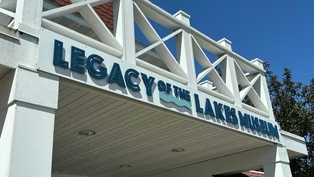
Legacy of the Lakes Museum
Season 39 Episode 7 | 28m 45sVideo has Closed Captions
The Legacy of the Lakes Museum in Alexandria houses unique watercrafts and a public display garden.
The Legacy of the Lakes Museum in Alexandria houses unique watercraft like a Heliboat and an Amphibious car, with Associate Director Kaci Johnson guiding host Mary Holm through water history. Additionally, Carol Swenson showcases the museum's beautiful public display garden, a serene spot perfect for events or daily escape.
Problems playing video? | Closed Captioning Feedback
Problems playing video? | Closed Captioning Feedback
Prairie Yard & Garden is a local public television program presented by Pioneer PBS
Production sponsorship is provided by Shalom Hill Farm, Heartland Motor Company, North Dakota State University, Friends of Prairie Yard & Garden, and viewers like you.
Support provided by:


Prairie Yard & Garden
Legacy of the Lakes Museum
Season 39 Episode 7 | 28m 45sVideo has Closed Captions
The Legacy of the Lakes Museum in Alexandria houses unique watercraft like a Heliboat and an Amphibious car, with Associate Director Kaci Johnson guiding host Mary Holm through water history. Additionally, Carol Swenson showcases the museum's beautiful public display garden, a serene spot perfect for events or daily escape.
Problems playing video? | Closed Captioning Feedback
How to Watch Prairie Yard & Garden
Prairie Yard & Garden is available to stream on pbs.org and the free PBS App, available on iPhone, Apple TV, Android TV, Android smartphones, Amazon Fire TV, Amazon Fire Tablet, Roku, Samsung Smart TV, and Vizio.
Visit the Prairie Yard & Garden Website
Do you love gardening? Consider becoming a friend of Prairie Yard & Garden to support this show and receive gifts with your contribution. Visit the link below to do so or visit pioneer.org/donate.Providing Support for PBS.org
Learn Moreabout PBS online sponsorship(bright music) - Each year we have a gathering with Tom's side of the family called Holmpalooza.
It has gotten to be quite the family tradition with lots of activities, but usually includes a rousing game of Yahtzee and a pontoon ride.
My brother-in-law is always the skipper of the boat ride, as he was in the Coast Guard and knows lots about boats and their use.
Did you know we have a museum right here in Minnesota dedicated to boats of all kinds?
Come along, let's get aboard.
- [Announcer] Funding for "Prairie Yard and Garden" is provided by Heartland Motor Company, providing service to Minnesota and the Dakotas for over 30 years.
In the heart of truck country, Heartland Motor Company, we have your best interest at heart.
(gentle music) North Dakota State University, through its Field to Fork educational program, providing research-based information on growing, preparing, and preserving fruits and vegetables.
Mark and Margaret Yeakel-Jolene, in honor of Shalom Hill Farm, a non-profit rural education retreat center in a beautiful prairie setting near Windom, Minnesota.
The Minnesota Arts and Cultural Heritage Fund, with money from the vote of the people of Minnesota on November 4, 2008.
And by friends of "Prairie Yard and Garden," a community of supporters like you who engage in the long-term growth of the series.
To become a friend of "Prairie Yard and Garden," visit pioneer.org/pyg.
(lively music) (lively music continues) - [Mary] I heard about a place in the heart of Minnesota called Legacy of the Lakes Museum in Alexandria.
Recently I had a chance to stop in to see the museum, and it was awesome.
I thought, we need to do a show here for "Prairie Yard and Garden."
So I called Kaci at the museum and asked if we could come in to showcase this great place, and she said, "Sure, come on over."
Thanks, Kaci, for letting us come to visit.
- Well, thank you very much for coming.
We love having you guys here.
- How did the museum get started?
- Well, way back in the 1990s, about 1996, there was a group of individuals who were both locals and summer residents who just had a passion for wood boats and wood boat culture, and also lake life and lake life culture.
And they felt that it was something that deserved to be preserved.
And so they got together and kind of sat around and were like, "How can we make this happen?"
And so they determined they wanted to start a museum.
So they traveled all around the country visiting different boat museums, gathering research, and from there they took what they had learned.
In 1999, they incorporated into a non-profit.
Then in 2004, we opened a temporary exhibit at our neighboring museum, the Runestone Museum.
And then in 2006, we acquired the building we're in now.
And ever since then, we've just continued to expand the building.
So we've expanded into an additional gallery and the gardens, and here we are today.
- [Mary] What is the purpose of the museum?
- [Kaci] We are here to celebrate lake life and lake culture.
You know, we used to be called the Minnesota Lakes Maritime Museum and Society, but we changed that in 2015, 2016 to the Legacy of the Lakes because we wanted to better encapsulate all that we tell.
So we tell stories, not just relating to boats, but also to, you know, we talk about swimsuit history and personal flotation devices and resort culture and resort history.
So we're just all about lake life and lake culture and how, you know, going to the lake has just been something that's ingrained, not just in Minnesota, but you know, around the country, around the world.
- About how many visitors a year do you have?
- Well, it can vary, and as we've grown, so have our visitor numbers.
We're open for about six months of the year.
Last year we had just under 6,000, so that was our record year.
But typically we get about 5,000 a year.
- [Mary] What are some of the types of boats that you have here?
- [Kaci] Well, every year we change out exhibits, 'cause we try to keep things fresh for our local visitors who come every year.
So this year we have a temporary exhibit called "Out of This World: Wild and Wacky Watercraft."
So these are all boats that kind of are inspired by the Space Race.
It's kind of like "The Jetsons" meets the water.
So you know, we've got a flying saucer boat, which is kind of really interesting and does work, but we also have like the Heli-Bout, which is a cross between a helicopter and a boat.
It's an interesting thing that doesn't work.
It never flew, and as far as I know, it never went on the water, but it was a one-off that was kind of meant to inspire outboard motor builders about what we could accomplish in the future.
So it was built in the sixties.
Most of those craft are from the 1960s, right in the heyday of the Space Race.
- [Mary] What are some of the other things that you have that are more unusual?
- [Kaci] Oh, well, there's everything from a motorized surfboard.
'Cause you know, except for Lake Superior, we're not really getting big surfable waves here.
I think like the vintage swimsuits, kids come in and they're like, "Why do you have dresses on display?"
And it's like, "That's not a dress, that's a swimsuit; it just looks like a dress that you would wear."
So it's fun to see what kids see.
But you know, we've got original fishing tackle from back in the day and an ice house.
So those are just fun things to look at too.
- Were there many boats made in Minnesota?
- So many boats made in Minnesota.
It's interesting because you know, a lot of small towns each had their own individual boatworks.
Here in Alexandria, we had our very own Alexandria Boatworks.
It actually stood kitty-corner to where we are now here in the museum.
We're very pleased to be able to tell the story of our very own Alexandria Boatworks here.
- [Mary] What are the boats made of that you have here in the museum?
- [Kaci] Oh, we've got everything from fiberglass boats, which is of course developed later in the 1950s and sixties, but all the way back to wood boats, which is the main building material for centuries.
But we've also got aluminum boats.
There's canvas, which a lot of people don't know, but we have a boat that's made of cedar strip, but also covered in an airline canvas.
It's pretty interesting though.
Another thing we have on display is methods of powering these boats.
So I mean obviously the earliest boats were powered by paddle and other methods, but you know, after the advent of steam and combustion engines and all these things, really the powered boating industry just takes off.
And so there are two main types.
You have inboards and then you have the outboards.
And so we have a great display of outboard motors here at the museum.
So we have everything from Midwest local brands.
So you've got Johnson and you've got Mercury, and you've got Evinrude, and you really start to see a lot of development of that also in the fifties.
So again, in that "Out of This World" exhibit, we see a lot of development and out-there designs of those outboard motors in that exhibit as well.
So there's a guy named Brooks Stevens; he's from Wisconsin, and he worked really closely with Evinrude to develop a lot of designs.
So when he designed that Heli-Bout, it was actually to promote the Starflite motor on the back of it.
I mean it did well, but that was its purpose.
He's got the Evinrude Lark and the Johnson Javelin, which people recognize still today.
So we're just very pleased to have a lot of examples of those here.
- [Mary] Now who owns all of these display items?
- [Kaci] There's a mix.
So the museum owns a good chunk of the boats you see on display, and we actually have a storage facility offsite that has more boats in it.
But because we like to keep things fresh for our visitors, we do have a rotating display of boats that are on loan to us.
Most of these Glastrons you see on display here are on loan to us for the season.
So at the end of the season, they will go back to their owners, and next season we will bring in a new and exciting exhibit.
- [Mary] When I walked in, I saw a little blurb about Lake Adney.
- So we like to focus on just different lakes throughout Minnesota.
You know, we're not necessarily focused on Minnesota, but it is our home state.
And Lake Adney is one of the only lakeshores in Minnesota that was predominantly owned by Black homeowners.
There was a gentleman who was able to purchase up a large chunk of lakeshore, and then he sold it to predominantly Black families who then were able to enjoy homeownership on a lakeshore.
And it wasn't something that was readily available to them at the time.
And so it was something that they were able to then hand down to their families.
And to this day, I think still a good chunk of the lakeshore is still owned by those original families.
So it's just a unique story here in Minnesota.
- You had mentioned gardens, and of course my ears perk up with gardens.
Can we see your gardens here too?
- Yes.
Actually, I'm gonna hand you guys off to Carol, who's our former director.
She has been heavily involved in the gardens' development for years, so she'll take you guys out there and tell you all about 'em.
(lively music) - We've all experienced it.
We've found wilted lettuce in our refrigerator, or we've found leftovers at the back of our refrigerator that we forgot about.
Unfortunately, food waste is a major problem in the US.
We throw away 30 to 40% of the food that is available to us, and that's 133 billion pounds of food.
In fact, about one-third of food waste comes from home use.
You can take your kitchen scraps and compost it quite easily.
You don't need a fancy composter, but that certainly does help.
So compost is a mixture of browns and greens.
Greens can be your vegetable peels; browns can be dried leaves, or even newspaper.
When we add some water, and we give adequate time, and we tend the compost by turning it regularly, pretty soon you're gonna have what's called black gold, very rich soil that you can insert into your own garden.
Keep meat, bones, and dairy out of your compost pile.
They can attract pests.
Turn your compost regularly to keep it aerated, and add a little water now and then so it stays damp but not soggy.
By composting, you're keeping food waste out of landfills, you're reducing greenhouse gases, and you also have an opportunity for a great science lesson for kids.
They learn how to take banana peels and other food waste and make it into healthy soil.
I'm Dr.
Julie, bringing the field to your fork.
Until next time.
(lively music) - Hi Mary.
I'm Carol Swenson.
I'm the former director of the museum, and I'm really glad to have all of you here today and to talk about the gardens.
- How did the gardens get started?
- Well, the development of the museum was in 2005, and it was kind of always in the background in the plans to do something like this as an extension of the museum.
And in 2006, we began talking with the city, and then we gradually started doing our planning.
And the site work for the gardens itself was completed in 2012.
Prior to that, it was just an open area, open space with some large trees in it, and very underutilized.
And as we converted the maintenance building into the museum, this was a logical next step.
- [Mary] Why was it important to have the gardens, or why did you feel like you wanted to have the gardens here?
- [Carol] There are a couple of reasons related to that.
One is this whole area was conceived of as an improvement to the north end of Broadway Avenue.
Before, it was just kind of old buildings and a neglected area, but it also gives the museum a way to bring its mission outdoors and the celebration of lake life and lake experiences.
And so as you go through the gardens, you'll see that there are areas for contemplation, just rest and relaxation, look at the water.
And then there are other larger areas for gatherings, which is a lot of what happens at the lake.
And there are many community gatherings here.
It's a place to build community, and then also it's a place of discovery and learning.
And you know, about lakes and lake life and you know, what it all means.
- [Mary] Who did the design work of this beautiful place?
- [Carol] Well, the drivers of the development of the gardens were Bruce Olson and Bob Reckeweg who is an owner of Colorful Seasons Greenhouse.
And Holly Wallgren, who works at Colorful Seasons, was the person who laid out the basic design of the gardens and also helped lead and guide the selection of the plants and plantings that you see.
- [Mary] So who picks the annuals that are put here now?
- [Carol] Well, it's become more of a group effort.
Initially, Colorful Seasons helped us a lot, and volunteers and staff have been taking on that responsibility.
And actually, what we're looking at is starting a master planning process for the gardens itself and thinking to the future, and how can we make the gardens more sustainable, more reflective of native plants and plantings, and give our volunteers' knees a little bit of a break.
And I could start to think of perennials and so on that, you know, eventually will maintain themselves or require less work.
- [Mary] Well, that was my question, is who does all the planting and the maintenance?
- [Carol] We have a big planting day at the beginning of June, and that's when we put in the majority of the flowers into the beds.
And we have 15 to 20 volunteers who come in and get their hands dirty and their trowels into the soil and begin to really plant the gardens.
And then they continue to help us maintain the gardens over the summer.
We have some staff that do things like mowing the grass, et cetera.
But a lot of the annual beds, the weeding, that kind of thing, is really done by a really dedicated core of volunteers.
- [Mary] Carol, when this was designed, was it made so that there's flowers or color throughout the season?
- [Carol] Yes, it was.
And what we see is, in the spring, we have a lot of the flowering shrubs and trees that bloom, and we have, you know, some early plants like the Siberian iris that you see that brings out the purple.
And we have peony bushes and all sorts of different types of perennials that bloom in the early spring.
And then by early June, we have the annual beds planted, and that, you know, really gives everything a pop of color for when we have a lot of events going on in the gardens and we have a lot of visitors.
And then into the fall, we have the Joe-Pye weed begins to, you know, bloom, and our sedum is blooming, and you can see the hydrangeas, and it's all quite, you know, sequenced and lovely throughout the summer season.
- What are some of the main features out here in the gardens?
- Well, as people are leaving the North Gallery of the museum, where they see all of those beautiful mahogany boats, they first encounter our waterfall, which, you know, continues that theme of water into the gardens and the sound.
And you know, just watching the water flow is really something that a lot of people love.
It's a great place for photos, for family ops, and also for teaching.
We do classes with boat building for kids, and they come down here and see if what they built floats.
So it's, you know, really an active place, and you know, the sound just kind of sets the tone for going into the gardens.
And then, you know, throughout the gardens we have gazebos that are placed in a critical position, so you could have some with furniture inside of them.
And we have a lot of people who just come in with their friend and sit there for an hour and have a conversation.
The other gazebos we often use for either teaching or to support events that are happening in the gardens.
And then one of the main features of the gardens is the Pohlig Family Stage.
And that is where we have a lot of our concerts; wedding ceremonies happen there.
And so there are a variety of different activities that are generated and take place around the different garden features.
- [Mary] I need to ask you about one feature that I saw.
There's a sign that has different cities on there.
How did that come to be, and how did you pick those cities?
- [Carol] Well, that's a very interesting story, and it kind of is the story of this museum.
The pier and area around the sign is really a memorial for Fred Bursch of Bursch Travel.
And donations in his memory were used.
The pier was initially built as part of the second phase of the garden, but it was expanded on.
And that post with all of the different cities was donated by his wife, Terri Bursch.
And the cities are places that he loved to go and to travel.
And if you look carefully, there are sayings on there about the importance of travel and how our lives are enriched by travel.
- [Mary] Do you have to pay in order to come in and use this area here?
- [Carol] No, no.
It's open to the public from dawn to dusk.
There is no charge.
And so people can wander through; they make it a part of their lunchtime walk or their running that they're doing.
We see a lot of runners taking a little break here and then continuing on their way.
So there's no cost, and it's, you know, just a great place.
- [Mary] Thank you for sharing this beautiful spot, and I'd like to find out more about some of the events that you have here.
- [Carol] Thank you.
(lively music) - I have a question.
I just love native grasses.
What are some new varieties I should try?
- Wow, there's lots of new things with ornamental grasses, and especially with natives.
We have a huge collection at the Minnesota Landscape Arboretum, and I'm here with a prairie dropseed, Golden Prairie.
And it's yellow, yes, a yellow form of prairie dropseed, and right beside it is a variegated form, White Stripes, with little bluestem.
Both of these are great native grasses selected for their wonderful color appearance, and they're good for dry sites in full sun in your garden.
So two great natives.
So here is big bluestem, Blackhawks.
This is another native grass; you can see it's much taller.
It's even taller than I am.
But what's so beautiful about it is this dark purple-red color.
This is a great perennial if you like purple plants in your garden.
It's a native, so it's a really tough one for cold conditions.
And this is the Perennial Plant for 2026 from the Perennial Plant Association.
So that means it's a proven winner, and lots of perennial growers have voted it as a favorite.
Another great native grass is Sorghastrum nutans.
This selection comes from the University of Minnesota, is Golden Sunset.
You can see the wonderful yellow-gold fall color that it has.
It blooms earlier than many other forms of this yellow prairie grass.
And it tolerates dry soil, full sun conditions.
Now you can see it's floppy over a little, but we had a big storm here, and this can happen.
This will bounce back fairly well from this.
But it's another wonderful native grass.
In the fall, I love to see the birds on this.
The sparrows are often on it, eating it, as well as it's a good pollinator plant.
So there are many wonderful native grasses you can choose for your garden.
The University of Minnesota Landscape Arboretum has a wonderful collection open almost every day of the year.
- [Mary] Kaci, what do you use this beautiful area for?
- Oh, well, not only is it just used by the community in general, just for a quiet oasis, you know, in the middle of downtown, but we are also using this for different events, museum events.
We use it for our Music in the Gardens concert series.
It's part of our Nautical Night fundraiser every year.
We use it for rentals though too, so people can rent this out for wedding ceremonies, graduation parties, celebrations of life.
It's really just a community gathering space, whether you're renting it or coming here for a museum event as well.
Select Friday nights throughout the summer, usually about four or five times a year, we host music concerts.
So it's just another way that people can support the museum by coming to one of our music concerts.
We have food, cash bars, and it's just a great night to enjoy the beautiful surroundings of the gardens.
We hold it right here at the stage.
- [Mary] I heard something about a boat show.
Tell me about that.
- [Kaci] Ah, so there's been a boat show in Alexandria for 37 years.
Obviously, the museum hasn't been around that long, so we've been operating it since I think about the year 2000, maybe a little bit after that.
But yes, it's an annual gathering of boat enthusiasts from not just the area, all over.
And it's just a gathering of people who love classic and vintage boats.
And we hold it at Lure Lakebar, which is on Lake Le Homme Dieu, and it's a free event for the public to come to.
And there's classic and vintage boats.
We give boat rides.
There's different kind of vendors and booths to check out.
We do pop-up museum exhibits.
So it's just a fun day.
It's usually the second Saturday in July.
And again, it's a free public event, and we just love having it.
- So what do you do if you have an event scheduled and there's rain in the forecast?
- It depends on the event.
It actually happened to us this year where the weather was inclement during our annual Family Day, which is a free event we have every June.
We invite families in, and the weather and air quality wasn't the greatest that day.
Luckily, we do have that Boathouse Event Center.
So we moved all of the kids' activities that we had.
I think there was like 15 of them.
So we were able to disperse them throughout the Boathouse and the museum.
For music concerts, generally what we'll do is we'll look for a reschedule date and see if we can work it.
And luckily, the one camp concert we did have to reschedule, we were able to find a reschedule date for.
So... - Do you have events for children here too?
- Oh, we have so many events for children.
I mentioned our annual Family Day that we do every June.
We also do kids' programming, so kids' education classes.
They have their own flowerbed that they plant here in the gardens.
They do recycled boat building, and then they race them here in the little creek.
We try to involve kids as much as we can here.
And also, there are different groups that come in.
So every December for two years now, the Friends of Christmas have worked with us, and they have put on a light display in the gardens in the wintertime that people walk through then, and that's free.
The community just gets to walk through it.
So it's wonderful to work with other organizations too, to utilize the gardens.
- [Mary] Is the museum open year-round?
- We're not.
We are actually open only about mid-May through October 31st.
And that's just because our wood boats, they require special storage because changes in temperature and humidity are not good for wood boats.
So we actually store them in a special room inside the museum.
So we have to move everything twice a year.
It's a big boat moving day, but because of that, we are only open seasonally.
But we do do programming all year-round.
And like I said, we try to do different events.
So we have our Parade of Trees event in November, and then that's when that Garden of Lights occurs through the Friends of Christmas.
They use the gardens for that.
- [Mary] This is so beautiful, and I love the pathways, 'cause that makes it handicap accessible.
- [Kaci] It does.
The gardens are completely handicap accessible.
They're nice and wide.
Everybody can go through and just enjoy being out here in the gardens.
- Do you have to have fundraising events too?
- We do.
So we host an annual fundraiser every year called Nautical Night.
That's usually in July.
And then, you know, everything we do at the museum is really a fundraiser for the museum.
We don't get any funding from the government.
We're all privately funded, even though we are a public non-profit.
But we're a private, you know, museum.
So we, you know, Music in the Gardens.
Funds raised from that go to support the museum.
Our admissions go to support the museum.
When people buy memberships, those go to support the museum.
And then of course, the funds raised from Nautical Night go to support the museum.
- [Mary] Well, thank you so very much for letting us come and see this wonderful place.
- [Kaci] Well, thank you for letting us share it with you and with everybody watching.
(lively music) - [Announcer] Funding for "Prairie Yard and Garden" is provided by Heartland Motor Company, providing service to Minnesota and the Dakotas for over 30 years.
In the heart of truck country, Heartland Motor Company, we have your best interest at heart.
(gentle music) North Dakota State University, through its Field to Fork educational program, providing research-based information on growing, preparing, and preserving fruits and vegetables.
Mark and Margaret Yeakel-Jolene, in honor of Shalom Hill Farm, a non-profit rural education retreat center in a beautiful prairie setting near Windom, Minnesota.
The Minnesota Arts and Cultural Heritage Fund, with money from the vote of the people of Minnesota on November 4, 2008.
And by friends of "Prairie Yard and Garden," a community of supporters like you who engage in the long-term growth of this series.
To become a friend of "Prairie Yard and Garden," visit pioneer.org/pyg.
(bright music)
Preview: S39 Ep7 | 30s | The Legacy of the Lakes Museum in Alexandria houses unique watercraft and a public display garden. (30s)
Providing Support for PBS.org
Learn Moreabout PBS online sponsorship

- Home and How To

Hit the road in a classic car for a tour through Great Britain with two antiques experts.












Support for PBS provided by:
Prairie Yard & Garden is a local public television program presented by Pioneer PBS
Production sponsorship is provided by Shalom Hill Farm, Heartland Motor Company, North Dakota State University, Friends of Prairie Yard & Garden, and viewers like you.