
New Book Examines History of Wrongful Convictions
Clip: 6/23/2026 | 8m 26sVideo has Closed Captions
Cook County has been called the wrongful conviction capital of the country.
Cook County has been called the wrongful conviction capital of the country. But who is giving the county this title? In her new book, “Crime Fictions: How Racist Lies Built a System of Mass Wrongful Conviction,” author Nicole Gonzalez Van Cleve tries to answer that.
Problems playing video? | Closed Captioning Feedback
Problems playing video? | Closed Captioning Feedback
Chicago Tonight is a local public television program presented by WTTW
WTTW video streaming support provided by members and sponsors.
New Book Examines History of Wrongful Convictions
Clip: 6/23/2026 | 8m 26sVideo has Closed Captions
Cook County has been called the wrongful conviction capital of the country. But who is giving the county this title? In her new book, “Crime Fictions: How Racist Lies Built a System of Mass Wrongful Conviction,” author Nicole Gonzalez Van Cleve tries to answer that.
Problems playing video? | Closed Captioning Feedback
Where to Watch Chicago Tonight
Chicago Tonight is available to stream on pbs.org and the PBS app.

WTTW News Explains
In this Emmy Award-winning series, WTTW News tackles your questions — big and small — about life in the Chicago area. Our video animations guide you through local government, city history, public utilities and everything in between.Providing Support for PBS.org
Learn Moreabout PBS online sponsorship>> Cook County has been called the wrongful conviction capital of the country.
But how to get that title in a new book.
Crime Fiction's How racist lies built a system of mass wrongful conviction.
Author Nicole Gonzalez Van Cleve looks to answer that.
She identifies cases of black youth, some as young as 7 years old who are wrongfully accused and coerced into confessions.
Here to talk about the book and some of these cases is author Nicole Gonzalez Van Cleve.
Welcome back.
Thanks for joining us.
Thank you so much for having me.
So how do police prosecutors, the courts had all of these things collide to produce a wrongful conviction right?
We often talk about wrongful conviction as though it's an accident or a series of accidents.
And what I'm trying to do in this book.
>> Especially as a sociologist that uses data to build an argument is to think about wrongful conviction is a set of pattern to systemic way of kind of doing business by police.
And so this book is kind of a how Don it if we were going to dissect wrongful conviction and say, what are the what are the patterns?
That's what's in this book.
And I take it case by case some viewers will recognize some of these famous cases.
But at the end of the day, we have about 575 cases of wrongful conviction.
Chicago, we're kind of the best at it.
So in some ways, this is the perfect place to kind of do an autopsy, if you will, of how do police keep creating wrongful convictions in the same systemic ways.
And of course, you're you're familiar with with Cook County and with Illinois from your your previous last month where your other book county.
>> All the stories that you focus on in this book, they involved young black children, as we said, some as young as 7.
They're all falsely accused.
How did you begin to identify that pattern?
Well, I started with false confessions.
And so we also are the false confession capital of >> the nation.
And so we think there's no way to ever admit to a crime that didn't do.
How how does somebody going innocent and come out guilty and the eyes of the police?
And the issue is that police have ways of techniques of actually creating wrongful conviction.
Sometimes they're isolating these children.
There's a detective named James Cassidy who would hold children's hands and see the police would forgive, would forgive them the way God forgives them.
And in some ways made his interrogation room into a type of confessional.
He feed them happy meals, get into their space and often they would use black officers to lore these children to kind of warm them up and trick them.
So there are these techniques that are tried and true.
But when the person doesn't confess, they can actually just write whatever they want.
And doctor evidence and doctor documents when that happens, its partially our fault as the public that we only believe the police right there.
Word is a type of evidence that we see is, you know, Yeah, it's a gospel of true.
So it's not the only technique.
False confessions is kind of the engine, if you will, of wrongful conviction.
But police have other ways of coercing witnesses are bringing in kitten as a witness with no lawyer, no parent present and then changing them into a suspect and framing them as well.
So as you said, you know, as of January 2026 of the total 3,767 national cases of wrongful conviction that we know of.
>> As you said, 575 576 are from Illinois with 148 of those convictions, including false confessions.
Do you have a sense of how many from Illinois of the false confessions?
Well, that the those numbers are from Chicago and Illinois.
So I focused on that starting do.
We have a sense of why we have so many and why we have so many.
When we think about the numbers like it when it when we say we're the best or the worst ever wrongful conviction.
>> We're we're creating more false confessions than any other place in the nation.
You know, one explanation is that we have developed exoneration movement, right?
We have multiple universities and dog attorneys on the other side that are helping to expose these cases.
So it's possible that places like New Orleans, they don't have these attorneys.
And so the they have maybe even more cases, right?
This is a national epidemic.
We are just we need to be curious that Chicagoans as to why we are doing this the best.
What are these techniques can we create reforms to repair this?
But the issue is we have never really put our Chicago police in check.
We haven't.
There are no reforms that would in some ways prevent wrongful conviction.
And we see time and time again that we leave the reform to the police themselves and they let us down to the cases of the George Jones case in Chicago police officers were hiding evidence.
They call them the street files.
They were bearing exonerating evidence that could free somebody defendant.
In that case, George Jones was the a son of an officer and they still did to this black child.
He was an honor student when that case was exposed, the police said that they were.
Reforming.
And what ended up happening is that that system continued all the way until now.
We've done really nothing that police have the total authority to assemble a case file and we're none the wiser win.
Exonerating evidence goes missing.
Attorney Candace Gorman who represents young man.
in this book name Abdul Malik Muhammad.
She went into one police precinct at 51st and Wentworth and found 500 cases buried in a boiler room.
And I said to her, what did you think when you she was searching for one so-called street filed for one case and she finds 501 police precinct.
And she said all I could think about is how many of those young people were executed.
And it just sent chills down my spine that we are allowing this to continue because you also write, that's that the flip side of this is that it's one thing for one person to be wrongfully convicted and locked up for probably what is but most or all of their life.
And we're kind of >> waiting on this.
The system of exonerations in attorneys to work to get them out.
But the flip side of that is the safety factor.
wrongful conviction means one.
person who actually did it is walking around, right?
Absolutely.
So in that George Jones case, while they're framing this son of a police officer to this black child there, there's another.
There's another offense.
There's another assault.
>> And so we are really gambling with the safety of Chicagoans, right?
This is a dangerous business.
And one of the things we don't talk about is that police clear about only 50% of cases clearance is a metric of effectiveness, but it only means that the police have charged somebody and that somebody could be anyone once they charge their absolved of any more investigative duties.
But it has no measure of accuracy.
So it's still low.
50% means that we could flip a coin in Chicago and get away with murder.
That's unsettling.
But we don't know how many of the people they do charge are actually innocent.
As you see in the cases that are in this book.
And that to me is a public safety issue.
Are prosecutors and judges should be very concerned.
Our mayor should want to get to the bottom of this as a matter of public safety.
Just a couple seconds left, what more needs to be done?
What has been done?
Well, right now, we have completely stalled looking at in conviction, Integrity Unit.
We have to start thinking of it as not looking in blaming people.
We need to see that.
That is good.
That's kind.
The duty of a prosecutor.
Did they get it right?
And again, it's a matter of public safety.
Don't we want to know?
It's also a matter of system, legitimacy.
If we are just charging young people and we don't really care if it's the right person.
We are betraying victims.
We are betraying the public and were betraying the overall legitimacy of our criminal justice system.
And so I do think we need to take serious and come back and get big.
She's meet the Conviction Integrity Unit to be reviewing cases again, we need to stop making it harder rather than more thorough and a little bit easier for people who have claims of innocent to a good faith have their claims reviewed.
That's the least we can offer people when we take away their freedom.
Okay.
That's where we'll have to leave it offer.
Nicole Gonzalez, Van Cleve, thank you for joining us.
Thank you so much.
 New
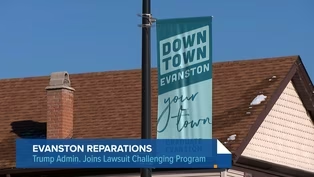
NewTrump Administration Challenges Evanston's Reparations Program
Video has Closed Captions
The DOJ filed to join an existing lawsuit challenging the program, which began in 2021. (12m 15s)
Providing Support for PBS.org
Learn Moreabout PBS online sponsorship New Episode
- News and Public Affairs

Top journalists deliver compelling original analysis of the hour's headlines.
 New Episode
- News and Public Affairs

Today's top journalists discuss Washington's current political events and public affairs.
 New Episode
 New Episode
 New Episode
 New Episode
 New Episode
 New Episode
 New Episode
 New Episode
 New Episode
Support for PBS provided by:
Chicago Tonight is a local public television program presented by WTTW
WTTW video streaming support provided by members and sponsors.