
No Limits | Beyond The Score
9/2/2026 | 26m 46sVideo has Closed Captions
Profiling blind skateboarder Nick Mullins and adaptive baseball's Miracle League.
Beyond the Score host Al Martin explores what happens when passion overcomes life’s greatest physical hurdles. Skateboarder Nick Mullins shares his journey of navigating life and sport after losing his sight. And The Miracle League of Mid-Michigan demonstrates how adaptive baseball creates a community where every athlete gets their chance to play, shine, and score. A WKAR original series.
Problems playing video? | Closed Captioning Feedback
Problems playing video? | Closed Captioning Feedback
Beyond the Score with Al Martin is a local public television program presented by WKAR
Support for Beyond the Score with Al Martin is provided by Capital Insurance Services.
No Limits | Beyond The Score
9/2/2026 | 26m 46sVideo has Closed Captions
Beyond the Score host Al Martin explores what happens when passion overcomes life’s greatest physical hurdles. Skateboarder Nick Mullins shares his journey of navigating life and sport after losing his sight. And The Miracle League of Mid-Michigan demonstrates how adaptive baseball creates a community where every athlete gets their chance to play, shine, and score. A WKAR original series.
Problems playing video? | Closed Captioning Feedback
Where to Watch Beyond the Score with Al Martin
Beyond the Score with Al Martin is available to stream on pbs.org and the PBS app.
Providing Support for PBS.org
Learn Moreabout PBS online sponsorshipBeyond the Score is supported in part by Capital Insurance Services offering comprehensive personal and commercial insurance, including medical professional liability to Lansing and throughout Michigan since 1980.
More resources and information about offerings at capitalinsurance.com There' always a story Beyond the Score.
No way.
I can't believe that guy's blind.
You can't sit here and not be happy.
I was pretty much dead at one point.
Whoa!
I remember those first game and I just was with my husband when like, this is amazing.
Welcome to Beyond the Score.
I'm your host, Al Martin.
I'm here at Ranney Park, where every ledge, rail, and ramp tells a story of persistence.
Around here, falling isn't failure.
It's simply part of the process of getting better.
So today, we'll first head to the Miracle League of Mid-Michigan, where every athlete gets the chance to experience the excitement of stepping onto the field, hearing their name announced and playing the game they love.
Then we'll meet Nick Mullins whose passion for skateboarding helped hi navigate extraordinary adversity and ultimately inspired hi to redefine what was possible.
One story reminds u that everyone deserves a place to play.
The other shows us that sometimes that place becomes exactly where we discover our greatest strength.
This is Beyond the Score.
Baseball has always been defined by the numbers.
Nine innings, three strikes, 100 mile an hour fastballs, and the exact distance between base paths.
It's a game measured by wins losses and flawless execution.
But today, we're stepping ont a diamond where the scoreboards don't dictate the victory.
At the Miracle League, every single player steps up to the plate, every athlete scores and the true measure of the game is found in pure, unfiltered joy.
To understand what happens on this field, you first have to understand how the game adapts to every athlete who steps on to it.
You'll notic various sizes of sizes of bats.
Some friends use a tee, some don't use a tee, some use gloves, some don't.
White balls for kids like Cooper and big orange balls for kids like Dominique.
I know which athlete uses which ball.
And we've got a basket of them right next to the pitcher's mound and you're like, oh, Dominique's up.
Let's use the orange ball.
Oh, Grace is up.
She uses this ball.
So yeah.
And it's what they can hit.
The rules here are built entirely around inclusion.
Two innings.
No outs.
Everybody bats, everybody scores, and everybody wins.
The only time the base are cleared is if somebody hits a legit home run or the very last batter gets to hit a home run.
What's your favorite part abou playing in the Miracle League?
I think it would be the hitting.
Because you get to have a home run if it goes far enough.
Have you had one yet?
Yep.
The vision for this league didn't start yesterday.
Its roots trace back decades.
Born from the passion of a pediatric physical therapist in Vicki Caine, who spent 30 years working alongside youth with disabilities.
In 1990, I read an article in a PT magazine about a group that was having disabled youth, play baseball through Little League out on the East Coast.
So I approached Lansing Parks and Rec about it to let my team play.
Typically developing five and six year old T-ball teams on a field behind Foster Community Center I saw the looks on the kids faces when they batted for the first time, when they ran the bases or walked the bases or wheeled the bases, whatever they di and how much joy it gave them.
Vicki ran that initial program through 2000, but was forced to pause when finding enough volunteers became an overwhelming challenge.
Yet the dream never died, and her recollection of the original and current cro of teams is pretty impressive.
The originals are the Cubs.
The Braves.
They were the Angels but now they're the Nationals.
They were the Blue Jays but now they're the Mariners.
The Athletics.
The Marlins.
The Royals.
The Rays.
We have the Rockies.
The White Sox.
And the Yankees.
And nobody's allowed to be the Detroit Tigers.
Why are they so sacred?
Because everybody would want to be the Detroit Tigers.
That makes sense.
When the league reignited as the official Miracle League in 2012, it starte with five teams and 62 players.
Today, it has expanded to 11 active teams and over 153 athletes across 30 municipalities.
But as the league grew, Vickie realized another critical barrier needed to be broken.
Raising the age limit to include not just kids, but adults over the age of 18.
I petitioned the board we have athletes from I think our youngest is six and our oldest is 63.
Children with disabilities gro into adults with disabilities.
And as they grow older, recreation or socialization, everything dwindles the older that they get.
By removing the ceiling, the Miracle League created a lifelong home, a sanctuary where age and ability never restrict the chance to play.
At the heart of the Miracle League is the buddy system, pairing every athlete with a volunteer to assist them on the field.
What starts as a game day assignment quickly transforms into deep multi-season friendships.
Definitely just kind of like a sense of nervousness at first because you want to have like be a good support system for them, but also like get to bond with them and see what kind of person they are and like let them also have a lot of fun.
You want to make sure this is a great experience for them.
You don't want to do anything that's going to ruin that experience for them.
But at the same time, we're here for a purpose.
We're here to help, to facilitate and to protect them a little bi when they're out in the field.
If someone you know gets or gets a hold of a ball, we're not always going to be ready for it.
The buddies need to step in and be ready for that.
For the families sitting in the bleachers, those bonds offer something equally powerful.
The rare gift of simply being a spectator.
It just makes me happy to know that they're just so happy.
This is therapeutic for you.
Yeah.
Yeah.
And I mean, I feel bad because I feel like I'm making it about me and I' not trying to make it about me because it's really just truly all about them.
It's a human connection shared between two people, right?
The buddy and the athlete who's participating.
So I totally understand that.
For everyon who steps foot on this complex, the field becomes an emotional refuge.
One of our athletes that played on the Braves years ago.
His mom was sitting in the stands and I walked over to her an she said, you know what this is?
And I go, what She goes, it's my happy place.
It's my happy place.
Like, you can't sit here and not be happy.
One of our players- I'm going to bring up Alex.
Everybody talks about A-Rod We call him A-Rod around here.
And he- it's his favorite thin is to come out onto the field.
Everybody knows this.
I remember one nigh it was raining and I was like, oh, I hope we don't have a game tonight.
Like, I just didn't want to be in the rain.
The game didn't get canceled.
And we get to the field.
And his mom says to me, I'm so glad that we didn't cancel the game tonight.
He would have been so upset and had so much anger inside of him.
It really made me look at i from a different point of view.
Like, you know what?
I don't care if I get wet, like, who cares?
It's just water.
It's not going to kill me.
I just want to make sure our players are happy.
And it just made me look at i from a different point of view.
There's a reward for actually being out here, you know, because you get to see the miracles that happen on our field.
Every legendary baseball stadium needs an iconic voice, right?
Up next, Clark Wilmore!
For the Miracle League, that voice belongs to Jack Stoner.
Jack has the neurologica movement disorder cerebral palsy and started as an athlete in Vicki's original tee ball league as a young child.
This was like the perfect opportunity and the perfect scenario for him to actually get to play baseball, it was like a huge deal.
Playing then led to announcing.
Vicki pitching a new role to Jack.
Taking over the stadium mic.
Thank you... vote of confidence.
Announcing is, it's a it's great And when I would watch on TV, I would always think about mor than just the actual gameplay.
I would think about like the whole presentation.
So I tried to like, present i in a way, and I just loved it.
everybody loves it.
That's the top of the first... In conventional sports, success is defined by scoreboar totals, standings, and trophies.
But the athletes of the Miracle League offer a completely different masterclass in what sport are actually meant to achieve.
Jack.
Who inspires you here?
Everyone.
it's been better than I ever could have imagined.
The great Al Martin!
For Chris and all the athletes in the Miracle League, this field isn't just a place to play.
It's a place to say thank you.
I'm Chris Williams of the Orioles.
And I would like to thank all the staff and the parents and the staff that supported us this year.
All the fans, moms and dads.
These elements helped to make it a good year.
So come on out and watch us sometime.
Thank you.
Skateboarding ha always been defined by vision.
How a skater sees a handrail reads the transition of a bowl or lines up a landing.
It's a sport where a fraction of an inch separate perfection from a brutal slam.
But today, we're stepping into the world of an athlete who navigates all of it without seeing a thing.
From a tiny country town in Ohio to testing Olympic ramps in Paris.
Nick Mullins proved that losing your sight doesn't mean losing your vision.
To understand how Nick Mullins skates, you first have to understand how he perceives the world.
When Nick lost his sight it wasn't total pitch blackness.
It became a shifting canvas o static and unexplainable light.
So what I see is visual snow.
So imagine a, black and white static TV, and they constantly warp, change shape, change color.
There's colors that I see that I can't even explain.
There's nothing here.
there's no light even able to come into to even hit the retinas.
Instead of eyes, Nick relies on acoustic mapping and feel.
On the ramp, he uses the location of the overhead speakers and the distinct grind of his trucks to locate center court.
So say, if I do a grind that's too far that way, I can, as I'm going, listen in, hear the speaker and check myself and come back to the center.
There's a trick called a 50-50 where, like, you're grinding with two trucks on the rail, where there's other tricks, like a 5-0, where you're kind of doing, like a wheelie.
One truck on the rail But you can tell them apar from the two trucks on the rail, like they just sound differently.
One time he said, you know, I like the way it sounds when you do like that ollie blunt I'm like how can you tell I'm doing that?
Or he's and he's like, it just it sounds proper, like I know how a good one's supposed to sound.
Okay, Nick.
What I want yo to do for our audience watching this is take us through how you do what you do.
What I like to do when I first get to a ramp is I'll get my cane out, and I'll first just start walking to see how wide it is.
And then I'll get the distanc from transition to transition.
So the more I feel the ramp out with my cane the more I'm able to map it in my head.
And then I'll jump in and start pumping it.
Just taking it easy.
And then I'll try to find the coping.
And then once I find it regular and switch, add a couple turns, and then air.
I saw him on the six foot half pipe.
And I said oh my God, that guy's good.
And I went to George.
George happened to be there, and I'd say, see that guy over there?
And he'd go, oh, yeah, he' really good, man.
It's amazing.
And I go, yeah, he's blind.
And they're like, no way.
can't believe that guy's blind.
And when you see that kid skate, you would never know he was blind.
He's such a good skater.
You don't even think he can't see.
This is George Leichtweis.
He's the owner of Modern Skate and Surf which was founded back in 1979.
The famed indoor skate park has been at its current Royal Oak, Michigan location since 2008.
60,000 square feet of pure skating bliss and the park that Nick calls home.
Long before he was dazzling crowds at modern, Nick grew up in Northwood, Ohio, a small town next to Toledo.
He fell in love with skateboarding at ag ten for the sheer freedom of it.
By 18 he was filming for a skate tape to pursue a professional sponsorship.
I just came into the bank a little too toe heavy, and I hit that crack and flew through the air.
And, as soon as I hit tha ground, my skin came right off.
I had to literally peel my pant off of my leg when I got home.
You've taken worse, though, right?
Oh, yeah.
that fall was literally every other week.
It's that fall.
Which was like kind of silly because something that small blew into something that enormous.
What seemed like a routine scrape turned into a living nightmare.
How did you feel hours or days after that where you knew something was off?
It took probably three weeks to a month before I actually like felt what was going on.
I got these big blisters, like almost boils on my, my left thigh.
And when I knew something was a real big problem is the biggest boil that was on my leg.
I took the bottle of alcohol, and I put it on there an squeezed it, and I felt nothing.
Like, that should burn so bad and it's not burning at all.
That's when I was like, this is a bad problem.
Misdiagnosed at first, the wound contracted a severe MRSA staph infection.
I went into the hospital and the doctor told me I had folliculitis, which is, ingrown hairs in my legs, which I was like, that's not right, but okay.
And he gave me some pain meds and sent me home.
Nick got sicker by the day until his body began shutting down completely.
It was like having the extreme flu, just feeling like pure death.
I mustered up enough energy to crawl out of my bed to my dad's bedroom door.
And I knocked on it and I was like, I, I think I'm dying.
The last thing remember before I blacked out in my coma was a seven inch needle getting slowly jabbed into my back.
Nick slipped into a month and a half long induced coma.
I know they gave you what, a 1% chance to live?
I was pretty much dead at one point.
I think legally, they have to give me a 1%.
My liver and kidneys were like, completely shut down and my heart was at its maximum beat rate.
If my body temperature went up a half a degree or anything, my heart would have probably exploded.
And that would have been it.
And then one day, things just changed.
Unexplainable.
Many would describe it as a miracle.
Somehow, through everybody's prayers or whatever was going on that night, my temperature dropped my liver and kidneys started up I was able to start cycling my blood I mean, everybody thought I was dead.
Everybody was waiting for that call in the morning like, yep, he's out.
Like, that's it.
It didn't happen.
Still here!
Haha!
How do you rationalize having a 1% chance to live and now still being here?
There's got to be something because it's- that was too on the nose.
After that, I believe in God 100%.
That one kind of shocked me a little bit because I'd pray every so often.
But after that happened, it, it shook me to my core.
And definitely a believer now.
The infection also devoured th blood vessels behind his eyes.
I would open my eye and it felt like there was just, like a foggy mirror in front of my vision.
one thing that did cross my mind is if I'm ever going to be able to see a sunset again, you know, or if I have children, if I'm ever going to be able to see their face.
Nick, you go home.
What are those first days and months like?
I know they weren't, they weren't easy.
Yeah.
Those first few weeks honestly were the hardest because I was a stubborn kid.
I didn't like a lot of people around.
In those times, I allowed myself to sink into my bed and reach a very deep, dark depression where I hated literally everything.
I hated myself, I hated the air that I was breathing, I hated God, and I didn't want to live.
I wasn't excited for the future.
I thought there was no future.
just ruined me, knowing that I can't be the person that I was before.
And then an internal will kicked in.
And then, I don't know, this just like, echo out of nowhere in the back of my mind echoed forward and was like, yo, like, what are you doing?
Like you're letting yourself fall apart.
We can't lay here all day and just mope, whine, and hate life for no reaso Because I'm not doing anything.
It's up to me.
It's my perspective.
And even after all of that, Nick still had the skateboarding bug.
He couldn't shake it.
I could not stop thinking about the feeling of just rolling away from a trick.
There is not a diamond or money in the worl that can pay for that feeling.
Just hours of just drilling at this trick.
Just for just for one roll away is all you want.
But I couldn't let that go.
I wanted that so bad.
It's that intoxicating?
Oh yeah, it's a drug.
It literally is.
It's love on wheels for real.
To rebuild his life.
Nick needed a safe haven.
He found it in Royal Oak, Michigan, at Modern Skate and Surf under the wing of George.
This place is what makes a heart beat.
This is a fortress of love.
He saved me a few time from some real deep depression.
He means a lot to me.
I love that guy.
I can tell you guys are family man.
Yeah.
Oh, yeah.
After the infection hit, Nick disappeared from the scene to cope with his new reality.
When he finally resurfaced at Modern, George saw a familiar fac on the board, completely unaware of the life altering shift that had just taken place.
One time he was on the six foot ramp and I walked by him, and I knew I was in his peripheral vision.
But he didn't say anything.
He didn't say hi.
And I thought, well, maybe he doesn't recognize me or something and then think anything of it.
Well, then later it comes out to find that, he was blind.
And I said, dude, you don't have to pay to be here.
I said, you'r more than welcome here anytime.
So since then, put him on the team and, he's one of the more amazing skateboarders in the world.
Not only is he good skater, he's a good person.
He deserves everything the way I look at it.
And that's what skateboarding teaches you is perseverance.
You know, you have to fail a bunch of times in order to succeed and, pick yourself up, dust yourself off and do it again.
Nick's comeback didn't stop a learning how to drop in again.
He began competing nationally, finishing 32nd out of 41 sighted world class athletes and Tony Hawk's Vert Alert and flying to Paris to test adaptive ramps for the upcoming LA 2028 games.
There's 300 people on the plane, front of the line.
And then all of a sudden they go, we want to announce we have a special guest, Nick Mullins, is going to th Olympics representing America.
And all 300 people are like, yeah.
And Nick's facing the wall, they're all over there.
And I turn him around, I turn him around, okay?
They're all over here.
And he goes, yeah.
It was a beautiful opportunity for us to show what we can do on our skateboards adaptivel and that we're not just sitting, you know, letting, letting skateboards just roll by us.
Beyond his personal triumphs, Nick's return to the board transformed him from a local talent into a beacon for th entire skateboarding community.
But when his girlfrien Kelly first entered his world, the full scale of that impact was still a surprise.
I didn't really like gras how many people like knew of him and how many like people loved him until like we, started like coming here and then it was like, oh, everyone like, recognizes him and we've, like, gone out into public and people are like, oh my God, no way is that Nick Mullins?
And I'm like, I, he's just my boyfriend.
I don't know.
That public awe becomes unmistakable the moment Nick steps foot inside Modern Skate.
On any given day a line of young skaters gathers around him, eager to ask for autographs, Here?
Yeah.
snap pictures, or simply stand near the guy who proved that loss doesn't mean defeat.
Does he see it as overwhelming pressure or eh, just a responsibility that I have?
Some of it's responsibility.
But I think a lot of it is some pressure.
And he I think he could almost want more.
not like more fame or anything like that, but like just inspire more people.
I think he sees it more as like a gift almost.
He has this story that he ca tell that does inspire people.
So I feel like it's almost like in his mind, like his obligation.
Watching Nick skate isn't just watching someone adapt to a disability.
It's watching a master of his craft who relies on absolute trust, muscle memory, and courage.
When you try to learn a kickflip, it' also like writing a book report.
You know, you got to write a couple of rough drafts before you get to final cut.
I feel lik life is kind of the same thing.
Skateboarding teaches one thin that none of the other sports, or they don't even teach you in school.
And that's how to fail.
How many times you eat s--- doing a trick?
A couple hundred times.
What do you do?
You still.
You keep doing it.
In skateboarding, every lande trick ends with the same sound.
The smooth, uninterrupted glide of wheels across the ground.
Skaters call it the roll away.
For Nick Mullins, every roll away is proof that true vision isn't what you see with your eyes.
But what you refuse to let go of in your heart.
Whether it's a baseball diamond designed for inclusion or a skate park buil on perseverance and creativity.
Today's stories remind us that sports have a remarkable way of bringing out the very best in people.
At the Miracle League of Mid-Michigan, we saw that the joy of the game belongs to everyone.
And through Nick Mullins' story, we are reminded that when life goes dark, the human spirit still has a remarkable way of finding the light again if given the chance.
Different sports, different paths, same endurance.
Thanks for watching.
Beyond the score.
I'm your host, Al Martin.
Be easy people.
Beyond the Score is supported in part by Capital Insurance Services offering comprehensive personal and commercial insurance, including medical professional liability to Lansing and throughout Michigan since 1980.
More resources and information about offerings at capitalinsurance.com
 New
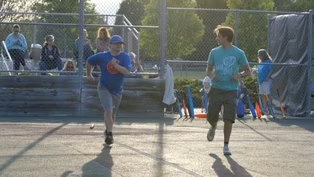
NewTRAILER | No Limits Miracle League
Video has Closed Captions
Premiere Thu 9/3/26 on WKAR-TV | Adaptive baseball's Miracle League (30s)
 New
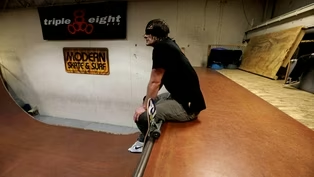
NewTRAILER | No Limits Nick Mullins
Video has Closed Captions
Premiere Thu 9/3/26 on WKAR-TV | Skateboarder Nick Mullins (30s)
Providing Support for PBS.org
Learn Moreabout PBS online sponsorship New Episode
- News and Public Affairs

Top journalists deliver compelling original analysis of the hour's headlines.
 New Episode
- News and Public Affairs

Today's top journalists discuss Washington's current political events and public affairs.
 New Episode
 New Episode
 New Episode
 New Episode
 New Episode


 New Episode
 New Episode
 New Episode
Support for PBS provided by:
Beyond the Score with Al Martin is a local public television program presented by WKAR
Support for Beyond the Score with Al Martin is provided by Capital Insurance Services.