
Raj Kumar on "The Business of Changing the World"
Clip: 5/16/2019 | 15m 36sVideo has Closed Captions
Raj Kumar discusses the Trump administration’s immigration plans .
Hari Sreenivasan sits down with Raj Kumar, author of “The Business of Changing the World,” to discuss the Trump administration’s immigration plans and the humanitarian crisis developing on the United States’ southern border.
Problems playing video? | Closed Captioning Feedback
Problems playing video? | Closed Captioning Feedback
Raj Kumar on "The Business of Changing the World"
Clip: 5/16/2019 | 15m 36sVideo has Closed Captions
Hari Sreenivasan sits down with Raj Kumar, author of “The Business of Changing the World,” to discuss the Trump administration’s immigration plans and the humanitarian crisis developing on the United States’ southern border.
Problems playing video? | Closed Captioning Feedback
How to Watch Amanpour and Company
Amanpour and Company is available to stream on pbs.org and the free PBS App, available on iPhone, Apple TV, Android TV, Android smartphones, Amazon Fire TV, Amazon Fire Tablet, Roku, Samsung Smart TV, and Vizio.
Watch Amanpour and Company on PBS
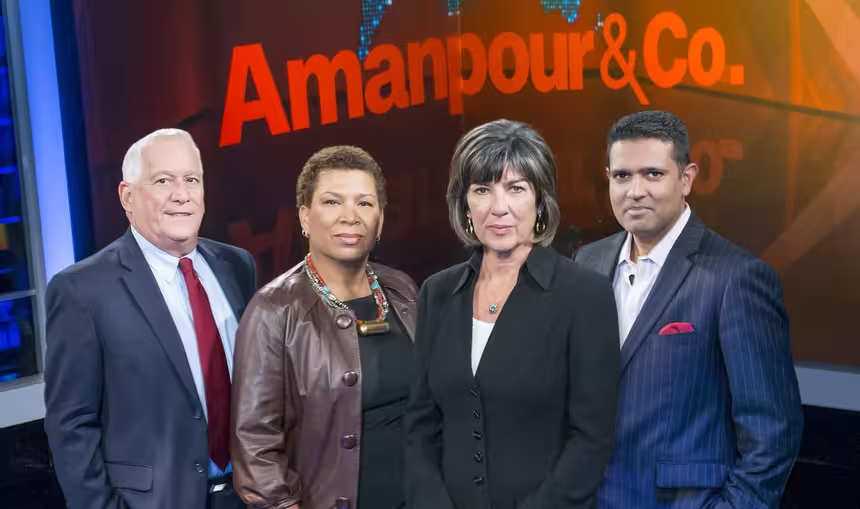
PBS and WNET, in collaboration with CNN, launched Amanpour and Company in September 2018. The series features wide-ranging, in-depth conversations with global thought leaders and cultural influencers on issues impacting the world each day, from politics, business, technology and arts, to science and sports.Providing Support for PBS.org
Learn Moreabout PBS online sponsorshipPresident Trump is unveiling his new immigration plans today amid a humanitarian crisis on the southern border due to a dramatic increase in asylum seekers Trump has repeatedly threatened to cut aid to Central American countries.
Those to permit the caravans to move north.
But global development specialist Raj Kumar argues that this will drive more migrants to the border, not fewer.
He lays it out in his new book, The Business of Changing the World.
He told our Hari Sreenivasan what works and what doesn't.
In the world of foreign aid, just tell us for a perspective.
How big is foreign aid around the world?
If you add up all the money from governments, so USAID and the US defeat in the UK, you add in the World Bank, the philanthropies, it's about $200 billion a year.
So it's a pretty big industry.
Yeah, I think we often think of it as small because we really think of our local charity or local institutions, but overall it's sizable by $200 billion a year.
Just to also remind people what fraction of the US budget is going to foreign aid, it's only around 1% of our federal budget that's used for foreign aid.
So it's pretty, pretty small part of what we do as a country.
Is there a cynicism with the general population of what is working, what isn't working?
I think so.
I think there's been a long term sense among the American public that too much is spent on foreign aid or that we don't know what happens to it and some of it's wasted.
There's the late Senator Jesse Helms talked about foreign rat holes.
The money would go down.
I think most of that skepticism comes from ignorance, not from really knowing how the sector works.
When I go and travel around the world and talk to the organizations doing the work.
Mostly we're talking about really well-organized, efficient, professional groups trying their best under very tough circumstances.
Is it still something that we're using almost as statecraft?
I mean, vote this way with me on the UN and you might get a few extra bags of rice I'm going to write you a check.
It'll just be in the form of aid.
So we were doing that in the Cold War.
Yeah, we stopped doing that, by and large, after the Cold War.
We have just started again with the Trump administration.
There is now the president quite regularly talks about to the Central American countries, for example.
Vote with us or change your policies on on immigration or sending people out of your country or we will cut aid that had largely gone away in a couple of decades after the Cold War ended and has started to come back in a big way.
What's what's different then or what's wrong with the president saying, listen, we have been spending so much money in the countries in Central America and we are not seeing results.
Right.
Well, a couple of big things are wrong with it.
One is counterproductive right?
So by cutting off funding to those countries, we're very likely hurting the people themselves that we're trying to support and driving more of them to leave and try to come to our southern border.
You know, in the end, the projects, the US government funds, we're not giving money to the governments of El Salvador, Guatemala.
We're going there and funding our own projects that directly help people.
So it's really counterproductive, even if it sounds logical in a way, it's counterproductive to do that.
Second thing is, these countries are so far below us in terms of their economic situation it's not going to be corrected in a year or ten years.
It's just through normal business activity and economic growth.
The gaps are far too wide.
We're going to need to be there supporting the work of local communities, local governments.
We need to be there for generations.
Put it perspective.
Our goals on border security and building a wall in dollar terms relative to what we spend in foreign aid in those countries or really even the GDP of those countries.
I'm going to guess.
I don't know the exact figures, but it's 1020 x is what we'd spend on border security versus what we would use in these countries.
I mean, these are very small countries, low, low population numbers.
The total aid budgets, they're in the hundreds of millions of dollars.
We can and should be spending much more than that to address the root causes of the problem.
I think if you don't address problems in a lot of these countries, they will come back to bite us in economic terms or in security terms.
I mean, many of these are fragile states, and that's where extremism grows and that's where we end up with terrorism problems.
So they're a direct kind of national security arguments around an aid budget.
But there's also a basic moral and humanitarian and values based argument that I think most Americans find appealing to say, you know, we are a leading country in the world where the richest country in the world, we have an obligation to to do our very best to help the people who are in absolute worst straits.
It's 20.
19.
Very soon we might be going around in driverless cars in this country.
We have so much advanced technology.
It's incredible to think 10% of people on this earth still live in extreme poverty, less than $2 a day.
Many of them are down at $0.50 a day.
And the idea that we would simply look at that and say, well, that's someone else's issue and not ours, I think is not American in terms of the way we view our values as a country.
You also write in the book about how these kinds of decisions have kind of political costs as well, which lead to inefficiencies, you point out.
What we did, for example, to Haiti, we I mean, the intent was to help people and feed them with our bags of rice.
It was and, you know, Haiti is a country where rice is a staple crop.
People eat a lot of rice there, and most of it was grown domestically.
There are Haitian farmers growing rice.
And then when they went through some real problems, the US thought we're going to help were going to send rice grown by American farmers.
And essentially, we decimated the Haitian rice industry.
You know, when you're getting it for free, how can you afford to grow it and and build a business doing that?
And so it was good intentions, but it really failed.
And it's a good example of where the aid industry hasn't had the kind of accountability that it needs to have and that I'm calling for going forward.
One way to think about this is, well, look, there's this entire industry trying to fix problems.
Why can't we figure out ways to just solve those problems in the first place instead of them getting to a point of such inequity where we need international agencies that are trying this?
Well, most of the inequities we're looking at in the world today at the global level started in the colonial era.
I mean, this is this has been around for hundreds of years.
It's not a coincidence that the poorest countries in the world were mostly colonies, that the richest in the world were the colonizers or some of the more imperial economies in the world.
So these are very long term historic trends that we're that we're addressing.
And it will take a long time, maybe generations, to fully address them.
And there isn't really an opportunity in my mind to just sort of step back and let the problems fix themselves.
It would be nice to think that that, you know, revolutions will happen in the poorest countries.
When poor governments aren't addressing the needs of their people, but realistically their lives at stake today.
So we need a robust industry that gets the poorest kids fed their kids literally still in this you know 2019 that are just not getting basic food or very basic medicine.
We can address it.
We ought to you lay out in the book how one of the big changes here is that there's a decentralization of power.
Then it's not necessarily just those 56 agencies around the world that are doing all of this.
But there are new forces at play.
There are lot Gates Foundation is a great example.
Right.
So they came on the scene in a huge way.
They're now funding a five $6 billion a year, which puts them at the level of countries, you know, in terms of the country's foreign aid budgets.
And so they're coming in and saying, we care about evidence, we care about data.
They're funding organizations that gather evidence about what's happening in health, for example, in agriculture.
And that starts to move the whole industry in a certain direction, because it's a lot harder to justify your foreign aid budget if there's organizations out there showing what you can get with the dollar and your foreign aid agency maybe isn't.
So we started to have more competition in the space.
Gates is just one example.
There are many, many behind them.
And other countries are getting into space in a big way.
Countries like China is now a major foreign aid donor.
So this competition around what do we do with the aid budget is actually driving some innovation and a better focus on what we ought to do and what the results ought to be from every dollar we spend.
Are we relying too much on billionaires to solve these problems?
Well, it would be great to not have to rely on billionaires to say, set the agenda in our sector.
I'm thinking we can rely on their money.
I think we're there is danger in relying on billionaires is if they're setting the agenda around philanthropy or setting the agenda around what we ought to fund that doesn't have to be the case.
It can be science.
It can be very basic evidence around what works.
That sets the agenda for our industry.
And as I said, the UN has a set of goals that have been agreed to by 193 countries.
There's 17 of them.
So it's actually quite an array of issues around health and education and environment.
So my argument to anyone who's new to the scene of philanthropy is look at that roadmap and you can still pick the area you want to focus on, but do it within a framework that is globally accepted.
That 193 countries have signed up to that.
Just about every NGO and nonprofit and institution in the world is working with do it within that framework.
There's lots of room for innovation, but let's align our efforts in that way.
$200 billion is a lot of money and it is enormous.
But is there a possibility here that the billionaire class could end up becoming bigger than that when it comes to giving?
Because not all of them are in this space.
I mean, you point out the Gateses and a few other ones that are, but most billionaires are not planning on giving everything away.
That's right.
Yeah.
Only about 10% of the billionaires in the world have signed the giving pledge, which is this pledge.
Warren Buffett and Bill Gates came up with.
Now, others might be giving outside of that, but it's hard to give large sums anonymously without people noticing.
So most billionaires, probably 90% or so, are really not significant donors at any level.
I would hope that all of them will move into the space.
They hold about $10 trillion in wealth.
So there's enormous potential if that money gets dedicated to the highest priority issues.
If it's spent in transparent ways, we can scrutinize as a public and if it actually goes to things that we know work.
So I think there's huge potential, but we need rules for the road It might even require legislation.
We might even need to have given you the sums of money going into philanthropy.
A new a new legislative approach to transparency, for example.
You also mentioned that aid is shifting from kind of a wholesale model to a retail model, partly because of this.
Explain.
What does that mean?
You know, for a long time, we would cook up good ideas in places like Washington, D.C. and Brussels and London, and we would think about serving whole populations.
So we're going to launch a big project to feed kids in school or a big project around delivering medicines And part of the rationale was, well, we can't actually go and talk to the people effect as to many of them are to spread out their disconnected.
That is no longer really an excuse.
You know, you can go to almost any country in the world now, any place, even pretty rural places, and find there's Internet connections.
People have cell phones, often smartphones.
Increasingly, people are connected to mobile money systems.
So it's a lot easier to just get directly to the person you're trying to help.
And increasingly, projects are doing that.
Now, there are examples like the Uber for tractors.
Hello Tractor in Nigeria.
How does that work?
We're basically they said, you know, the tractor was invented over 200 years ago.
And yet most small scale farmers don't have access to one, so they can't afford their own.
But if you can share your tractor among many farmers, it can work.
So this is a simple technology.
It works very much like Uber.
You own a tractor, you share it.
Other farmers pay you for access to it, and they're now 75% of the new tractors coming into Nigeria use this help tractor sharing technology.
They're in five countries across the continent of Africa.
It's a great opportunity where you say, who's the key to solving rural poverty?
It's the farmer.
It's not the aid agency.
It's not the nonprofit executive.
It's the farmer.
And increasingly, retail aid is about going to the people who are going to really solve the problem, which is poor people themselves, figuring out what they need and helping them with it.
What about ideas like crowdfunding or I mean, I remember my sort of holiday donations sometimes would go to micro-lending through Kiva or through other startups that were trying to get money more quickly.
To the people who actually needed it and could benefit from it instead of going through a giant charity and then having their decision process hopefully get to that person.
Yeah, there's a lot of that.
So Kiva has grown over $1,000,000,000 in loans have been made through the Keeper platform with individuals often just $25 a time.
Making those kind of donations or donors choose here in the United States, owners choose certain.
That's right.
And now there's a group called GiveDirectly where you can literally provide cash to a person who needs it, who's living in extreme poverty.
The way they do it is they use satellite imagery to look at rural communities in Kenya and Tanzania and Uganda and other places like that.
And they say, which of these households doesn't even have the money to afford a tin roof and instead has a thatched roof they use that as a sign that they're likely very poor and they directly send them about $1,000 to their cell phone.
And they study exactly what that does, that thousand dollars and how it lifts up their family.
It gives them opportunities for new employment.
And they've found ways now.
And these are increasingly kind of a competitive market for your donation around the holiday time to say where can I give I can give to traditional charities I work with for a long time, who themselves are getting more innovative, more rigorous.
I can give to loan through loans like Kiva platform.
I can give directly to the poorest people in the world through GiveDirectly.
So there's a lot of new opportunities in this competition for our dollars, for dollars in wealthy countries, for ordinary givers.
I think is really healthy.
There's also seems to be social enterprises and corporations starting to shift a little bit and thinking about not just the triple bottom line, but saying, hey, this is going to be part of my mission.
Yeah.
And I think the big opportunity isn't necessarily the small social enterprise or small social enterprise.
It's the big corporations.
And increasingly their employees, their consumers, their investors are saying, you know, you might be a big corporate billions of dollars.
We expect you to have a social mission in addition to your business mission.
And that's hard.
But increasingly, that's where business could head if we push it.
And then there's big opportunities.
And we saw the walkouts at Google over discrimination thousands of employees walking out.
Right.
Employees have a lot of power and consumers have a lot of power.
If we use it, we might be able to shape business so that social entrepreneurship is kind of the standard approach to doing business, which is critical.
I think if we want to have any shot of achieving these sustainable development goals, addressing climate change, it can't just be there are some do gooders over on the side.
And then the main thrust of what we do in the world is contributing to pollution or inequality.
It kind of all has to work together.
For decades, there's also been this perception, Oh, here comes the America and here comes the Europeans to solve all our problems.
They're just going to wave a lot of money around.
How do we keep that from perpetuating?
It's getting better.
It's still an issue, but it's getting better.
Increasingly, organizations are saying, you know, we'll actually fund a local group instead of bringing in a US or European group to do this work.
Many of the big international organizations themselves are becoming more locally oriented.
They're hiring people in these countries, are setting up offices locally.
So it's starting to really improve.
There's a lot further to go on this a lot further.
If local communities, local experts, local businesses are part of the solution, you're much more likely to actually solve the problem.
So it's not just a question of representation.
So how do individual users, I guess not users, but just citizens, normal people impact such there's this enormous $200 billion global aid industry.
I think one way is to just get educated about it.
Like this is our industry as citizens.
We're paying for it through your tax dollars.
You're paying for it through the donations that you make.
You know, pay attention to it and learn about it and start asking tougher questions even of the organizations that you may have known for many years and trust.
Find out what they're doing with that money that you're donating.
And I think also as a taxpayer, push our government to actually take some more risks, to be a little more innovative, not to say, you know what, we just better be careful.
Not a dime of taxpayer money gets stolen.
And to do that, we might have to spend huge amounts on bureaucracy.
Let's get out of that risk game and get more into results and get more into impact.
I think we as citizens can push that if we change the way we think of this industry.
I think for too long the aid industry has been seen as owned by someone else.
It's owned by the nonprofits or it's owned by aid workers or it's owned by certain agencies.
At the U.N..
This is our industry.
This is the public's.
Rajkumar, thanks so much for joining us.
Thank you for having me.

- News and Public Affairs

Top journalists deliver compelling original analysis of the hour's headlines.

- News and Public Affairs

FRONTLINE is investigative journalism that questions, explains and changes our world.












Support for PBS provided by: