
Sept. 16, 2026 - Full Show
9/16/2026 | 26m 48sVideo has Closed Captions
Watch the Sept. 16, 2026, full episode of "Chicago Tonight."
Pushback on a plan for a new Amtrak facility. And how a new generation of Latino parents is keeping a part of their culture alive.
Problems playing video? | Closed Captioning Feedback
Problems playing video? | Closed Captioning Feedback
Chicago Tonight is a local public television program presented by WTTW
WTTW video streaming support provided by members and sponsors.
Sept. 16, 2026 - Full Show
9/16/2026 | 26m 48sVideo has Closed Captions
Pushback on a plan for a new Amtrak facility. And how a new generation of Latino parents is keeping a part of their culture alive.
Problems playing video? | Closed Captioning Feedback
Where to Watch Chicago Tonight
Chicago Tonight is available to stream on pbs.org and the PBS app.

WTTW News Explains
In this Emmy Award-winning series, WTTW News tackles your questions — big and small — about life in the Chicago area. Our video animations guide you through local government, city history, public utilities and everything in between.Providing Support for PBS.org
Learn Moreabout PBS online sponsorship>> Hello and thanks for joining us on Chicago tonight.
I'm Brandis Friedman.
Here's what we're looking at.
Our community feels pretty disrespected right now.
Residents push back on a plan that would bring a new Amtrak maintenance facility to Bridgeport.
>> A lot more of the grandchildren and generations call it that.
they are starting to reclaim this idea of their Spanish.
>> And the Spanish language is fading across generations of Americans.
How a generation of Latino parents are fighting to keep it alive.
First off tonight.
>> If you're getting a loan for a new home or car or working to pay down your credit card balance, it is likely going to start costing you more.
That's because the U.S.
Federal Reserve voted today to raise interest rates by a quarter point from 3.7, 5% to 4.
It's the first rate hike in 3 years and is being done in an effort to target inflation.
The hope is by raising rates.
It will reduce consumer spending and help prevent costs from rising further.
But critics say the move will slow economic growth.
The board's move was unanimous, including new Fed chair Kevin Warsh, who was selected by President Donald Trump, who himself has been vocal about wanting to see rates lowered in you.
Victims and witnesses who are participating in a Cook County criminal case may be able to receive protection from the Cook County State's Attorney's office.
The office is launching a new victim witness relocation program with a nearly $250,000 grant to help with short term or permanent relocation and safety planning.
States attorney Eileen O'Neill.
Burke says the program will be especially helpful for victims of domestic violence who may face financial or physical barriers to leaving an abusive situation.
Her office estimates more than 200 victims could have benefited from relocation assistance last year.
Had it been available?
Chicagoans who rent their homes could be getting new protections under revised ordinance that passed a city council committee today.
>> Having a rental registry allows us to know what those land will have them accountable to making they Expanding tennis twice the rest inland.
Looks at high school in 40 years ago.
Getting rid junk fees allows us to be able to get the up like this.
We want to have as they and go.
>> Advocates and renters express.
Their support for Mayor Brandon Johnson's proposed rental ordinance outside City Hall today.
Inside older people passed a revised version of it after a 3 hour meeting of the Housing Committee.
If it passes the full City Council next week, it will be the first rewrite of the law in 40 years.
But it faces competition.
Zoning Committee is set to hear a rival proposal backed by landlord groups tomorrow.
Youth development organization, a better Chicago just got a 1 million dollar boost in funding from Google to support their effort to reduce chronic absenteeism being chronically absent means missing 10% or more of the school year and over 40% of Chicago public school students during the 2024.
25 school year met that definition.
They say the answer isn't as easy as telling kids to show up.
>> The reason student Miss School are complicated and sometimes it's transportation, sometimes circumstances with their families.
Mental health challenges are other challenges that just make it difficult for young person to feel connected.
There isn't one solution to this problem, which is why every day counts brings together schools, community organizations and funders to test different approaches and learn what actually works.
neither they say the new funding will be invested into advancing innovative community-driven solutions while strengthening ways to use strengthening ways used to evaluate and scales successful approaches.
>> Up next, locals react to a plan to move the South loops.
Amtrak rail yard to Bridgeport right after this.
>> Chicago tonight is made possible in part by the Alexander and John Nichols family.
The Pope Brothers Foundation.
And the support of these donors.
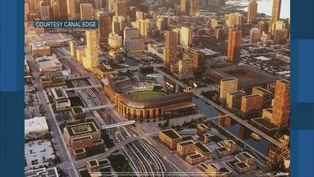
>> Residents are pushing back on plans for a 24 07:00AM track maintenance facility on the South side, the 900 million dollar development would move the railyard from the South Loop to Bridgeport, causing confusion over what this means for residents and the future home of the Chicago White Sox.
Amtrak says a change in location is necessary, but some community members are working to derail these plans.
Joining us to talk more about this are Maria Ludeke Leo co-founder of the Armor Bridgeport residents, coalition Alderwoman coli of the 11th Ward, which includes neighborhoods like Chinatown, Bridgeport and Armor Square.
Joseph chauffeur, professor emeritus of civil and environmental engineering at Northwestern University and Tyler Jones, director of planning and development for South Loop Neighbors, a community organization that works to enhance the quality of life for residents of Chicago's South Loop.
We also invited representatives from Amtrak and Chicago White Sox, but both organizations declined.
Thanks to the 4 of you for joining us.
Professor Chauffeur.
Let's start with you.
What exactly is this maintenance facility?
What to do?
>> maintains rolling stock for for Amtrak locomotives and cars.
So locomotives need routine maintenance on a daily basis that that's going to go on probably 24, 7 because the trains run.
24 7 and also maintenance for the cards.
And apparently what they want to do is have and indoor facilities so they can work all kinds of weather that will make sense.
The need is their location is another matter.
Give us a sense of the importance of that particular location in Chicago's Chicago, Chicago ransacked the hunt the nation railroad service.
Passenger services as what was right for a primary.
Amtrak is we in all fairness, a small player in the national passenger Travel network.
But it's important and it's especially important for people in rural areas.
A lot of passengers live there.
Those people with without car.
So important service heavily subsidized by the federal government.
Useful question because is it really worth it?
I think that's a subject for another show.
>> Subject another show.
We'll have you all back for that one Tyler, current maintenance yard has existed Southwick for over 50 years.
Its been cited for several complaints over pollution and fires.
What has the impact of this facility been on the South Loop?
Yeah.
The impact on the South loop Fortunately it's on the other side of the river where there's a lot more retail and things like that.
So most of south the residents don't see the impact of it.
>> I think the impact we do see is on what isn't there.
important.
Real estate right on the river, very close to downtown.
I think south of prisons as a whole would like to see, you know, that obviously the 78 but also the other side of the river developed into more housing, more neighbors and more uses that benefit.
The overall city.
>> So according to the company's website of quote, Amtrak says Amtrak's Current Yard 14th Street is undersized and fragmented and the site cannot accommodate today's equipment.
The Canal Street yard has hosted railroad operations for more than a century and meets those requirements and building their allows Amtrak to keep running service throughout construction instead of working around active trains for years.
Maria, what is your response to that?
>> Well, I'm a resident who lives about 120 feet away from where they want to put this proposed facility.
And I'm also a life long Bridge Park resident.
And and as long as I've been alive, that has been freight operations winding down and then trains passing through.
So.
What Amtrak is pointing to is like a freight era gone by.
And so I don't really think those are comparable statistics.
What the neighborhood experience from this is a big industrial maintenance facility smack dab in the middle Bridgeport, Armory Square and Chinatown.
Feet from Homes and Texas, 120 feet.
But I'm not sure where they're getting that number.
Some of these houses back windows and doors literally touch the train tracks.
So we'll be feet from about 6,000 homes and the impact will be felt by all of us.
Not only just the pollution and environmental impacts, but just what that looks like in the middle of our community.
The central part of community dividing us in half.
>> Describe the community for man and the proposed site.
Obviously lots of houses who's there.
>> So Bridgeport and Chinatown or both communities and it within the city of Chicago that go back generations.
We have a lot of new residents as well, but really like me in particular, I my family back 5 generations.
And I have my 9 year-old daughter who is 6 generation.
So we stay.
We moved 3 minutes away.
5 minutes away.
But we stay around that community and we look out for each other and we are all aligned and this this is this would not only impact like the air we breathe, but also I the way we interact with our historic park.
That's 400 feet away from this proposed facility or the way we interact with each other.
It would run from 23rd to 39th Street that runs the whole span of.
3 neighborhoods.
So this would really just be this big industrial blight in the middle of a highly dense residential community and liked at Tyler said the south of presidents now don't really experience negative effects from it because according to Census data, there's only 26 residents who live within 500 feet of that versus the 6700 in our area who live within 500 feet of that facility.
And we're looking at right now is Amtrak's sort of rendition of what this would look like that what's currently in existence and what they're what they're proposing.
Let's talk about the air.
You breathe.
>> Alderwoman lead the Federal Railroad Administration determined that the project qualify for a categorical exclusion, meaning it did not undergo an environmental assessment.
What are your environmental concerns?
I have a million actually brandis.
This again moving from and a highly industrial area to a very densely populated residential area.
We do not know what the Aaron Packs are going to be.
We don't know what the noise and the lights are going to be like.
The comparisons that we've seen Amtrak has compared the what the future conditions would be to what the prior conditions were completely negating.
The fact that we have since at least 2019 been enjoying relative silence coming from this yard.
We we don't want to see this come to our community.
So that's really interesting observation that the before and after.
>> Are not really before and after her before and after.
And that's really the reason for the categorical exclusion.
That is the didn't change.
But the functionality did change.
And so the neighbors got used to one environment and that's going to go back to what it was.
Well, before I would argue that it's going far beyond what it was before trains came through.
Fleck cars were loaded.
I used to work for a railroad in intermodal.
>> And what this is going to be is a is a major industrial development.
They're servicing trains, which includes refueling huge refueling tank.
Probably.
We still haven't seen where that's going to go.
They're going to be servicing toilets on these trains as well as well as the commissary.
So we know for based people who have retired from working at that rail facility that it it is not a place where people want to live next to Tyler.
What could moving this facility mean for the South Loop?
>> Yes, I kind of touched on this before.
So South loop and specifically this and the Anderson 78 parcel.
They are very close to downtown.
They're very close to other dense uses.
They're really high value parcels.
When you look at what could be, I think from looking at what benefits the South loop, but also the entire city.
You have to consider the highest and best use of land and, you know, I'm not saying that the should move into Bridgeport, but I'm saying that that land just in a vacuum being built up benefits the overall city by providing property tax revenue and it benefits the South Loop area by providing more neighbors, restaurants, obviously having the White Sox potentially and the Chicago fire nearby benefits, everyone.
But I it just lift everyone up by by building more housing and other other amenities.
If I may brand of one of the pieces of legislation that's before the Senate currently the McDonald Amendment.
It's already past Congresses sitting before the Senate today.
>> Would allow for any P 3.
So public-private partnership with Amtrak those projects would be exempt from local property taxes, local zoning rules and local environmental rules.
That would mean that whatever the taxes that are currently being paid, that's all the taxes that they So any future development in a higher value would essentially robbing the state and the county and the city of any additional property taxes.
That's an interesting point.
But also to, you know, to your point, Tyler, you know, in-house, the South Loop would benefit from it being gone and other opportunities being brought to that neighborhood.
Is there?
>> A conversation or a question to ask, hear about, you know, who's neighborhood does this going right?
Like it's okay for one neighborhood but not for the other Go to you first.
Yeah.
Let me be clear.
One of the more per development alderman on the city council voted for every major mega development that's been put before the council.
My service.
>> We're not saying that the should move into someone else's community were saying that this does not belong there.
Any residential.
As Maria said earlier, we know that within 500 feet of the current yard are 26 residents within 500 feet of the canal yard.
We have 6,741 residents.
That's 1000 children, 1300 seniors where the median income within 500 feet a $63,000.
That's about 140,000 where the yard is currently.
Professor show for what do we know about the impacts of quality of life for surrounding communities when transportation facilities like this what we know is that transportation.
>> Contribute substantially to the quality of life.
In terms of, you know, look at this group of people who we all thought traffic to get here.
But we were able to get here.
able to achieve a lot of objectives that we have a daily basis.
However, there no transportation system that doesn't also produce negative externalities.
The easy way to make decisions.
If you're managing a transportation system, whether it's a public one or a private one is to say I'm concentrating on maximizing my operating revenue or might my profit and the externalities are not my problem the fact.
In fact, they are their problem.
And the challenge that we all have in a situation like this just to get move those extra.
Now he's inside decision process and to give them the kind of priority that they take.
So what are you've already made them?
they don't have to name moving again, but they're very substantial.
And that's true for any any real work facility.
just would like to pitch one other question.
And that is.
Falling to relocate Does it have to be in this location?
Maria, since the initial announcement last month, communities in Bridgeport, Chinatown are risk where you will of rallied against this move.
House Amtrak responded.
>> Amtrak has banned largely doing no community interaction.
We had one meeting with them on August.
20th for the present head a slide deck to us.
And they told us about the categorical exclusion.
And since then, any questions to them have been answered by saying that a maintenance project plan website was coming.
That website was set up last week and it has have an ongoing continuously updated FAQ.
But even the community meetings, there's one scheduled for this Thursday.
It was supposed to be in Chinatown, which is a big part of the 11 Ford and one of the communities that will be most majorly affected and they moved at the last minute to a union outside of our ward.
And they also have been really kind of not communicative about if I registration was received or not until today we finally received that we registered.
But the e-mail to register over a week ago and they're now saying that we can't bring signs, banners anything inside and we have to submit questions through some way that they tell us about today like some e-mail system, so check has not really been.
I think I would cut more community notification that this project is happening versus community input.
>> Other woman lead.
There are rumors that this move is tied to the Chicago White Sox potentially leaving a guaranteed rate Field after their contract expires in 2029.
The Sox have said that they are completely unaware of any such plans, although this development is partially funded by a minority owner.
Justin Ishbia, do you think these plans are tied together?
I think like everybody else looks like a duck and it quacks like to talk it is a clear that the 2 are tied together.
You know, Amtrak's on documents, the you know, we've we've read, you know, this is the first domino to fall.
moving the railyard to to the canal yard in order to make way for the 14th Street are to be turned into a mega development where Justin Ishbia, who's a minority owner of the White Sox, would like to see a new stadium Now, currently the White Sox are controlled by current owner Jerry Reinsdorf.
And that has not been the context of the conversation that I've had with the White Sox and Mr.
Reinsdorf so that is a future vision that I believe he's trying to build from.
What I've read reported in cranes that this after they do their due diligence, it's just ironic that they're doing due diligence on this and not in the rail yard that this could potentially be an option for the White Sox tickets consider for a future home.
What would happen to right field in the communities around it.
If the White Sox left rents weird staring down the barrel of a of double got punch here.
If the rail maintenance facility is built, this infrastructure is going to be built 4, not 5 or 10 years.
This is going to be built for another 7200 years.
And if the White Sox do leave and there's not a plan for what happens on that property, 80 plus acres, we're going to be left with with the with the vacancy with the empty stadium empty.
Lots and not a whole lot of motivation for people to develop around.
24 hour maintenance facility, Tyler residents in the South Loop are concerned that there's not enough infrastructure to deal with increased traffic that if a development like this and other developments that we know are already in the works for South loop.
>> prepared for more big changes.
>> Yes, wanted to make one coming about what older Alderwoman Lee said.
And that's that that does need to be a plan.
I think no matter what happens, there should be, you know, a formal study of the land either with the White Sox without the White Sox with or without the Amtrak yard.
All these options need for most addicts.
There's a lot of parking lots there.
There's a lot of land there and to just do something without really planning for the future and what could be it's kind of a disservice to the residence.
Such want to make that out there.
And then to left your question about about the infrastructure.
So when the Chicago fire were were coming and made their plans to move the 78, there was a traffic study that was done that basically said that we maximize the thorough put of Roosevelt, other streets with the Chicago fire and putting a larger state in there with then theoretically exceed that.
So we need other other alternatives traditional conversation that the professor chauffeur mentioned earlier.
We're going to have to have back to that.
Sorry to cut you off.
Thanks to all 4 of you, Maria, Leo Tyler Jones, Nicole and Joseph Chauffeur.
Thanks, everyone.
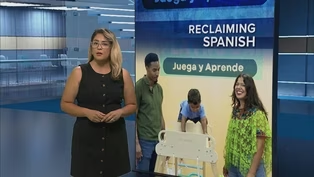
>> Thank Up next, our Joint Hernandez shares how a new generation of American Latinos are preserving the Spanish language.
>> Nearly 30% of Chicagoans are Hispanic or Latino.
But as the city's Latino population grows passing down the language from one generation to the next can take work nationally and analysis from Pew research shows Latinos who speak Spanish at home has fallen from 78% in 2000 to 68% in 2024, that decline has been especially noticeable among U.S.
born Latinos as English becomes more dominant across generations.
But now a new generation of Latino parents are finding ways to keep Spanish a life.
For an team of sand.
Right.
And her husband, Jeremy, raising her 2 boys and Spanish.
>> Was an intentional choice.
I want children to be able to communicate with my family in Mexico and like wherever else they are.
I that was extremely important or or not.
>> And selfish.
They also didn't want to be like that stereotype of an American family that has an Au sable kid.
And, you know, everyone talks crowd.
>> Jeremy was raised in Mississippi in didn't grow up speaking Spanish.
It was very challenging, especially when Sebastien of the first on the younger.
>> I first started with readings have every night and Spanish.
And so I would keep myself and words here.
And there.
>> Out, but keeping Spanish alive from one generation to the next can be challenging in general.
Yes, we do see that immigrants com, for example, you know, and they're modeling well in Spanish.
Their children are, you know, typically bilingual in English and Spanish.
The English is typically stronger.
And then the grandchildren.
Sometimes they speak.
It sometimes don't understand.
It sometimes is nothing.
So that sense, yes, there's a your camp.
A Taos ski is a Spanish studies professor at the University of Illinois.
Her research looks at how Spanish changes across generations and what helps families pass it on.
And that's what it boils down to both that linguists call it in.
Put input is language that is directed to the person who's learning, you know, you need input, love at 50 year.
>> a coffee shop in back of the Yards.
A group of parents gather for bilingual story time.
I think myself growing up only speaking Spanish, like I then learned English at a later time.
>> I just did not want her to lose our No matter is bilingual.
While her husband only speaks English, it's lot.
We have an effort to do both.
Yes, because you have to constantly switch back and forth.
If you're seen Apple Month and I would have been an of life everything is.
>> You say it twice and help with being a mom the tracking food taking care of her breastfeeding fleet deprived everything.
But it's so ISIS that, but it won't do so.
>> for a new generation of Latino parents passing down Spanish is a way to embrace both their American and Latino identities grantees to be seeing now is a lot more of the grandchildren generation.
Let's call it that they are starting to reclaim this idea of their Spanish.
Right.
And they're starting to 2 demand.
I think more space for a Latino identity that includes bilingualism.
For Angie, creating that kind of space is part of that effort.
She opened la Casa playroom so children could play and be around Spanish.
What I've been hearing from moms that come here, they take open so they feel uncomfortable, teaching them their children Spanish because they don't want to teach them the wrong Spanish and the fear of not speaking Spanish fluently is part of a larger conversation too.
The term know Sable is used negatively to describe Latinos don't speak Spanish.
>> We need to stop that bullying that happens.
We call people know sable kids.
And we say that they speak Spanglish we >> we've got a knock that off.
That doesn't help anybody.
But we need to do is encourage people to grow their standards.
But for Angie, Teach your kids, Spanish also presents challenges.
I get a lot of dirty looks, especially in white neighborhoods.
When I'm speaking to my child in Spanish, even had this white gentleman come up to me and to ask spoke English.
>> I told inspections which is how many do you He spoke one.
>> And for parents learning along the way, Jeremy says there's no perfect time to start.
You know, I started when I was 26 as it is never too get to learn as my kids learn, which is pretty And as these parents are showing, you don't have to speak.
Perfect is spying on to pass it on.
Brian does.
Freeman is back to wrap things up right after this.
>> Reflecting the people perspectives that make up This story is part of Chicago tonight.
Not the >> And that's our show for this Wednesday night.
Join us tomorrow night at 5, 30 10.
Now for all of us here at Chicago tonight, I'm Brandis Friedman, thank you for watching.
Stay healthy and safe and have a good night.
>> Closed captioning is made possible by Robert a cliff and Clifford law offices, Chicago, personal injury and wrongful death that supports
 New
NewBridgeport Residents Push Back on Plan for New Amtrak Facility
Video has Closed Captions
The $900 million project would create a 24/7 maintenance facility in Bridgeport. (15m 29s)
 New
NewHow These Latino Parents Are Working to Keep Part of Their Culture Alive
Video has Closed Captions
As the Latino population grows, keeping the Spanish language alive takes effort. (5m 2s)
Providing Support for PBS.org
Learn Moreabout PBS online sponsorship New Episode
- News and Public Affairs

Top journalists deliver compelling original analysis of the hour's headlines.
 New Episode
- News and Public Affairs

Today's top journalists discuss Washington's current political events and public affairs.
 New Episode
 New Episode
 New Episode
 New Episode
 New Episode
 New Episode
 New Episode

Support for PBS provided by:
Chicago Tonight is a local public television program presented by WTTW
WTTW video streaming support provided by members and sponsors.