

September 11, 2026
9/11/2026 | 55m 19sVideo has Closed Captions
Steve Coll; Vali Nasr; Paul Greengrass; Janet Reitman
On the 25th anniversary of September 11, journalist Steve Coll and professor Vali Nasr remember the attacks and discuss how they shaped the world order in the years since. Paul Greengrass reflects on his documentary about the heroes aboard United Flight 93 and discusses his new film "The Uprising." Journalist and author Janet Reitman on how the attacks and subsequent fear reshaped America.
Problems playing video? | Closed Captioning Feedback
Problems playing video? | Closed Captioning Feedback
September 11, 2026
9/11/2026 | 55m 19sVideo has Closed Captions
On the 25th anniversary of September 11, journalist Steve Coll and professor Vali Nasr remember the attacks and discuss how they shaped the world order in the years since. Paul Greengrass reflects on his documentary about the heroes aboard United Flight 93 and discusses his new film "The Uprising." Journalist and author Janet Reitman on how the attacks and subsequent fear reshaped America.
Problems playing video? | Closed Captioning Feedback
Where to Watch Amanpour and Company
Amanpour and Company is available to stream on pbs.org and the PBS app.
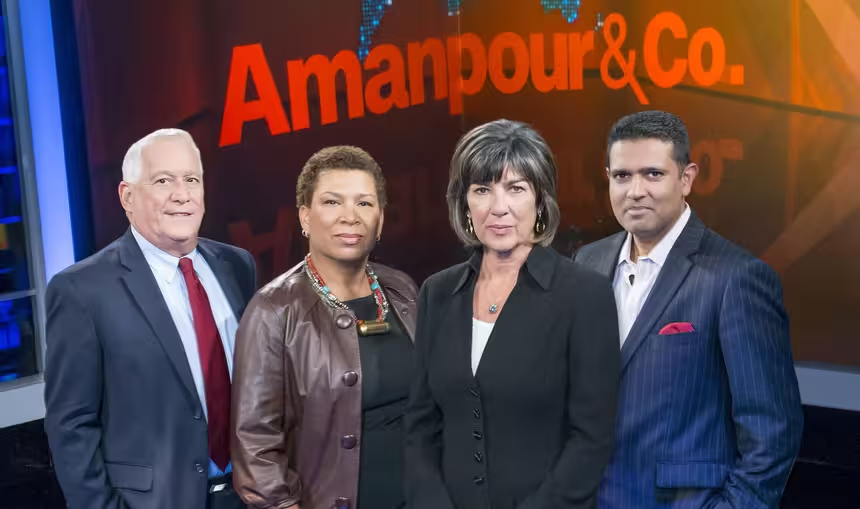
Watch Amanpour and Company on PBS
PBS and WNET, in collaboration with CNN, launched Amanpour and Company in September 2018. The series features wide-ranging, in-depth conversations with global thought leaders and cultural influencers on issues impacting the world each day, from politics, business, technology and arts, to science and sports.Providing Support for PBS.org
Learn Moreabout PBS online sponsorshipHello everyone and welcome to Amanpour and Company.
Here's what's coming up.
When the second plane went in, it finally occurred to me, "Oh, this is Al-Qaeda."
This is not something that just happened in New York, but actually everybody around the country felt it.
A day that lives in infamy, 9/11 and the 25 years since a world order reshaped.
Reflections on that terrible event and the wars that followed.
Then... - Those people on that airplane met the moment and that inspires me and gives me hope in our difficult times that we still can.
- The heroes of United 93 on 9/11, forever immortalized by film.
Legendary director, Paul Greengrass reflects and discusses his new film, The Uprising, and... The war on terror is a war on fear.
It's not a war on anything.
There is no nation of terror.
There is no ideology even of terror.
It's a feeling.
Fear begets extremism.
The lives forever changed by the war on terror and what America and the world inherited from the tragic events of September 11th.
Amanpour & Company is made possible by The Anderson Family Endowment, Jim Atwood & Leslie Williams, Candace King Weir, The Sylvia A.
& Simon B. Poita Programming Endowment to Fight Anti-Semitism, The Strauss Family Foundation, The Peter G. Peterson & Joan Gantz Cooney Fund, Charles Rosenblum, Monique Schoen Warshaw, Ku & Patricia Ewan, Committed to Bridging Cultural Differences in Our Communities, Barbara Hope Zuckerberg, and by contributions to your PBS station from viewers like you.
Thank you.
Welcome to the program, everyone.
I'm Christiane Amanpour in London.
Twenty-five years ago today, the world was utterly changed.
The September 11th attacks were an assault, not just on the United States, but on the very psyche of the free world.
The deaths of almost 3,000 innocent people, men, women and children from around the world, seared in the memories of millions far beyond the American homeland.
And in the quarter century since, hundreds of thousands more have lost their lives by the decisions of leaders in response to those evil acts.
Those not even born on 9/11 have felt its impact deeply.
America's NATO allies united then to defend one of its own.
Wars were waged, lies were told, autocracies and theocracies fell and then rose again.
History was rewritten.
To reflect on that extraordinary day and the earthquake of the events that followed, and to join the dots to where we are today, I'm joined by journalist and author Steve Cole, renowned for his investigative work on the roots of the attacks and the post-9/11 wars, and by Vali Nasser, well-known to this program and around the world for being an academic and former State Department advisor specializing in analyzing the Middle East.
Vali Nasser and Steve Cole, welcome to the program.
I want to just start by getting each one of you to reflect and react to what you remember from that day itself.
Vali in Paris, where were you and what do you remember?
I was actually in Tucson, Arizona at a conference and early morning I had gone jogging back at the hotel.
I turned on the television and I saw pictures of the airplane going into the second tower.
And then I was stuck there for two days trying to make sense of it and also trying to get back home since all flights were cancelled.
Where did you see what had happened, Steve, and what immediately went through your mind?
Well, I was the managing editor of the Washington Post at the time, and I was at home just outside of Washington, doing some work in my home office.
And I had CNN on mute because I had news responsibilities.
I saw the first plane go in, and I thought, "Oh my goodness, this is going to be a busy news day."
Went and got my stuff, and I saw the second plane go in.
And by an accident of professional assignment, I had been in Afghanistan and covering al-Qaeda during the '90s.
And so when the second plane went in, it finally occurred to me, "Oh, this is al-Qaeda."
And then I drove into Washington, and the next six weeks were pretty much a blur of news gathering, as I'm sure it was for you.
Vali, at what point, because Steve knew pretty quickly that this was Osama bin Laden and al-Qaeda, what did you think it was in those first hours and couple of days?
We didn't have any confirmation about who exactly it was, but I also thought that it was al-Qaeda, largely because we had had the attack in Africa, and also I had been working on Pakistan, and I knew essentially that it was part of the entire sort of groups that were around Al-Qaeda, supported it, that they had their sights set on the United States, and that ultimately, I remember even about six months before, I had been in Islamabad and at a gathering I saw a poster which I bought and brought back with me, which was of a camp in Afghanistan and on the hill behind a fighter with his face covered it had written in stone, "America, we are coming."
So there was no other candidate right at that point in time that would have carried out something like this other than Al-Qaeda.
Wow, that is a dramatic thing to remember that inscription.
And obviously Steve, this was the first attack on the American homeland since Pearl Harbor and it fundamentally obviously terrified the nation but changed the nation's psyche.
Do you agree?
I mean did it have that dramatic an impact that kind of the DNA flipped that day and in the intervening weeks and months and years?
Well yes I think it unfolded in stages as you say the initial feeling in the country and especially in New York and Washington where I was spending my time was sort of disorientation.
I remember driving into the city that morning and thinking as you know someone like you has covered a lot of wars that the experience of being under fire was not new to me.
But I realized almost everyone around me this had never happened before.
And it was also disorienting that it wasn't a state that had attacked us after a long period of tension and declared war.
The president was informed by the afternoon that day of 9/11 by the CIA that they were 100 percent sure it was Al Qaeda because they had obtained manifests of the hijacked aircraft and had identified a couple of people they'd been following to their horror.
They had missed them.
But to explain to the country what Al Qaeda was, why bin Laden would do this, contributed to the disorientation.
But I remember the rally around the flag effect very clearly.
I remember going to a sporting event, you know, maybe 10 days after the attacks and having people, you know, just emotionally shouting out, screw the Taliban, we're coming, things like that.
And so there was this intense support for the president, for the country, for the military.
And then we moved into a phase of, you know, expeditionary warfare that imposed an enormous cost on our volunteer military, on the country.
And, you know, I think we can talk about that as a sort of separate subject that is still with us.
But I think of that phase as really beginning with the President's decision to invade Iraq because that broke the consensus.
It divided Americans about the value and the purpose of these expeditionary wars.
And since it was based on a false premise, it shattered trust in the government.
That is the lasting impact, plus the forever wars.
I just want to rewind a little bit and ask Vali to pick up on something you just said, Steve, because it was, I guess, the beginning of intense Islamophobia, which has lasted since then.
Screw the Taliban was maybe the least of the issues in America.
People were attacking, throwing stones at anybody who even looked Muslim, whether they were or not.
Even though President Bush went to a mosque and said, "This is not about all Muslim people.
This is about terrorists."
But Vali, did you imagine that this kind of Islamophobia which emerged from there would be so visceral and last to this day?
Well at that point in time, we didn't know that it would lead to wars, as Steve said, and that it would last.
But it was very clear that the scale of the attack and the fact that it was so disruptive immediately, all airports, all flights in the United States was cut off.
It was very clear that this is not something that just happened in New York, but actually everybody around the country felt it.
Everybody basically didn't know when the next attack would come.
The message immediately from Washington was that they really didn't know if there were other terrorist cells or was this just it.
So I think the shock basically continued after the initial attack.
And then it was very clear because I actually lived in San Diego at the time which was far removed from all of this that a lot of Americans for the first time far away from Washington and New York were really really absorbing this idea that we have a problem in the Middle East that there are enemies there and they not only mean us, mean the United States harm, but they actually have the capability to reach America.
And regardless of what the President said, very quickly from the circle around him, from Dick Cheney, from his wife, from many people close to the administration, this was not about a particular terrorist group.
It was actually about Islam itself.
It was about Islamic radicalism.
Something was wrong with the region.
Something was wrong with the Arabs.
And in fact, it became part of the language of the administration that not that they have to destroy a particular terrorist group, but they actually have to fix them at least get to get radicalism out of the mind of the people.
And so this and then for 20 years, the administration followed a global war on terror, the ideological anchor of which was essentially going after the Muslim world, going after its belief system, demanding of Muslims to be following a different kind of faith.
And the administration never really tried to separate the religion from the radicalism.
It said it sometimes, but everything it did suggested that it was not really observing any kind of distinction.
So the Americans basically took that on and reacted to it viscerally as well.
I'm going to ask you because you were there in Paris.
You remember the day after 9/11, Le Monde, the famous French newspaper, wrote, "We are all Americans."
And that was the moment, the days, the weeks after 9/11, when there was a true outpouring of solidarity for the United States.
All leaders were pledging shoulder to shoulder.
And it was generally assumed, certainly in the U.S.
and other circles, that the Afghan war was a just war.
It had to happen.
It was self-defense.
It was attacking those who had attacked the United States.
I'm going to ask you before I turn to Steve on this, but, whoa, look where we are now.
The countries where you are, allied countries, are definitely not saying we're all Americans today.
All these years later, 25 years later, the relationship is no longer shoulder to shoulder in the way that it was.
No, it is not.
I mean, I think that was a very unique moment.
And it could have gone in a different direction.
I mean, we are talking now where the United States is actually at a war with with Iran, Iran was the actually the only country in the Muslim world where you had people coming the streets in sympathy with the United States.
Candlelight vigils in Tehran of the time, basically sympathizing with the US and and decrying what they saw as the kind of Taliban-like Sunni radicalism.
And not only nothing was built on that sort of a momentary sympathy going forward, but very soon Iran and the US would be at each other's throats in Iraq.
And then here we are, 20-some years later, what started at that moment at clashes in Iraq has now ended up in a full-blown war.
Steve, you've done, as we said, so much work and so much writing on al-Qaeda, on Afghanistan, on this whole issue, the war on terror.
Where do you think it all started to go wrong?
Because there was support for the Afghan part of this.
And as Valya said, as we kind of know, Iraq did divert.
But it wasn't just that, right?
It was Abu Ghraib, it was Guantanamo, it was all sorts of things.
In your mind, can you analyze how it all sort of went wrong for the United States after that?
Yes, I mean, it's a it's a great question and a big one.
But just to distill a few points, I think, first of all, to globalize an abstraction as the basis for policy was a fundamental and early mistake that led us down a lot of, you know, dark roads.
To declare war on terrorism was such an undisciplined idea amidst the fear and the, you know, emotive reaction to the surprise attack.
It allowed our government to act in an undisciplined way.
Almost anything was justified if you're fighting something abstract like terror.
From this day forward, any nation that continues to harbor or support terrorism will be regarded by the United States as a hostile regime.
I think we also didn't know what we didn't know, and that is hard for governments and for societies.
There was a lot of fear, and the fear was not irrational.
The attack had taken the government by surprise.
It had missed the particular cell, but also underestimated al-Qaeda's determination to cross borders and do something hugely ambitious.
And so there was an assumption, the president was briefed by the FBI after 9/11 that there were, you know, I forget the exact number, 9, 10, 11 sleeper cells in the United States.
Then evidence emerged that bin Laden had had conversations with Pakistani nuclear scientists and suddenly everyone was thinking that they were going to attack the United States with a bomb.
So the circumstances, you know, he seemed extreme.
And then the president made decisions that were based on that fear that proved very hard to undo.
And then I think finally, I would say on the counterterrorism front, you're right.
I mean, the counterattack in Afghanistan was a just war recognized as a just war by NATO allies.
And, you know, the coalition that went in there in 2001 actually hung together all the way to 2021.
But to militarize counterterrorism was another fundamental error.
In the end, Al Qaeda, it turned out had its moon shot on September 11.
They did not have the capability to carry out the follow on attacks.
And their offshoots and successors in Islamic State proved challenging.
But the best way to contain them, it turned out was through cooperation, policing, better borders, better information, better surveillance, and especially alliances, which with a lot of other states who didn't want loose bands of violent people coming into their cities and blowing up cafes.
And so that cooperation succeeded.
But the thing we remember correctly, because it's what we did, was that we actually attacked the problem of terror with large expeditionary armies that were sent abroad into societies that didn't want them there.
And that was the final, I think, huge error that I worry we haven't learned from very well.
So I'll put our final question then to Vali on that, because clearly Osama bin Laden's aim was to upend the United States' dominance, its leadership in the world.
He had a visceral hatred of the U.S.
presence in his own country, Saudi Arabia.
And here we are 25 years later with Saudi Arabia, the United Arab Emirates, Qatar, Kuwait, and the United States, and Israel, all involved in this war against Iran, war on Iran.
When you think about that and you try to join the dots and you're such an expert on the Middle East, you wrote that book The Shiite Revival, and what happens next?
Well, in some ways, based on what Steve was saying, building on that, I think the United States after 9/11 also made a mistake of going to war with an idea and having this view that somehow radical surgery in the Middle East would actually get rid of all the problems.
In other words, Islamic fundamentalism was caused by dictatorship.
So if you went to war with Iraq, you brought democracy over there, you built a shining city on a hill in Iraq, the rest of the Middle East would basically become democratic and the problems would go away.
And the Bush administration failed in achieving that.
It caused 20 years of blood and treasure in the Middle East with nothing to show for the consequence of which was the rise of China.
And in some ways, President Trump is back at that kind of a maximalist goal in the region.
In other words, using war in order to remove a regime in Iran as a sort of radical surgery of the Middle East, after which there would be peace and prosperity in the region and would be done with the Middle East.
So we're back to the same mistake President Bush made.
And so, yes, the circumstances of the war on terror after 9/11 were different, but the mistake looks to be very much the same mistake.
And it really does lead to a question of where America's leadership is now and going forward.
There's so much more to talk about.
Hopefully we can again.
But thank you both so much for joining us.
Vali Nasser and Steve Cole, thank you on this anniversary.
The stories of courage and humanity amid the tragedy and evil of 9/11 are innumerable, not least the heroic actions of the people aboard United Airlines Flight 93.
33 passengers and 7 crew members valiantly fought back against the hijackers, diverting them from creating further carnage in the nation's capital.
All of those brave people lost their lives, but they saved countless others on the ground.
It's documented in the film United 93, a seminal project for director and former journalist Paul Greengrass, the man behind hits like the Bourne Trilogy and Captain Phillips.
And he's got a new film out too, The Uprising, which brings viewers to the hell of 14th century plague ravaged England when a farmer leads a rebellion against the king.
Here's a snippet of the trailer.
It is time to set the world on fire.
Rebel armies converge on London.
Ten thousand, maybe more.
Who leads them?
But Salman... There will be no peace until we are free.
Listen.
Listen.
Can you not hear their rage?
And when we met here in London, he told me about that little-remembered rebellion that resonates so strongly today.
Paul Greengrass, welcome to the program.
You have done so many films and we've interviewed about them that are of the issue but always of the moment it seems and the same with this one.
But why do the film version of the 1381 English peasant revolt now and for the first time it's never been brought to the silver screen?
You know it's funny I actually started writing this on the second day of lockdown so six years ago.
I'd been thinking about doing a film about an English rebellion I had a few and then I thought I'll do the peasants revolt I'd done quite a bit of work about it and then I put it all away and said well let's write the film it was quite uncanny to start because you were sort of journeying back 600 years to this medieval world and yet it was so eerily familiar, you know, post-pandemic world, a world sharply divided by oligarchs protecting their power and wealth and an enraged population and them being blind to it and the tension building and then this sudden uprising and it just felt incredibly incredibly contemporary what specifically do you think you know because this is about serfs this is about being treated like you know ex-cribbly by the landed gentry by the establishment this is about a revolt against taxes when they were imposed but it's also as you say about what happened to people during a plague because it was the time of the plague and you said you came to it with a Covid idea.
I think the main eerie similarity is that feeling of rage.
Rage everywhere against a failing state, a system, a way of government and you know it's not a question of politics.
I think wherever your politics are right, left, center, wherever, I think that's a common feeling.
People feel the center's failing, it's not working, we're not delivering and the rage is growing and it's growing and it's growing and you feel that in your country, in our country here in the UK, I think all across Europe, it's a pervasive feeling.
And the question is what to do about it, what can be done about it.
And in a way, this film is about what happened 600 years ago when you have that tinderbox and then it only needs a spark.
- And the spark was the demand after all the hardships, right?
That the serfs were suffering, that they needed to pay taxes.
- There's a moment in this film, it's very early on when Andrew Garfield's character, who's just a simple farmer.
- Who you call Plowman.
- Plowman, he's a simple farmer.
And he goes into his village and they come for the taxes and he sees the tax collectors abusing the young women as they did.
But what you really feel is rage brewing until finally he snaps, "We've had enough.
We've given you enough."
And again, that's 600 years ago, but that's what you feel.
You go out in the streets on the tubes and in the streets and out in the vacant towns of England.
That's what people feel like.
You can feel it all around.
I'm going to play a clip of the scene that you're talking about.
Again, it's Plowman against the Crown official who's collecting the taxes.
Here's what he says.
What did you say?
I said, how much goes into your pocket, you and the Lord who sent you?
Listen, you pay your taxes, or you're going to lose your hand.
We're going to the tea.
Dodger!
Enough!
Enough!
We've given you enough!
Did the rebellion work?
I mean what should people 600 years later learn about this big huge result?
Very interesting question.
I mean the truth about revolutions is that the ledger is not written the day after the rebellion or even 100 years after the rebellion.
Our uprisings echo down the centuries.
This was the most profound uprising in medieval Europe.
Ostensibly it failed, but actually it planted a seed.
It's the first moment really where you can say that the common man and woman moved center stage and said what we want matters, our rights, and they articulated very specific political and economic rights and that flame, that dream, it never was extinguished entirely and it stayed alive in a number of very interesting ways.
First of all it stayed alive after the rebellion in outlaw stories that you see emerging from underneath, particularly stories like the Robin Hood legend, but other outlaw myths, because people told stories about outlaws who stood up against power because it was a way of keeping the dream of freedom alive.
But you can also tell that people in power never ever could forget or take for granted again the mob, the masses, common people.
We're going to play another clip and this is of the uprising of the real life character of a priest John Wall who's also been radicalized.
He's speaking to Plowman.
God left my fields long ago.
No, he has not left you.
It is a plan.
A plan.
Why would God have a plan to cause us such pain?
The sickness was his punishment for the crimes of the rich.
So why do we suffer also?
To show us the truth and fill us with rage.
Surrender to it and it will set you free.
Isn't that where we are today?
A lot of the beliefs, of course in those days people axiomatically believed in God.
But what people felt at that time was that justice which they believed came from God through the King to be delivered to the people had left what they were faced with was injustice created by man, you know, laws created by man.
If you think of today that's basically how people feel.
They don't express it in religious terms but the beliefs that people have had in my lifetime, you know, I was born in 55 so I'm the recipient of everything wonderful that the post-war settlement gave us in terms of the welfare state, good education, public health systems, all those, all the trust and support that we grew up with has collapsed and is collapsing very very fast.
So there's this pervasive feeling that people have that they can't believe in what was given to them.
What comes next is the issue for us today.
So the anger that you talk about, you can feel it everywhere you go.
You can feel it in politics.
You can feel it in radicalization, left, right, and far right, and their winning elections, certainly here in Europe.
I want to ask you about Andrew Garfield's comment in an interview that he sat for with you.
And he addressed this very issue, the real division between the haves and the have-nots.
And he said, you know, this film should make the billionaires really scared.
I was next to him.
It was a joke.
It was.
But listen, first of all, can we not joke about billionaires anymore?
Is that where we've got to?
That's point one.
Point two, there's a serious issue.
I don't think anybody, no matter what their politics, can look at our world today and look at the staggering accretions of wealth amongst oligarchs, and not just in the US, I'm talking about across the world, the huge divide and not say that that is a core part of the rage and the problem that we have.
The hollowed out middle class, the settlement I was talking about, you know, that was part of what the post-war world was about.
Aspiring folk could see a way that they could move forward in the post-war world, and their children could move forward.
They don't feel the same way now, because society is sharply divided, I would say, in the last 30 years, the last generation.
And the acceleration of that divide, the plutocratic power, it's not that I judge them, that's not the point, you know, or as I say, if we can't make a joke about billionaires, then we really are in a bad place.
The point is, what are we going to do about the hollowed out, vacant middle?
Where do we plug that gap?
Huge gap with aspiration and a place where people can bring their families up.
That's the big challenge.
I wonder, because it's this week and it's the 25th anniversary, if you can use that term, of 9/11, and your film United 93 was one of the best ever made about that day and about a specific issue and I wonder just 25 years later what was that film about?
It was about a group of people on that last airplane who were the first people to enter the post 9/11 world for this reason all the rest of us you and I included were on the ground and when those first planes hit we didn't really know what was happening those 40 odd people on that airplane knew because they knew what was going on and they saw what they saw in their plane they knew what had happened on the ground those messages we know for a fact got through to the airplane so they the decisions they took the courage that they showed which still to me is astonishing even 25 years later and I would say this about those events or the events on that airplane.
There are times today when you can look at the world and feel very depressed anxious the world off kilter and I was talking to some people because they were screening that film at the Gettysburg in Gettysburg this weekend and I did actually read Lincoln's address and which I hadn't read since college I think and he talks about meeting the moment those people on that airplane met the moment and that inspires me and gives me hope in our difficult times that we still can.
Unless anybody forget and I didn't mention when I asked you about your memories that was the plane that the passengers and the crews commandeered, fought back, overpowered the hijackers even though they knew it was going to drive them to the airport.
And save the Capitol building.
And save the Capitol.
Could you imagine?
It is remarkable.
Oh, and could you imagine, I mean, how bad was 9/11, but imagine if that airplane had gone into the Capitol building.
And because everything often is sensationalized and you don't know if you're telling somebody's story or not or whatever, tell us about the enduring relationships you made with the family members, other officials who were on hand at the time.
Look, it was the most, the greatest privilege of my working life to make that film and to engage with those families.
And the extraordinary thing about those families and the people on the airplane is that they were of very different political opinions, very different cultural opinions, you know, all cross-section, but they came together, the passengers on the plane, they engaged with that world, they made that sacrifice in an extraordinary way, and the families have kept that flame alive in the memorial at Shanksville, beautiful memorial with the wind chimes, the 44 wind chimes.
That's in Pennsylvania where it happened, number 40.
Yeah, yeah.
And they're an absolute inspiration I think to us all, those families.
You started your career, very early in your career, you were a journalist.
World in Action.
A little bit of foreign correspondent because you travelled a lot and World in Action was a very famous ITV program I think.
Yeah, ITV, yeah.
And it did what it said.
It showed the world in action.
Correct.
What were your formative memories or the memories that last, the experiences that you had there covering the world, the upheavals, the disasters?
It was amazing.
It was an amazing program.
No longer with us of course now.
It was direct.
It was tabloid.
It was... In the best way.
In the best way.
Popular.
It was a top ten show.
Didn't talk down to people.
It spoke eye level and when you joined that program, as I did as a very young man, you were told to tell stories that people cared about in a way that people could grasp.
It was direct and uh... it educated me in the world, the ways of the world for sure, but it also showed me the world and how the world is always in action and it is always about the struggle between those who have the power and those who want it.
Wherever you are that's the stress and tension, the push and the pull and I've said before but it's true I started off making world in action for Karnataka television but I've tried always to make films about the world in action and the uprising is no different it's about the world turning in 1381 as it is turning right in front of us today Paul Greengrass thank you very much.
Thanks.
America was so deeply affected by 9/11 the subsequent war on terror left profound wounds to scars that have yet to heal in many cases and they're best understood through the experience of individuals who are caught up in the extremism and fear of that time.
Trauma that's reverberated across generations.
The award winning journalist Janet Reitman traces the long shadow of the war on terror in her new book, The Inheritance.
And she's now with Michelle Martin to reflect on what America's response to 9/11 set in motion and what the country and indeed the world has inherited from the choices made over the past 25 years.
Thanks Christiane.
Janet Reitman, thank you so much for talking with us.
Thank you so much for having me.
Now, you've been reporting on national security, extremism, the war on terror for a long time.
But this book, The Inheritance, is about people.
It's a deep dive into people's lives that have been touched by, let's just say for the sake of conversation, the war on terror.
Is there a through line among these stories?
Like why were these the stories that you wanted to tell?
I mean, I think there's several through lines.
I was particularly interested in the, for lack of a better word, sort of the politics of fear and how fear and, you know, and anxiety and also this kind of divided nature that we are now very used to in our culture, this polarized us versus them sort of mentality, how that began and how that metastasized.
And I've been covering national security and extremism, as you mentioned.
And so I had been, and I'm a narrative writer, I'm a magazine writer.
So I was writing stories about people anyway, who's, who, a lot of times young people who are kind of caught up in this, in these political moments that sometimes they didn't even really understand.
And I began to get really interested in their families and in sort of how they even wound up at this place.
Each of these stories stands on its own.
I mean, there's a suburban military family whose son is drawn into neo-Nazism.
There's a Muslim teenager who tries to join ISIS.
There's a Palestinian American businessman who gets caught up in this post 9/11 terrorism crackdown.
There's an FBI agent who becomes so disillusioned with this war on terror that he actually starts leaking classified documents.
So you've covered a lot of these stories, but I'm just sort of wondering, how did it become a thing where you realize, actually, this fear, this fear is going to ossify, and it's going to turn this country into something that a lot of us aren't going to recognize?
So coming out of the '90s, we were a fairly united country for as many divisions and as much kind of chaos as that era had that maybe sometimes we forget about a little bit.
But there was a sense of Americans being one people.
And you even heard it in President Bush.
His initial rhetoric in the aftermath of 9/11 was to bring everyone together, not to say to divide us.
And so what I would say is that fear element of it, I did not notice initially.
But what I began to notice was, I would say as soon as they created a Department of Homeland Security, as soon as they redefined America as the homeland, and sort of began to utilize rhetoric and create an infrastructure that was going to be able to do that, I think that was the moment that I saw the most of the American people.
And I think that's what made America so special in a lot of ways, was that we were people that were not afraid to speak out.
And so I think that's what made America so special.
And I think that's what made America so special.
And I think that's what made America so special.
And I think that's what made America so special.
In a lot of ways, was that we were people that were supposed to be strong and proud.
And we don't have much of a historic memory in some ways because we're constantly moving forward.
But what happened after 9/11 was we discarded that narrative and we created a new sort of template.
A template became a template of national security, a template of defense, and a template of being on guard.
And what happens to you when you're on guard, I mean, basically a war on terror is a war on fear.
It's not a war on anything.
There is no nation of terror.
There is no ideology even of terror.
It's a feeling.
And when you declare war on something like that, you're basically declaring a state of hypervigilance.
And hypervigilance is traumatic and it has a long-term impact.
And I began to see, I would say, around 2000 and maybe 2002, 2003, certainly after the invasion of Iraq, because I started to see how this war was being sold to young people who went over there thinking that they were fighting a war to avenge 9/11.
Yeah.
So let's talk about some of the stories, starting with the Onishuk family.
Which, I mean, they're kind of like the heart and soul of the book, but there's just a fascinating family.
The dad, Walt, he builds a career in the military, loves it, you know, concludes his military service, then builds a career as the sort of post-9/11 security world.
But his son, Andrew, becomes attracted to the neo-Nazi movement.
Can you explain how that happened?
Walter was a freewheeling, fun-loving, adventure-seeking Navy pilot in the '90s who joined the Navy after college because he wanted to be Top Gun, literally.
And so in the aftermath of September 11, he saw, "Well, I have a security clearance.
How can I make a living using what I have?"
And so he got involved in doing R&D for military contractors.
So he worked for government-funded R&D assets that did -- oversaw designs of a variety of technologies that were part of the national security infrastructure.
And that set a lifestyle that was both a very profitable, comfortable lifestyle.
It also continued his ability to have ventures all over the world because he would deploy to Afghanistan, or he deployed -- he once deployed to Iraq as a reservist, but he made many, many, many trips to Afghanistan as a contractor, and leaving his family for weeks or months, sometimes many, many months.
One time it was almost a year.
And so his son grows up in a kind of -- you know, he grows up a little bit in a vacuum without his father.
He grows up like worshiping his dad's lifestyle and freedom and adventure.
And also the sort of -- they were a particular family that I would say -- I hate this term normalization, but it's a good term for this.
They normalized guns.
They normalized a military lifestyle and a kind of a -- well, this is just who we are.
So he grew up with a kind of unique situation.
And I think that what I felt in terms of his becoming a neo-Nazi was that, like, something entered the water in that -- in the 2000s.
Again, it's that sense of, like, the way that Americans sort of defined -- redefined themselves in a militaristic manner.
Well, Andrew went crazy on this.
He loved video games.
He loved guns.
He joined an airsoft forum.
He started to, you know, want to be even more of a big he-man type dude than his dad.
And I think that led him down a road, particularly online, that took him into communities that were very militarized or militant, I would say, and also quite extreme in their rhetoric, and were really, really invested in the divisions.
Well, he wanted, it's like he wanted to be somebody, you know, like his dad wasn't around, so he, you know, his dad was doing something honorable, but he was kind of creating an identity for himself.
And then, you know, he goes down this rabbit hole.
This does not end well, I'll just say.
It does not end well.
And here's one of the reasons I wanted to bring this up is that you also profile a young girl, a young woman named Maryam Khan, who was a child when 9/11 happened.
She grows into a deeply religious teenager.
She becomes increasingly focused on the suffering of Muslims abroad.
And she then connects with ISIS supporters online and then she tries to leave the United States.
So it just, you know, it just fascinated me in reading this is that, oh my goodness, it's like, it's like, she's like Andrew, like in the sense that she wants to be part of something bigger than herself.
And she's searching for something.
I just found that fascinating.
They both interpreted sort of these ideological movements, for lack of a better word, as being giant causes.
The neo-Nazi white supremacist, white nationalist movement framed especially for young people.
They were very active online.
During the time that our country was very focused on ISIS and on trying to find radicalized teens like those who tried to go off and join the Islamic State, the number of white supremacist accounts on Twitter was a far greater number.
And they had this very specific outreach to young people that was very similar to the Muslim world's outreach, which was that your country sucks.
Your country sucks.
Either it sucks, because you as a Muslim kid grew up with parents who've been afraid of being, you know, arrested or deported, and they've had to shut their mouths and be quiet and be good Muslims, as they said, so that they won't get in trouble with the United States government and won't get, you know, arrested or prosecuted for terrorism.
And so they're fearful and they forgotten who they are.
That was the messaging that some of these Muslim kids got.
And then the white kids were like, your country is sucks because it's too politically correct.
It didn't win the war in Afghanistan and Iraq.
It's still fighting this endless war in Afghanistan.
It didn't win in Iraq.
You're too woke.
You're you're you, you know, you've opened up your military to women to, you know, so they can be in combat.
I mean, there's a long list of things that were pushed on young white men to give them an outlet for their own dissatisfaction and alienation and teenage whatever they were feeling, which is kind of typical teenage stuff.
In a lot of cases, in fact, writing about Andrew and having written about Mariam, I began to see that they were mirror images of each other.
And that this very interesting, in particular as well, because the FBI paid very close attention to the Khan kids and that they got they were arrested because they wanted to join ISIS.
And the FBI was looking very specifically at people who wanted to join the Islamic State.
So they were arrested.
And Andrew was not monitored at all because the FBI did not monitor domestic actors and domestic groups.
They did not look at white supremacist groups as in the same vein as they would have an ISIS or an al-Shabaab or an al-Qaeda or something like that.
Meanwhile, these groups are exploding online.
Many people forget now that there was actually a group of white supremacists who were trying to kill President Obama just as he was being nominated for the when he was about to receive the Democratic nomination.
In fact, the FBI disrupted a plot of and he was in fact the candidate who received the earliest Secret Service protection in history because of the level of threats being directed at him.
Another fascinating character, a person named Terry Albury, who is an African American man who joins the FBI, super gung ho, and really believes in the mission.
And then so explain what happens to him.
So Terry begins very idealistically as a person who is he's a he's an African American guy who is really believes when he joins the FBI two things.
One that the FBI and this is legitimate the FBI was incredible in the 90s in particular at finding missing and exploited children.
And this is one of the things he really wanted to do is help children.
The other thing he believes is that the FBI was cracking down on local police forces that were you know in like like in Los Angeles or in other parts of California that were involved in police brutality.
They were opening investigations on the LAPD and things like that.
So he saw the FBI as the good guys.
They're gonna stop racist cops and they're gonna find missing children.
So he joins the FBI and it just so happened right after graduating college was just in 2001 and then 9/11 happens and now he has shifted his mission entirely to become a foot soldier in the war on terror as he was called and what happens to him over these years is that he gets in at the ground floor of an ever expanding FBI in terms of its power and a complete shift in the mission of the FBI from being an organization devoted to investigating crime and finding criminals to more of an intelligence operation.
And so he gets in at this very root level of spying on people, trying to make cases by linking a friend of a friend of a friend of a friend of a friend of somebody who might have known somebody who committed an act of terror.
Literally, this was the kind of 25-degree separation of people that would be investigated at times.
And he was involving himself in that.
And he began to think increasingly that this was sort of killing him soul-wise.
This was not accomplishing, it wasn't actually catching terrorists.
He never caught any terrorists.
He didn't know anybody that caught terrorists.
He didn't, he stopped one plot, I believe.
But most of what they were doing was just building cases for the sake of building cases and building a budget for the sake of building a budget.
And this budget got huger and huger and huger.
And he started to look at it as he's described to me many times as a Ponzi scheme, which is very interesting because the tremendous expansion of the FBI is what I think is responsible for a lot of what we are seeing today when we look at, like, you know, ICE.
And you could draw a direct line from all of the stuff that you might have an issue with ICE doing to what the FBI did in the 2000s.
>> And say more about that.
Why do you say that?
>> Well, I mean, I think if you look at what -- some of the behavior that, for example, rounding people up on expired visas or questionable immigration status or whatnot and just getting rid of them, just deporting them, just -- you know, people disappeared like this in the early 2000s.
We didn't know about it because -- in the same way that we know about it now because we didn't have social media.
But certainly the attorneys knew about it and the FBI agents that arrested these people knew about it.
I mean, I think that the sort of impunity that we see with ICE is a direct result of these lengthy investigations and this kind of repeated outing actually of the FBI by journalists who were like calling them on this behavior and then nothing really changed and their power kept expanding, which is kind of fascinating.
But that, I think, you know, it kind of numbs people in this culture to a lot of this stuff.
And so now you see ICE and you see them wearing masks and you see them behaving like, I mean, the guys I used to see in Iraq, they behave like them.
And there's a real continuum, I think.
- And there's just so many fascinating stories that you tell and so many sort of fascinating details.
But I do want to sort of ask you, because I think some people may question this, they say, "Well, you picked the most broken, damaged people to sort of tell the story of the country in a post-9/11 world."
And I just think some people may wonder if that's really fair.
And what would you say to that?
I mean, I think we're a pretty broken damaged country.
And you know, we see it playing out constantly, you know, and everything.
And so I wanted to look at the roots of that.
And in order to do that, you do have to, you do chase back people who have had a lot of either damaged themselves or who are grappling with the unraveling of some of these institutions, the unraveling of some of their ideals and their morals.
I mean, these are all things that happened.
And I think that, you know, we're at a moment in our history where it's time to look pretty honestly at our past and reckon with some of these things in order to move forward.
You know, in the process of writing a story that will take us forward, and I hope, you know, we write a good story.
But in order to write a good story, you have to look at your past and be honest about where we've come from.
Janet Reitman, thank you so much for talking with us.
Thank you so much for having me.
I appreciate it.
And we must all remember the victims and we must never forget what 9/11 unleashed because we really do need to hope that correct policy decisions are put in place to keep us all safe and to guarantee our democracies and our civil liberties going forward.
And that is it for our program tonight.
If you want to find out what's coming up on the program every night, sign up for our newsletter at pbs.org/amanpour.
, !
Thank you for watching and goodbye from London.
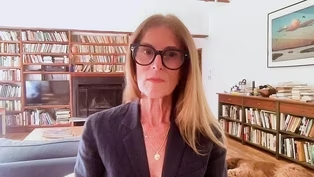
The Scars Americans Carry from 9/11 and How They Have Shaped Us 25 Years On
Video has Closed Captions
Janet Reitman discusses her new book "The Inheritance." (18m 2s)
Providing Support for PBS.org
Learn Moreabout PBS online sponsorship New Episode
- News and Public Affairs

Top journalists deliver compelling original analysis of the hour's headlines.
 New Episode
- News and Public Affairs

FRONTLINE is investigative journalism that questions, explains and changes our world.
 Recently Added
 New Episode
 New Episode
 New Episode
 New Episode


 New Episode
Support for PBS provided by: