
Taxpayers Could Be on the Hook for Cleanup Costs From Old Oil Wells
Clip: 2/10/2026 | 7m 57sVideo has Closed Captions
A new report says unplugged wells could wreak environmental havoc, leaking toxic chemicals.
A new report suggests pumpjacks — and the inactive oil and gas wells that lie below them — are more than just relics of a bygone industry. They also could be environmental time bombs lurking underground, threatening to expose Illinois taxpayers to more than $1 billion in future clean-up costs.
Problems playing video? | Closed Captioning Feedback
Problems playing video? | Closed Captioning Feedback
Chicago Tonight is a local public television program presented by WTTW
WTTW video streaming support provided by members and sponsors.
Taxpayers Could Be on the Hook for Cleanup Costs From Old Oil Wells
Clip: 2/10/2026 | 7m 57sVideo has Closed Captions
A new report suggests pumpjacks — and the inactive oil and gas wells that lie below them — are more than just relics of a bygone industry. They also could be environmental time bombs lurking underground, threatening to expose Illinois taxpayers to more than $1 billion in future clean-up costs.
Problems playing video? | Closed Captioning Feedback
How to Watch Chicago Tonight
Chicago Tonight is available to stream on pbs.org and the free PBS App, available on iPhone, Apple TV, Android TV, Android smartphones, Amazon Fire TV, Amazon Fire Tablet, Roku, Samsung Smart TV, and Vizio.

WTTW News Explains
In this Emmy Award-winning series, WTTW News tackles your questions — big and small — about life in the Chicago area. Our video animations guide you through local government, city history, public utilities and everything in between.Providing Support for PBS.org
Learn Moreabout PBS online sponsorshipIllinois taxpayers could be on the hook for more than a billion dollars due to tens of thousands of unplugged oil wells at risk of abandonment across the state.
A new report from Northwestern University says those unplugged wells could wreak environmental havoc.
We can talk sit chemicals into groundwater.
Joining us to break down that report is Robert Weinstock director of the Environmental Advocacy Center at Northwestern University's School of Law.
We also invited the Illinois Department of Natural Resources who declined as well as the Illinois Oil and Gas Association, which did not respond.
Robert, thank you for joining us.
Thank you for reading.
So your report found that the Illinois Department of Natural Resources tracks over 30,000 oil wells in Illinois that will eventually need to be kept unplugged appropriately.
What are the danger, dangers of leaving those Wells Unplugged.
>> Thanks.
So unplugged.
Oil.
Well really creates 3 categories of environmental hazard.
First.
>> Many of these wells leak methane, which is an incredibly potent greenhouse gas fueling climate change and contributing to the extreme weather events we've seen on oil just like was just featured on the program.
Second.
Well, it can leak contamination into groundwater and in downstate Illinois, many of our residents get their drinking water in their homes from private wells on their land.
Right from the same groundwater aquifers that these wells can be leaking.
All sorts of carcinogenic and other toxic chemicals into and then finally, some of some of the pollution from these wells can lead directly into the soil.
And in southern Illinois, you're talking about really productive agricultural soil.
That can be fouled by the contamination from these wells causing it to be worthless as the farmland is and could one of these unplugged wells look like.
And it sounds like you're saying many of them.
Most of them are in downstate Illinois where they that's right.
There heavily concentrated in southeastern what it looked like when we if I'm driving through southeastern Illinois, what I Yeah, I mean, really ranges.
That was one of the things that surprised me in doing this research.
Sometimes it is sort of that iconic oil, derrick, that you might imagine.
And the Southern California skyline or something like that.
I sort of with right other times.
It's just a pipe sticking out of the ground.
Many times.
It's that pipe, which is the actual top of the of the boring along with all sorts of equipment or infrastructure left over from oil drilling, that might be tanks.
That might be small pipelines running out.
That could be actual waste pits itself.
It really varies quite a bit from site to site.
So in 2025 official records identified over 6,000 wells as requiring immediate closure.
But you find that the majority of Illinois's 30,000 plus wells.
>> Are currently tracked are likely at high risk of abandonment.
Why is there this discrepancy between the official records and what your report has found?
So our report is based entirely on idea our records.
And what we did was we looked at it in different ways so that 6,000 number actually sort of 2 buckets combined its one, a group of about 4,000 wells, which have been formally orphaned.
So the state has can't find the entities that are responsible for cleaning them up.
They've been abandoned by the oil companies that drill them in the first place 2000.
More of those wells, the state has identified a permit holder.
So someone who's supposed to be legally responsible for the cleanup.
They've sent that person a citation saying it looks like you're well as an active in time to be closed and that person hasn't responded, hasn't acted on that to fulfill that legal obligation.
30,000 is the entire set of wells that the that the state tracks in its pomp with through its permit program and the state itself says more than half of those are producing about a barrel or barrel half of oil a day at most, which makes them economically unproductive.
So what are they doing?
Still an close if they're not producing useful oil, I would also say there's another number that that's in the report that's really important, which is 155,000.
That's the number of wells that the state estimates have been drilled in Illinois throughout history of the oil That number is really important because those old can track them.
So the 120,000 wells out there that the state can't even tell you where they are when they stop producing oil or if they're properly closed early to be remediated further.
And of course, we know the state of Illinois is not producing the way it did years past when 155,000 wells, we're dog.
Yeah.
Over production.
Certainly down.
We're still the 16th largest oil producing state in the country and we still do produce useful products from some of these wells.
The problem is that trend line, it's less and Meanwhile, all these older wells are sending their top with the potential for extreme environmental and public health impacts and the companies, some which are there.
Others are disappearing day by day.
Many of them like you said, they've been, you know, abandoned by owners.
What does it mean for well, to be become abandoned who becomes responsible?
>> Because it cost to to clean it up to cap it and then to close that well off.
So should be responsible for this.
Well, state was actually quite clear that the people in the companies that drill those wells are responsible for closing them at the end useful life.
>> Closing them and cleaning up the site however, companies, many companies, certainly not all, but many simply walk away from their obligations in other states.
There's been documented cases where larger companies have sort of Well, that's no longer really making any money sold to a small company that they know is going to go bankrupt and that small company then declares bankruptcy, leaving the well clean up to go to the state.
And that's really orphan.
Well, program I mentioned before is the state's way to deal with that?
Unfortunately, it's wildly underfunded.
Most of the work done and that well, and that orphan well, program has been done using limited federal funds that come from all of our taxpayer dollars.
Your report also shows difficulty tracking a lot because of data collection.
House, Illinois compared to other states.
Yeah, this is one of the most remarkable things I think we found is that Illinois is an absolute laggard when it comes to simple data collection.
And you compare that I'm nationwide.
So any other state that produces significant quantities of oil, you can go on a publicly with helpful website.
Largely there's interactive Web sites where you can say that seems to be a well on my property who owns it, how much oil's of producing one was a drilled in Illinois?
None of that data out.
First of all, the production data isn't collected at all and much of those other pieces you have to go through and do for follow-up.
Put in formal records request to the agency and get that data.
Why is that such a big problem?
That lack of production data tracking because that's the easiest way to telephone.
Well, is no longer producing oil is just to ask.
And the agency doesn't do that.
The agency sends inspectors out routinely.
Sometimes they spot old wells, but they don't do the very simple thing of requiring the producer simply to tell them how much oil are you producing?
And then when those reports stop coming in, the agency would know it's no longer producing.
Let's go shut it down.
What are the steps that this state has taken so far to mitigate some of the dangers of these unplugged wells will.
So as I mentioned, the state, the only department natural resources has done a really great job in going out getting federal funding that was available under the Biden infrastructure law.
The bipartisan infrastructure law passed under President Biden.
They've they've receive that money.
They're spending it.
They are using that to plug a limited number of wells that they can with those proceeds with the with the revenues from the federal taxpayer That's great.
What they need to do is take these other steps and laid out in our to actually prevent wells from becoming orphaned in the first place to make sure the companies that profited from them actually pay to close and then to create a system whereby we know that the oil industry through permit fees through bonds that are appropriately set that actually match cleanup costs will be the one paying for the mess that they made a That's where we'll have to leave it.
I'll be curious

Chicago Reader Returns After a Short Hiatus
Video has Closed Captions
Clip: 2/10/2026 | 7m 46s | The beloved publication has focused on arts, culture and investigations since its founding in 1971. (7m 46s)
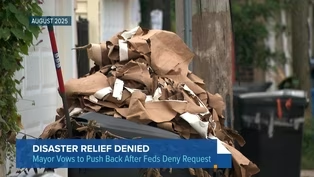
Johnson Vows to ‘Push Back’ After Trump Administration Denies Disaster Relief
Video has Closed Captions
Clip: 2/10/2026 | 2m 57s | Storms flooded basements across the Southwest Side twice during the summer of 2025. (2m 57s)
Providing Support for PBS.org
Learn Moreabout PBS online sponsorship
- News and Public Affairs

Top journalists deliver compelling original analysis of the hour's headlines.

- News and Public Affairs

FRONTLINE is investigative journalism that questions, explains and changes our world.












Support for PBS provided by:
Chicago Tonight is a local public television program presented by WTTW
WTTW video streaming support provided by members and sponsors.