
The Quest for Camelot
Season 23 Episode 4 | 55m 15sVideo has Closed Captions
A professor seeks to prove Arthurian legends have roots in actual British history.
Can the stories about King Arthur be proven true? Was the legendary court of Camelot a real place? Join Prof. Mark Horton on his journey across Britain to prove real events and places inspired the chivalric myths. Horton scours medieval texts and archaeological sites for a new understanding of the Arthurian legends and what Britain was like after the Romans left in the fifth century.
Problems playing video? | Closed Captioning Feedback
Problems playing video? | Closed Captioning Feedback
SECRETS OF THE DEAD is made possible, in part, by public television viewers.
The Quest for Camelot
Season 23 Episode 4 | 55m 15sVideo has Closed Captions
Can the stories about King Arthur be proven true? Was the legendary court of Camelot a real place? Join Prof. Mark Horton on his journey across Britain to prove real events and places inspired the chivalric myths. Horton scours medieval texts and archaeological sites for a new understanding of the Arthurian legends and what Britain was like after the Romans left in the fifth century.
Problems playing video? | Closed Captioning Feedback
How to Watch Secrets of the Dead
Secrets of the Dead is available to stream on pbs.org and the free PBS App, available on iPhone, Apple TV, Android TV, Android smartphones, Amazon Fire TV, Amazon Fire Tablet, Roku, Samsung Smart TV, and Vizio.
Buy Now
Providing Support for PBS.org
Learn Moreabout PBS online sponsorship♪♪ ♪♪ -In a lost period of British history more than a thousand years ago, legend tells of a mythic ruler -- ♪♪ King Arthur... founder of the fabled Court of Camelot.
But did historical fact inspire this fantasy?
-There's no smoke without fire.
I mean, how come these Arthurian stories are so persistent and so widespread?
-Could the stories be based on real places and events?
-There's no doubt there would've been conflict.
-Professor Mark Horton believes cutting-edge archeology can provide an answer.
-Oh, that's so exciting!
No idea quite what we're going to find.
-He's uncovered clues from a little-known period of history, after the Romans left Britain.
Could the town of Cirencester in southwest England have inspired the legendary Court of Camelot?
-People never thought about what had happened after the Romans left.
-It can't have all just collapsed in 410.
-He's investigating fresh evidence from the 5th century.
It points to a wealthy realm and powerful army able to hold back the invading Saxons longer than anyone thought possible.
-I think this find changes everything.
-Tantalizingly, he's hoping to reveal the location of the real Round Table... -That is a very big structure.
-...and unearth the historical origins of the legends of Camelot.
-I'm just staggered that what we've actually found here is beyond one's wildest expectations.
-"The Quest for Camelot."
♪♪ ♪♪ -King Arthur... a hero for the ages.
Tales of his heroic exploits, and his court at Camelot, have captivated people around the world for centuries.
♪♪ But is any of it true?
-I think that a proper understanding of what's happening in this century, post-Roman Britain, is the key to unlocking the Arthurian stories.
-Camelot is the legendary capital of King Arthur's realm.
It was first mentioned in stories in 12th-century stories -- a fantasy world of chivalric knights and romantic castles that resembles England in the Middle Ages.
But many believe the stories are based on much earlier events that took place in Britain in the 5th century.
And one man is using all the tools of modern archeology to find new evidence.
-I feel that we might be able to use the archeology to get in behind these legends and myths and actually find if there really is a historical Arthur behind it all, a historical Camelot.
-If a historical Arthur did exist, scholars think he lived in the virtually undocumented era after the departure of Rome's legions in 410 AD.
Decades of conflict and invasions by tribal peoples, like the Saxons, followed.
The historical assumption has always been that it was a time of poverty and chaos.
But what if a Roman Christian way of life continued and one leader united Britons to defend it?
-Camelot has always been seen as the emblematic place associated with King Arthur.
A sort of Disney-like castle, if you like.
But where is its origin?
Was there a place, an idea of Camelot, which refers back to the 5th century that really did exist?
-The Romans ruled over Britain from 43 AD until the beginning of the 5th century.
They left their mark all across the British landscape during their 400-year occupation, from the massive 70-mile military fortification of Hadrian's Wall... to the luxurious spa town of Bath.
It was all linked by their famous network of roads.
♪♪ Professor Mark Horton believes that if evidence of a real Camelot exists, it will be found by re-examining Roman sites.
Only a few tiny fragments of artifacts, and virtually no documents, survive from post-Roman Britain.
For historians, any new discovery could transform the understanding of the period when the Arthur legend originated.
-The 5th century has long been described as the Dark Ages.
There's 90 years between 410, approximately, and 500 in which we have virtually nothing -- 90 years in which there's practically no archeology and practically no history.
And that's what we have to try and find.
-Mark is a professor of archeology at the Royal Agricultural University in the Cotswolds region of England.
-We can wring out a few facts -- a prosperous Romanized society survived somewhere in the British Isles during the 5th century.
These surviving Romans, British, fought battles against the incoming Saxons and were successful in staving them off from their own territory.
And then, possibly most controversially, that the figure that might've led this resistance was called Arthur.
[ Birds chirping ] -Where did tales about the knights of the Round Table and Camelot come from?
The tiny fragments of documentary evidence for 5th-century Britain, when the Arthur myth originates, can be found in manuscripts across the world.
Mark's come to the Bodleian Library at Oxford University to investigate some of them.
Professor Marianne Ailes is helping him trace the story from its earliest origins to the legends told today.
The two most important accounts of events in the 5th century are written by monks known as Nennius and Gildas.
Nennius has the earliest example of Arthur's name written down, but he wasn't called a king.
-This is the chronicle that mentions Arthur for the first time as a great military leader, the "dux bellorum," the leader of war.
-The chronicle recounts a Christian Arthur, fighting on behalf of the kings of Britain after the end of Roman rule.
He defends what remains of Roman Britain in 12 battles against the pagan Saxons.
These events will guide Mark in his search for archaeological evidence from British history.
The monk Gildas -- the earliest known source writing in the 6th century -- reports a climactic battle at a place called Mons Badonicus.
-The first time we really find out about this Battle of Badon Hill, Mons Badonicus, is in the work of a 6th-century author called Gildas.
-Gildas wrote just a few short lines about this battle, dating it to the late 5th century.
-So, with Gildas writing in the early 6th century, we're getting really close to when these battles happened.
Mons Badonicus, Gildas dates it for us.
He tells us, "40 years ago," on the day he was born, this battle took place.
-But... does Gildas mention Arthur?
-No.
Well, not by name.
So, this is where we get a bit of a -- an impasse with the -- the literary sources that we've got almost back to the date of when Arthur may have lived.
You've got a war leader, but no name.
-So, what I can see from the sources is that we're in the 5th century.
Arthur, if he existed, was a war leader, not necessarily a king, trying to defend the Roman world, or what was left of the Roman world, from everybody around.
And he was so successful that he was remembered in myth and legend over thousands of years.
-From these tiny historical details, the story gets shared, and embellished, across Europe over the centuries.
Many parts of the Arthurian legend are first written down in 12th-century France by a poet named Chrétien de Troyes.
Chrétien de Troyes invents many of the best-known elements of the story, like Sir Perceval and the quest for the Holy Grail... and he introduces Arthur's Court at Camelot for the first time.
Most later versions take inspiration from Chrétien's work, borrowing his medieval setting and cementing it in popular imagination.
One of the most significant adaptations of the story is called "The Lancelot-Grail Cycle," written in the 13th century.
-Isn't this beautiful?
So, this is quite a late version of the Arthurian story.
We're talking about medieval bestsellers here now.
They're spreading across -- across Europe.
-Yeah.
-It's exactly what we think when we think, in the 21st century, about King Arthur.
You think of Arthur, knights-errant, the Round Table... -And Lancelot's illicit relationship with Guinevere.
There they are, hugging themselves in a rather, how can we say, intimate way.
-This is a romance.
This is -- is entertainment, really.
Sometimes beautifully written, sometimes beautifully illuminated, but it's not history.
-[ Chuckles ] -Mark has traced the popular romances of Camelot and today's Arthur legends to their roots in historical accounts.
Now he wants to find physical evidence from the little-known, 5th-century, post-Roman realm of the war leader Nennius and Gildas described.
-I want to get under the skin of the Arthurian myth.
Where was Camelot?
Who was Arthur?
And what can we find out about the epic battles that he was meant to have fought?
-Mark considers where he should start his search for Camelot.
-Camelot has been located all over the British Isles, and actually some in northern France as well, so... tying down where these myths originate is a fascinating problem, the biggest one that we have to crack.
-The giant Roman fortress at Caerleon in Wales... medieval Winchester in Hampshire... and the spectacular ruins of Tintagel Castle on a dramatic Cornish headland, have all been suggested as locations for Camelot.
No definitive archaeological evidence has ever been found to support the stories.
♪♪ But Mark has a new idea of a possible location that's never been investigated.
-In this period in the 5th century, as Roman Britain collapsed, Romanitas collapsed, the Roman army was recalled back to Europe, to Gaul, the cities and towns of Roman Britain had to look after themselves.
And it's long been realized that in western Britain, that sense of Romanitas and civilization survived far longer than it did in the east and in the north.
So, if we're looking for Arthur and Camelot, where these stories might have originated from, we have to look in western Britain - and the first place to look is in the capital, which is ancient Corinium, or Cirencester.
[ Birds chirping ] ♪♪ -Cirencester is a quiet market town in the southwest of England.
But in Roman times, it was known as Corinium and was one of the most important cities on the island of Britain.
It was the capital of the entire west of Britain and a hub on the network of roads.
It would have been an ideal seat of power for any ruler who took charge after the Roman Empire collapsed.
Mark suspects this city is the center of a post-Roman kingdom that held off the Saxons... and is the inspiration for Camelot.
-I've found two historical sources that directly connect Arthur with Cirencester -- one written by a medieval chronicler called Alfred of Beverley in the mid-12th century, and a second an antiquarian account by William of Worcester who came to Cirencester in 1480 and recorded legends and traditions that he was told about.
What we've learned since about Roman Cirencester tells us it was a really important place, but in truth there's been very little extensive excavations in the Roman town since the mid-19th century.
-Just a few fragments of the old Roman city wall remain visible today.
Mark and his remote sensing team traced the last unknown section, which ran under the grounds of Cirencester Park, family seat of the 9th Earl Bathurst, near the town center.
♪♪ His new discovery fills in the last section of the ancient Roman wall in Cirencester... and it shows just how large the city was.
In fact, Corinium was the second largest in Roman Britain, after London.
Sources claim that Arthur lived in the immediate aftermath of Roman Britain and protected a wealthy kingdom.
Is there other evidence to suggest Corinium was the center of that kingdom?
♪♪ The Corinium Museum is filled with artifacts, showing just how important this city was.
Some of the most expensive luxuries were finely crafted mosaics.
-So, Emma, I mean, how many mosaics are here in Cirencester Corinium?
-So, over 90 are known from the town, some of them are still underneath the ground.
Anywhere you walk in Cirencester, you'll be walking over the top of a site where there is actually a mosaic underneath your feet.
Many huge townhouses were decorated with figurative designs, some geometric designs.
This is the famed hare mosaic.
You can see that it's a hare at peace, it's nibbling a plant.
It's really beautifully defined with some green glass across the back, which would make it twinkle in the light.
-So, you can imagine the sheer wealth of the place.
-There is a huge amount of wealth here.
It's shown in the architecture, the stonework, the decoration in the buildings, even public buildings were decorated in this way.
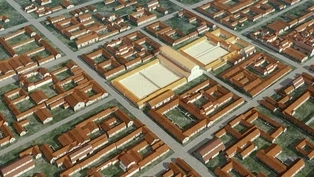
♪♪ -Archaeologists have reconstructed what Corinium would have looked like towards the end of the 4th century.
With its size and impressive public buildings, it was clearly a place of great wealth and power.
But the reason Mark thinks this city is a prime contender for Camelot is this column in its central forum.
-This is the largest column capital from Roman Britain, this huge column capital that would've stood at the top of a massive column in the center of the town.
-So, London doesn't even have one larger?
-No.
We've asked around.
The diameter of this is the largest from Roman Britain.
Highly decorated, and there's a slot in the center, just here, for a statue.
-And it could well be for a Roman emperor.
-At the base of the column, a carved block of stone identifies Corinium as the capital city for the Roman province of Britannia Prima, which covered the entire southwest of Britain.
What happened to this grand capital city after Roman rule collapsed in the year 410?
Did it remain a capital and the center of a wealthy post-Roman kingdom in the time of Arthur?
-Did everything in Corinium come to an end in 410?
-I don't think it can have done.
I think, with it being the center of Britannia Prima, the wealth that was here, it can't have all just collapsed in 410.
I think that Corinium continued as an administrative center into the 5th century.
-If Corinium remained a capital city, there should be evidence of how it was governed.
-If Britannia Prima survives as a political entity, then we'd expect a political structure.
So, we need to find the places where politics was undertaken.
-Present-day Cirencester's largest Roman structures, and most visible ruins, are the obvious place to look for evidence of what happened after the Romans left.
The amphitheater, just outside the Roman city wall, is one of the largest found in Britain.
The remains of banked seating are still clearly visible in the landscape.
The structure could have held 8,000 people in its viewing area.
-It's kind of dwarfing to be here in the middle of the arena.
Here I'm standing where two gladiators would've fought to the death in this very spot, being cheered on with thousands of spectators.
-Experts have reconstructed what the amphitheater would have looked like in Roman times.
But what happened here when Roman rule ended and the games stopped?
Mark's working with remote sensing specialist Dr.
Henry Webber to look for any signs that this impressive structure was still in use in the time of Arthur.
They're using ground-penetrating radar and magnetometry to search for evidence under the arena floor.
-So, we know that Roman amphitheaters are basically a great big open space in the middle, nothing but sawdust and sand for the various Roman games.
So, anything we find in the middle here must date to after the Roman occupation.
-Mark was intrigued by a 1960s excavation that discovered the remains of a large fortification added to the amphitheater.
It dates to the 5th century, when Arthur could have been alive.
-A gateway was built at the entranceway, suggesting that the whole of the amphitheater was converted in to some kind of fortress in the 5th century.
-The earlier excavation showed that the old Roman arena was reused after 410 AD, but no archeology has happened here for more than 50 years.
The team is hoping that modern techniques will reveal why this huge structure was fortified.
-People probably assume that it was just never reused and, you know, never thought about what had happened after the Romans left.
And this is the first time we've done a radar survey on a Roman amphitheater.
You know, this is breaking new ground.
-Even on the first runs, Henry and Mark start to see features under the arena floor.
-Yeah, we're seeing some really good data.
Essentially, it's transmitting radio waves down into the soil.
You've got a big stone, it just pings, hits the stone, comes back up, and that basically calculates the depth.
A lot of circular anomalies coming up.
-Yes?
-Really high definition as well.
We need to obviously get the survey finished, then we can map them all together.
We've got 32 channels on 8 different sensors in this, all at the same time, with all the GPS.
We're on really high resolution in that top meter where we'll hopefully find most of the archaeological features that we want to find.
-Two radar surveys and the magnetometry data reveal a mass of features hidden underground in the center of the amphitheater.
-This is meant to be an open blank area.
-Yeah.
-But just look at the amount of occupation that's there.
-Just a fascinating amount of detail in there, isn't there?
-First thing we can see is the blocking of the amphitheater to create a fortress here.
-Tell-tale circular holes left by large wooden posts can be seen on the imaging scans.
-So, we clearly have a little arc of post holes running along here.
What size do you think those are, Henry?
-I mean, at least a meter because each swath there is 1.2 meters.
-A bit cruder, but we can see, very clearly... -Got at least six, seven, eight post holes in a curving line there.
-There's clear evidence of a building constructed after Roman times.
-If we superimpose one on the other... -Wow, look at that.
-...you've got clearly a circular building coming 'round like that.
So, there's the post holes, 'round there, 'round there, 'round there, 'round there, 'round there.
And then, actually, just back 'round there.
So, we've got a massive build-- What's that, 30 meters across?
-It's a 30-meter grid, yeah.
And it's not right in the middle, is it?
-No.
-It's actually slightly to one side, which is interesting.
-That's right, and you can see how they fitted it in.
-Yeah.
-Tightly into the southwest corner of the amphitheater, and double post holes all the way 'round.
One-two, one-two, one-two, one-two.
Huge, great big... -Yes, a large structure, isn't it?
Yeah.
-...monumental building there.
Isn't that amazing?
-The post holes are significant, aren't they?
-Yeah.
-In terms of, you know, the posts are there, how tall could it have been?
-Could be taller than the amphitheater itself.
-Could've been, yeah.
-With, presumably, a circular, big, pitched conical roof.
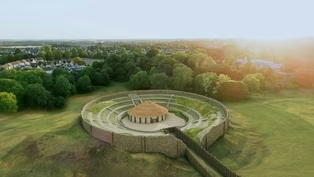
♪♪ -Mark's new results show how the amphitheater left by the Romans was added to.
The massive structure was fortified to be used as a stronghold.
A newly discovered round timber building sits at one end of the fortress.
Mark believes it's from around the time of Arthur.
-It's just staggering to think of the scale of what must've been there in the 5th century.
A huge circular building, occupying the whole of the southwestern part of the amphitheater.
What was the function of this building?
Well, you know, it can only have been for political or military reasons.
-Could this massive round building inside a fortress be where a military leader, who becomes known as King Arthur, gathered his forces together?
Many modern scholars have suggested that medieval romance writers took the folk memory of a round assembly place and invented the idea of the Round Table.
But no one was aware of the structure hidden here.
-I think this place is where the idea of the Round Table had its genesis -- either the oval amphitheater, or the circular gigantic building that we found sat within it and that we're standing looking at the place where the post-Roman militia, the Arthurian army, gathered before literally riding out to defend what was left of Roman Britain.
♪♪ -How accurate is the common understanding of post-Roman Britain, when Arthurian myths began?
♪♪ Historians long believed that after the Roman legions left, Britain descended into chaos, war, and poverty.
♪♪ But eight miles north of Cirencester, the potential location for Camelot, a new discovery is transforming experts' understanding of what happened in the 5th century once the Romans departed.
♪♪ Chedworth Roman Villa sits in a prime spot of lush Cotswold countryside.
It's one of the largest and most opulent Roman villas ever found in Britain.
♪♪ It was a grand country house, with up to 40 separate rooms and 2 separate bathhouses.
-The traditional view of the end of Roman villas like this is, around 410 the Roman army had left, the monetary economy had collapsed, and people couldn't afford to keep the villas going and so they abandoned them, just like that.
410, that's the end.
-Chedworth is one of more than 40 luxury villas that have been located across the Cotswolds and around Cirencester.
If Cirencester was a city that prospered even after the Romans left, villas like it would have continued to thrive.
But no evidence of a post-Roman lavish lifestyle has been found... until now.
-So, which room is this?
-This is the room, this is Room 28, and this is where we've got this mosaic.
-National Trust archaeologist Martin Papworth investigated a mosaic in the north wing of Chedworth Villa that surprised everyone.
-What we were setting out to do was to show the mosaic off and record it digitally.
-Now reburied to protect and preserve it, the mosaic is as finely crafted as others found elsewhere in the surrounding area.
-But there were lots of little bits of charcoal, tiny little twigs of charcoal, which is nice.
-Nice for dating, yes.
-Yeah, very nice for dating.
It was like a gift, really.
-Yes, yes.
-But I really did expect these little twigs to give me a date of late 4th.
-Late 4th century, yes.
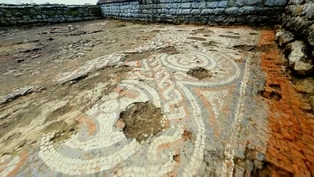
-The radiocarbon dates showed that a new, expensive mosaic was installed in the late 5th century -- long after the villa was supposed to have been abandoned.
-That's where we took the radiocarbon dates, just there.
We came back and we took more samples.
The other two hit the nail on the spot, both the same.
♪♪ -The beautiful patterns and intricate figures, dating to the late 5th century, indicate that people here lived a Roman way of life much later than previously thought.
Other villas in the area are now being re-examined to look for new radiocarbon evidence.
-What your evidence shows is that it didn't all come to an end in the early 5th century... -No.
-It carried on.
-It's not quite what it was, but they're holding on, like a fading country house.
They're commissioning a new mosaic, so they've got some money to make it.
-And, presumably, the fact we have mosaicists laying a mosaic in the late 5th century means that they must've had enough work to keep going.
-Surely, you've got a town-Yes.
-...where specialist craftsmen still have workshops.
-Yes.
-They're still taking work from wealthy people out in the countryside.
The countryside is still a reasonably peaceful place where they can ply their trade.
-We can imply that Cirencester must still be going.
-Yes.
I mean, that would be my thought.
-The new evidence at Chedworth supports the historical accounts that Arthur was able to protect a prosperous kingdom.
But who was he protecting it from?
♪♪ The Saxons.
The Cirencester Museum has preserved evidence of the enemy Arthur fought against.
-This is a adult female.
We have a nearly complete skeleton here of a woman from the age of 20 to 25.
-Dr.
Katie Miller is an expert in Anglo-Saxon burials.
The remains of this woman were excavated from one of more than 200 burials discovered 10 miles east of Cirencester.
It's a very different looking site compared to the other maybe Roman sites that we have around here.
This was an Anglo-Saxon cemetery site, and you can tell that based off of the grave goods that were found.
This individual was buried with these two cast brooches, where you can kind of tell where those objects would've been.
So, you can see this sort of, like, greenish-gray in here, on the rib bones as well as on the humerus here.
These lovely cast disc brooches, which are particularly distinctive to the Saxon culture, they mimic styles that are from the continental Europe, places like Germany, Netherlands, Denmark.
I think the skeleton and the artifacts come together to tell the whole story of an individual.
You can really paint a different picture about what was happening during that time period.
-Studying chemical isotopes in Saxon skeletons from across England helps map the Saxons' migration into Britain.
One of the most useful techniques for looking at where individuals are from is the analysis of strontium and oxygen from dental material.
And as everyone's lost a tooth and then grown a new one, it can tell you about a different part of their life.
-Different locations on Earth have differing ratios of strontium and oxygen isotopes in the crops and water.
This unique signature shows up in the bones of people living there.
There is slightly more of the strontium isotope in bone from Germany and Denmark than in southern Britain.
-That tells you the kind of geology of where that person would've been residing when that tooth was developed.
These Saxons were probably coming somewhere from basically Denmark, Netherlands, Germany.
The interesting thing is, if you're listening to the histories, the Britain histories, these were apparently barbarians.
These individuals came in as basically marauders and took over Romano-Britain because it was in collapse.
But I would be very shocked if these individuals on the Continent didn't run in to a Roman or two.
The individuals like this one here are almost acculturating or working with or living with, and almost assimilating with Roman culture.
-Mapping the dates and locations of cemeteries across the south of England indicates the Saxons arrived first in the area around London and Kent, which are closest to their homelands around modern-day Germany.
They spread along the south coast and then moved north and west.
Some groups may have lived alongside the existing Romano-British population.
Others may have been invited over as mercenaries.
-They start creating roots here, they start building communities here, and they basically start to gain power and wealth.
There's no doubt there would've been conflict.
I don't think it was the only thing happening, for sure, but certainly there would've been conflict.
-By the end of the 6th century, Anglo-Saxons ruled over much of the island, even giving the modern country its name -- England.
But is there any evidence that their advance was met with resistance?
-There's definitely something different happening in the southwest, so when looking at the burial context from the southwest and southeast, there is definitely a longer sort of Romanized practice and Romanized culture happening, which is quite interesting.
-Saxon burials like this aren't found in large numbers in the corner of Britain around Cirencester, and further west, until much later in time.
-Where we are now does become a very prominent, powerful Anglo-Saxon kingdom in the kind of later centuries, but it does seem to take a bit more time.
-The evidence from burial sites suggests something -- or someone -- slowed the pagan Saxon migration westward beyond Cirencester.
The Saxon burial sites support the historical accounts that describe Arthur uniting the Britons and holding off the incoming Saxons in 12 battles.
Mark wants to investigate the archaeological evidence for this conflict.
He examines small pieces of soldiers' equipment that survived from Arthurian times in the greatest number.
-They're nice pieces.
I mean, I have -- these are beautiful.
-Let's get it 'round the right way.
Author and historian Stuart Laycock has been investigating how the design of common items, like military belt buckles and brooches, changed over time -- a system called typology.
-We've put them in what we think chronological order.
-Yeah, roughly, yeah.
And in different parts of the country, they're making different patterns.
We know that Britain fragments in the 5th century into different kingdoms, and I think that what you're seeing here is that different tribes are asserting their own independence and authority by producing their own military, paramilitary, militia kit.
-Britain fragmented into small territories after the end of Roman rule.
They each produced unique designs of military regalia.
But when Arthur is said to have united the Britons, a standard design emerged in brooches worn by soldiers.
-Penannular brooches are this kind of -- it means like almost a ring, so you put the two ends of the cloak you're fastening through inside the loop and put the pin through them, then you wear them up on your shoulder.
But, you know, there was almost nothing in the archaeological record of British items from this period, probably like sort of 480 to 520 sort of thing.
There are these, you know, and that makes them special in their own right.
-Stuart has studied the locations where 60 examples of this type of brooch were found.
Arthurian legends say a great leader united the island's kings against the Saxon invaders.
-The Anglo-Saxons have already settled some of these areas in the east, in particular, and they don't appear so much in those areas.
-There's a massive concentration around Cirencester, isn't there?
Just look at all those dots there.
-And to the south, yeah.
-And to the south.
-And I think there is a feeling that this is the area where the design appears.
-Mark thinks the brooch evidence suggests a powerful army centered around Cirencester, the city he believes inspired the legend of Camelot.
And it matches the monk Nennius's historical account, which describes Arthur fighting 12 battles all across Britain.
-That little pattern corresponds so closely to the description of Arthur's battles.
-To the extent that we can work out where the battles were.
They tend to imply a figure who is capable to operate, you know, over long distances across the island.
There's always been this sort of slight question of whether that would really have been possible, you know, in a fragmented 5th- and 6th-century Britain.
What this seems to imply is there are alliances going on, which might represent the ability of a figure like Arthur to operate on a scale across the island.
-So, what we might actually have a map here, a late-5th-century map... -Yeah.
-...of this militia activity as it's moving across the British Isles.
-Correct.
-Is it possible to locate a site for a famous battle written about in the earliest historical accounts of Arthur?
Gildas and Nennius describe the Battle of Mons Badonicus as an army of united Britons defeating a huge Saxon force.
Many scholars suspect that the Iron Age hill fort at Badbury Rings in Dorset, just 60 miles south of Cirencester, derives its modern name from Badonicus.
Here, massive concentric earthwork rings rise spectacularly out of the landscape.
These defensive structures were first built before the Romans arrived in Britain.
But the site sat in a strategic location where five Roman roads met.
Did Arthur and his army seek safety here?
Experts carried out an aerial LiDAR survey after National Trust archaeologists excavated the site.
-We excavated just here, just inside this entranceway here, just within the rampart.
We took three charcoal samples with radiocarbon dating.
And the first one came back, and it was Iron Age.
The other two dated from 480 to 520 AD.
-That's incredible, because of course the traditional date for the Battle of Mons Badonicus is of 480 to 500.
-Yeah, so, that's a tick, isn't it?
-Absolutely.
-Unexpected.
-Bang on!
Just incredible.
-It seems the site was re-occupied at the same time to which sources date Arthur's most famous battle.
-Do you think the outer rampart, which is much less well-constructed -- could that be 5th century?
-I think it could well be.
And the reason for that is you can see it on the LiDAR.
You can look along this road -- it should go right up through, but it hits into this rampart, almost as if that rampart was thrown up after the road.
-The LiDAR scans show that the outermost rampart overlaps the Roman road.
The rampart must have been built later.
And that matches the 5th-century carbon dates found in the hill fort.
The archeology strengthens the case that Badbury could have been the location of Arthur's climactic battle.
-Gildas describes the Battle of Mons Badonicus and says after that victory, there was a generation of peace between the Britons and the Saxons.
If the Battle of Mons Badonicus took place just here... -Yes.
-...then that is the point... -Yes.
-...in which the line was held.
"Go no further."
-Yeah.
Yeah, you could certainly build up a good picture of that.
You know, it's in the right place.
-Another tantalizing connection to Arthur's battle has been found on a farm near Badbury Rings.
Mark's come to the site to investigate.
-When I first saw a photograph of it, I thought it was about twice the size, but it's absolutely minute, but so intricately carved.
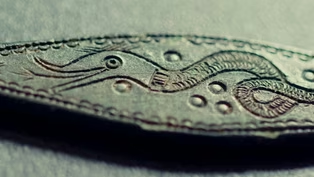
-A one-inch-long piece of metal shows a dragon figure coiled over itself.
It's the strap end from a military belt.
-You can see its head, its fiery tongue coming out.
Here's its eye, that's its skull, and then we've then got its body which has got these sort of scales on, going all the way 'round, twisting like it's waving in the wind.
The idea of a dragon goes back into the late 4th century, to the Roman army that we knew had dragon standards and those "draco," which they led into battle.
-The draco was a metal dragon standard carried in front of the army.
This piece of military uniform was found by the side of the Roman road leading to Badbury Rings.
Could it have been dropped by one of Arthur's soldiers?
-You can almost imagine a 5th-century army marching along this very road in which I'm standing.
Without sort of pressing the point too far, one must remember that the father of the legendary Arthur was Uther -- Uther Pendragon, which literally means "head of the dragon."
So, head of the dragon militia.
In archeology, we very rarely find these kind of things, but, you know, it's circumstantial evidence, but it's really persuasive.
So close to Badbury Rings seems to me a really convincing piece of evidence that it might well have come from one of those Arthurian armies on their way to either fight the Battle of Mons Badonicus, or maybe to return back to Cirencester.
-Gildas describes the victory as the Britons asserting their faith in the Christian God by defeating the villainous pagan Saxons.
An intriguing new site could shed fresh light on whether Christianity was still practiced in the Cirencester area.
-Here's a hat, for health and safety.
-It lies just 20 miles to the west of the possible site of Camelot, and Mark is leading the excavation.
-So, let's go for it.
Ah, it's so exciting!
This is always the best bit of the excavation, you know, I've no idea quite what we're going to find.
-Recently, archaeologists here uncovered a small section of an unknown building.
It had a coin accidentally sealed in its foundations during construction -- meaning, it must have been built after the year 380 AD.
-This perhaps the most interesting coin.
It was actually found mortared to the building, and it was issued by the Emperor Constantius II.
He died in 362, but the coin itself is very worn, and so it probably was deposited maybe 20 years later, at least.
So, that building has, I think, a terminus post quem, what we call a date after which it was built, around 380.
-Mark theorizes that if the building was constructed around 380, it was likely still in use after the Romans left.
-Post-Roman buildings are extremely rare, and archaeologists have found very few of them so far in post-Roman Britain.
And we're going to open up a much bigger area to see if we can trace the plan of this building, hopefully find a secure date for it, and hopefully find out what its function was.
-Mark suspects the wall is part of a religious building.
Over the next four days of painstaking work, the excavation reveals the remains of an entire structure.
The distinctive shape with a bay, known as an apse, at the east end, matches other known pagan temples.
There is one of the walls along here.
And then it returns behind me here.
We have a corner there, turning back to here.
And then at the east end, there's an apse.
I'm pretty certain that this is a... a temple, a Roman, or what's known as a Romano-Celtic, temple, going up maybe in the 380s or as late as the 400s, probably the last Roman temple built in Britain.
-This building appears to be a central holy sanctuary, reserved for statues, offerings, and priests.
Similar sites are surrounded by a much wider covered space for worshippers, within a large temple precinct.
But a significant discovery during the excavation suggests the temple might have been adapted for use as a Christian church in the time of Arthur.
-Well, it's a piece of Roman pennant roof tile, well-worn on one surface, but what's really intriguing about it is that it's got a very distinctive scratch marking.
And I can see a vertical line, and two cross lines, and actually what appears to be another line that's coming back to join one of the crosses.
If we get the light right, it looks just like a Chi-Rho.
-The religious symbol known as Chi-Rho is made up of the Greek letters chi and rho.
They represent the first letters of Christ's name.
-Chi-Rho's really significant because it's the symbol for early Christianity.
-Only a handful of Chi-Rhos have ever been found from this period in Britain.
This symbol predates the Christian cross used so widely today, and suggests the temple was used in the 5th century.
-So, I mean, the Chi-Rho only becomes really popular after the mid-4th century, and in particular during the 5th century.
-It seems Christianity was being practiced in the area around Cirencester, the potential modern-day Camelot, matching the stories of Arthur leading a Christian army.
-I think this find changes everything.
Because if we've got the presence of Christianity here, it would suggest that this building, at least at some point in its life, has a Christian function.
Even possibly a church.
It's just an incredible find.
Could easily have missed it.
[ Laughs ] It shows just how careful we have to be, that what looks like just a piece of Roman roof tile could actually be highly significant.
Yeah, the dates fit -- and of course, Cirencester is just there, just past that hill crest and that clump of trees.
-Inside the temple, the excavation reveals another possible connection to the Camelot legends.
-I think that's almost pure iron.
-Is that pure iron?
It is, isn't it?
Gosh, that's slightly -- slightly sparkly.
-Yes.
-These are slag remains, evidence the site was used for smelting -- creating iron metal by heating up iron ore.
But examining the spoil heap with a powerful magnet reveals an even more intriguing piece of evidence.
-Can you see -- so, this is a tiny piece of hammer scale.
When you make weapons, like swords, and you have to hit the iron really hard, and out comes little splinters of iron that look literally like the scales on fish.
So, what's significant about the hammer scale on this magnet is that that is the evidence for smithing, so they're not just making the iron, but they're also forging the iron into weapons.
-Mark suspects the story of Arthur drawing the sword Excalibur from the stone could have its origins in weapons being made from the sparkling iron ore, known as hematite, found in this area.
-With Camelot stories, there are ideas about magical swords coming out of stones, the iron that is coming from here, scenes of hematite, this magical substance, and of course, if they make weapons within a temple precinct, then they probably will be endued with magical and spiritual qualities that will enable them to be victorious in battle.
I'm just staggered that what we've actually found here, you know, is, you know, beyond one's wildest expectations.
You know, archaeologists are scientists, so we mustn't get excited, but actually, it is incredible that what we've got here is possibly the last pagan temple created in Roman Britain, which then carries on into the 5th century as this place of worship.
♪♪ -The evidence that Cirencester inspired Camelot is substantial.
Signs of a powerful military force from Arthurian times are found all around this area.
And new evidence in the countryside around Cirencester suggests Christianity survived the arrival of the Saxons.
It's likely that Cirencester was one of the most important places in 5th-century Britain, where a wealthy Roman lifestyle carried on long after historians had thought possible.
♪♪ And the monumental new round building Mark discovered could be the seat of power that inspired the tale of Arthur's Round Table.
-It seems that after we thought that the sun had set on Roman Britain, that actually, Roman culture survived here for another hundred years.
You know, where does the stories of Arthur, Camelot, and the Round Table come from?
Well, you know, I'm pretty convinced that it's here, this very spot.
-Cutting-edge science and archeology are completely rewriting the history of Britain after the Romans left.
And it's getting closer to the origins of the King Arthur and Camelot legends than ever before.
♪♪
Discovered Ruins May Have Inspired the Round Table
Video has Closed Captions
Clip: S23 Ep4 | 3m 1s | New evidence suggests an amphitheater became a stronghold linked to Arthur’s Round Table. (3m 1s)

How the Sword in the Stone May Have Begun
Video has Closed Captions
Clip: S23 Ep4 | 1m 53s | Iron smelting at a temple site may have inspired the legend of King Arthur’s sword, Excalibur. (1m 53s)
New Evidence That Roman Life Continued After the Empire's Fall
Video has Closed Captions
Clip: S23 Ep4 | 3m 1s | New dating shows a Roman villa mosaic was laid in the 5th century, reshaping post-Roman Britain. (3m 1s)
Preview | The Quest for Camelot
Video has Closed Captions
Preview: S23 Ep4 | 32s | A professor seeks to prove Arthurian legends have roots in actual British history. (32s)
A Roman Dragon's Possible Link to King Arthur
Video has Closed Captions
Clip: S23 Ep4 | 2m 10s | A Roman military belt bearing a dragon design may hint at the military roots of King Arthur. (2m 10s)
Was This City the Real Camelot?
Video has Closed Captions
Clip: S23 Ep4 | 2m 53s | Did Cirencester remain the center of a prosperous post-Roman kingdom in the time of King Arthur? (2m 53s)
Providing Support for PBS.org
Learn Moreabout PBS online sponsorship














Support for PBS provided by:
SECRETS OF THE DEAD is made possible, in part, by public television viewers.