Virginia Home Grown
Transplanting Leafy Greens
Clip: Season 26 Episode 6 | 4m 31sVideo has Closed Captions
Learn how transplant lettuce and kale into your garden
Randy Battle shares tips for transplanting leafy greens from cell packs into containers and garden beds. Featured on VHG episode 2606, August 2026.
Problems playing video? | Closed Captioning Feedback
Problems playing video? | Closed Captioning Feedback
Virginia Home Grown is a local public television program presented by VPM
Virginia Home Grown
Transplanting Leafy Greens
Clip: Season 26 Episode 6 | 4m 31sVideo has Closed Captions
Randy Battle shares tips for transplanting leafy greens from cell packs into containers and garden beds. Featured on VHG episode 2606, August 2026.
Problems playing video? | Closed Captioning Feedback
Where to Watch Virginia Home Grown
Virginia Home Grown is available to stream on pbs.org and the PBS app.
Providing Support for PBS.org
Learn Moreabout PBS online sponsorship>>Well, let's look toward the future though, because peanuts bring us up to the future.
>>Yes, Peggy.
We're going to talk about our leafy greens.
We have some dinosaur kale and we have some curly kale.
And I want to let people know that you can take what you have and make it work.
So we have a couple of different containers, as you can see.
This is one that you can sit right on your balcony or your patio and take one of your transplants.
As you can see, these are four plants.
There are four cells, and a cell is simply the containers that the plants are in.
So we want to be careful not to harm them and get those roots out.
>>Yes, very gingerly and very carefully.
>>Yeah.
>>Be kind to those plants.
>>We have to.
>>Yeah.
>>If you be kind to them, they'll be kind to you.
>>Absolutely.
>>So as you can see, that root bulb is doing just fine.
I'm going to do one plant in this container due to the size, and I'm going to break up that bulb.
And just gently place it in there just like so.
>>Yeah, we break it up so for those roots.
>>Yeah, they can easily move around and spread out.
Now, now do you grow leafy greens?
>>I do grow leafy greens.
>>Okay.
>>I grow the traditional, I'll say, lettuces and things, but I also enjoy growing kale, different types, the dinosaur as well as the curly.
And I also grow a few collards in my garden.
>>Okay.
Okay.
So as we could see, nice, easy.
It doesn't take a lot of work, you guys.
>>Nope.
Nope.
But what happens if I don't want to plant it in a container, Randy?
>>If you don't want to plant it in a container, we're going to act like this is our garden bed.
>>Okay.
>>So you could probably get two in here because they grow really big.
>>They do grow very large.
>>Yes.
>>Yes, and they fool you by being so small in that container.
>>Absolutely.
So we're going to take another cell, break up our roots, gently put it in there.
Take another one.
Break up our roots that goes in there.
>>But Randy, those are a little yellow.
Why is that?
>>Well, sometimes the plants need a little fertilizer, you know?
Not all of them, but sometimes when you start to see the yellow coloration, you might want to give them a little boost just to increase that nitrogen and get them back to their green state.
>>Right, I like a all-purpose slow release organic-based fertilizer.
>>Yeah.
>>Something nice and easy that's also good for the soil too.
>>Absolutely.
>>Yeah.
>>So that's all it takes when it comes to planting your leafy greens in a container or in your garden bed.
>>But what happens if I buy my containers and I don't have time to plant them in my garden, but they're so tight in that container, I need to get them out.
What's something I can do?
A stopgap?
>>I would say get you one of these little shovels and slowly dig around that container to loosen up that soil and gently remove that plant and put it into a larger container so that it can grow and expand and give you more production.
>>Right.
Lots of roots give lots of shoots.
>>Absolutely.
>>Yes.
So these plants here, you know, as well as the collards and such, those are sort of our future to production here in Virginia?
>>Yeah, they've actually increased quite a bit as far as production.
More people are eating more healthy.
They're using them for more different things like juices and different salads and things like that.
So yeah, they are one of the crops of the future.
And we just don't know how far they are going to go.
>>Well, it'd be exciting to see where they land.
>>Yeah.
Video has Closed Captions
Clip: S26 Ep6 | 3m 12s | Increase your blackberry harvest with proper pruning techniques (3m 12s)
Video has Closed Captions
Clip: S26 Ep6 | 8m 14s | Learn about tobacco cultivated by indigenous peoples to use for ceremonial purposes (8m 14s)
Video has Closed Captions
Clip: S26 Ep6 | 3m 16s | Brighten up your garden with sunflowers (3m 16s)
Video has Closed Captions
Clip: S26 Ep6 | 8m 18s | Meet a fourth-generation farmer that practices a traditional sun drying process to cure peanuts (8m 18s)
Video has Closed Captions
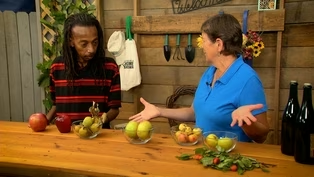
Clip: S26 Ep6 | 5m 4s | Discover Virginia’s role in shaping popular apple varieties (5m 4s)
Providing Support for PBS.org
Learn Moreabout PBS online sponsorship

- Home and How To

Hit the road in a classic car for a tour through Great Britain with two antiques experts.
 New Season





 New Episode
 New Episode



Support for PBS provided by:
Virginia Home Grown is a local public television program presented by VPM