
A New Hope for Freedom
A photograph reveals the rise of Black Muslim life in northern cities during the Great Migration.
From
A New Hope for Freedom
Episode 5 | 24m 45sVideo has Closed Captions
A photograph reveals the rise of Black Muslim life in northern cities during the Great Migration.
A 1922 photograph reveals the rise of Black Muslim life in northern cities during the Great Migration.
From
Problems playing video? | Closed Captioning Feedback
Problems playing video? | Closed Captioning Feedback
A New Hope for Freedom
Episode 5 | 24m 45sVideo has Closed Captions
A 1922 photograph reveals the rise of Black Muslim life in northern cities during the Great Migration.
From
Problems playing video? | Closed Captioning Feedback
Where to Watch American Muslims: A History Revealed
American Muslims: A History Revealed is available to stream on pbs.org and the PBS app.
Providing Support for PBS.org
Learn Moreabout PBS online sponsorship[Malika Bilal] Chicago, a city shaped by migration, movement, by people arriving in search of something new.
[Edward E. Curtis IV] You have to imagine the kind of bustling activity and exchange of people speaking different languages, of different ideas, coming in from all over the world, clashing with each other.
[Sylvia Chan-Malik] People imagine they could escape the horrors of the Jim Crow South... -[Bilal] Right.
-...and find new opportunities.
They were migrants.
-Hmm.
[Bilal] In this city, Muslim roots run deep, especially in Black communities.
You can't tell the story of America without the story of Black people, and you can't tell the story of Muslims in America without the story of African American Muslims.
[Bilal] That story shows up in this photograph.
[Fatima Fanusie] Who are these women?
And what does it mean for them to have, you know, this... be wrapped up like this at this time in America?
[Bilal] It's the first known image of a group of visibly Muslim Black American women.
And it was taken in Chicago in 1922.
I don't remember ever seeing a photograph of Muslim women from way back then.
[Malik] I called them visionaries.
-[Bilal] Wow.
-They're seeing the world through this newfound lens of being Muslim.
That's unprecedented.
[Bilal] I'm one of three journalists following a trail.
[Aymann Ismail] There was one of the founding fathers imagining Muslim Americans.
-Absolutely.
[Bilal] Each of us exploring a defining moment in American history.
Strong words.
- Very powerful words.
He wanted this mosque here... -Yes.
...in the US?
-They were all so proud of it.
[Bilal] Tracing a legacy that's coming back into view.
There's never been an America without Muslims.
[Zain Abdullah] This is not a foreign story.
It's a part of the American story.
♪♪ [Bilal] In the 1950s, a Muslim organization began to inspire Black Americans across the country.
Leaders like Malcolm X and members like Muhammad Ali soon made the Nation of Islam a household name.
Everybody in Harlem is a Muslim.
[cheering] I've been all over and everybody know and are talking about the Muslims in America.
[Bilal] The Nation became so well known it can feel like this is where the recent history of Black American Muslims begins.
-[Malcom X] We were brought here against our will.
We were not brought here... [Bilal] But I've heard about a photograph that suggests a different story.
It's the first known image of a group of visibly Muslim Black American women and was taken in Chicago in 1922, thirty years before the Nation of Islam came to national attention.
How did you come across this photograph?
[Malik] I started researching the history of Islam and Muslims in the United States.
I kept seeing this particular image, and it was just kind of put there as an indicator that women were present in this history.
-[Bilal] Mm-hmm.
-And I started asking, who were these women?
-Mm-hmm.
-And why do we include their images without finding out what their stories were?
[Bilal] The photograph was first printed in a magazine called "The Moslem Sunrise," published by a group called the Ahmadiyya Movement in Islam.
[Malik] They would list the names of people who converted and I looked for the names of these women and what I found is they all converted within a month or two of each other.
Then I was able to look through census records and I looked for all of them.
But only one of the women emerged continuously from the decades before the photograph was taken into the years after the photograph was taken.
And that was Florence Watts.
[Bilal] But who was Florence and what can she tell us about these early Black American Muslims and the times they lived through?
For a working class woman like Florence, the archives are thin.
So we start with the public record, the 1880 census.
Here, she's a child living in Ellicott City, Maryland, just outside Baltimore.
She's with her parents, John and Elizabeth Sullivan, whose birthplaces and dates suggest they were once enslaved.
In the 1900 census, Florence is living in Washington, D.C., where she spends most of her 20s working as a cook and a maid until she decides to move again, joining hundreds of thousands of other Black Americans leaving their homes in search of something new.
During what historians now call the Great Migration, you had unprecedented numbers of African Americans, the formerly, you know, enslaved freedmen and women and their descendants making the journey from the rural South to the North.
[Malik] People imagine they could escape the horrors of the Jim Crow South... -[Bilal] Right.
-...and find new opportunities.
They were migrants.
-Mm-hmm.
They were getting people who are adventuresome.
Because as bad as it is in the South, your home is there, your family, your community, and you have to go north and rebuild.
[Bilal] Of all the northern cities people migrated to, one had a special appeal.
Chicago.
It's where Florence moved to from DC, just before my own ancestors arrived here on their journeys out of the South.
The thing about Chicago starting in the 1910's, is it was seen as this fabulous place of opportunity.
[be-bop jazz music] And there's a number of reasons for that.
First of all, the railway.
So many trains led to Chicago.
[Curtis] Chicago offered unprecedented opportunity.
They could not find enough labor, and they didn't want to pay top dollar either.
It was very useful to welcome immigrants and African Americans from the South, and it's at that point it creates a meeting.
[Malik] Chicago was a place of mythology and folklore.
Blues singers sang about it in their songs.
[Fanusie] You have the establishment of independent African American institutions.
You have churches, you have salons, barbershops.
[Curtis] You have to imagine the kind of bustling activity and exchange of people speaking different languages, of different ideas, coming in from all over the world, clashing with each other.
I mean, this is just this very ripe moment for, for cultural creativity and fluorescence.
And so that's what I imagine her finding as she gets there.
[Bilal] Florence's decision to make Chicago her home makes her story feel very personal to me and to my sister, who still lives and works here.
It's on days like today that I'm really happy that our great grandparents chose Chicago.
Gorgeous.
They all came here in the Great Migration, which I've only recently begun to think of as a refugee story.
Mommy's parents family really kind of landed in Chicago, in some ways, really actively fleeing the terror of the South, fleeing a potential mob.
The migration here, the choosing of Chicago, and just the search for something more for their families.
I feel like, in telling the story of Florence, I am also retelling the story of our grandparents... -Mm-hmm.
-... our great-grandparents, even our parents.
-Mm-hmm.
[Malik] So one of the other things I also found is that when she is in Washington, D.C., Florence meets a man named George Watts... [Bilal] Okay.
-...and it's there that she marries George.
And so when she goes to Chicago, she does not go alone.
-Hmmm.
-She goes with George as a married woman, and that's when her name changes from Florence Sullivan to Florence Watts.
She arrives in Chicago around 1910, 1911.
In 1912, a momentous occasion occurs for her.
Her daughter, Arelia Watts... -[Bilal] Oh.
-...who is born-- -Is this her first child?
Yes, this is her first and only child.
[Bilal] Okay.
♪♪ [Malik] The next time we find Florence in the records is in 1920, when Florence is living in Evanston, Illinois, not in Chicago, working as a domestic.
[Bilal] So I spent four years in Evanston.
-Mm-hmm.
-It's a wealthy, predominantly white suburb of Chicago.
What was it like when Florence was there?
[Malik] Well, it was an almost entirely white suburb, save for the domestics and those who worked for wealthy white families, which is what Florence did.
She probably lived in a small room, the servants quarters.
We find Aurelia in the census in 1920, not with her mother in Evanston... -Okay.
...but at a boarding school for girls, was a school for orphans and destitute children.
♪♪ Aurelia is eight years old.
[Bilal] So her mother is employed, but her daughter can't be with her so she sent to this school.
-Right.
You see here the types of separation that these arrangements caused within Black families, the sense of necessity that would have compelled her to make such a difficult decision.
It's absolutely devastating.
[Curtis] It's quite a thing that in the Midwest that both immigrants and Black people are promised streets paved with gold, easy opportunity.
That wasn't the case for either of them.
[Malik] For immigrants coming from outside of the United States, America is this place of promise.
America has never betrayed them.
America has never enslaved them.
For African American migrants from the South to the North, while they have the same hopes and dreams of immigrants when they encounter these same types of conditions, it feels like yet another betrayal.
[Bilal] Florence, so she's without her young daughter, she's without her extended family, where does she turn for solace?
What do we know?
-Community.
-Mm-hmm.
Connection, support, friendship.
And like so many at that time, Florence begins to look for a spiritual home.
[gospel piano music] [Fanusie] Religion plays a crucial role in the formation of an African American people.
[Curtis] After the Civil War, during freedom, during the era of Jim Crow, the Black church emerges as the most popular institution of civil society.
It's not just where you go to pray or to sing.
It's where you do business.
It's where you meet your potential marriage partner.
It's called a nation within a nation.
[Fanusie] When you look at what was happening during chattel slavery, the major thing that was lost was responsibility.
The ability to be responsible for your individual self, including your very body, your children, your marriage, your union, your community, your economy, your life.
So when we get to these cities, of course, religion is one of the ways that African Americans immediately begin to exercise their own agency.
[Curtis] Most African Americans throughout the 20th century are going to remain Christian.
But the church was not the only religious institution in Black America.
And it is in this time in the 1920s, that there is an enormous, sort of, new energy around spiritual movements, in particular for African Americans because you have this wave of new political fervor and consciousness that's emerging as well through groups like the Universal Negro Improvement Association led by Marcus Garvey.
There was a spirit of Black nationalism.
♪♪♪ African Americans were thinking about an alternative to Christianity, you know, to integrate their spiritual and religious practice into this newfound politics of Black liberation.
[Zaheer Ali] I think for people who are drawn to Islam during this period, people like Florence, many of them appealed to a sense of ancestral legacy, that Islam was a recovery of a lost history that had been disrupted through slavery.
But there's also something new.
Islam as it is presented in this moment.
It is familiar enough in the spiritual sense, but new enough to introduce a different kind of political discourse, a discourse that challenges racism.
But why Islam and not another religious tradition?
Well, Islam from the 1800s on is associated with resistance to European colonialism and imperialism, and not just military and physical colonialism, but mental colonialism.
Islam is seized by some African Americans in the 1920s to articulate their dreams, to be free and dignified and liberated, and that appeals to men and women.
So you have new types of religious movements coming into the space in which working class Black Americans, many migrants are engaging.
For Florence, one of the encounters that she has is with a group called the Ahmadiyya Movement in Islam, a South Asia based movement in which its leader arguably declared himself a prophet.
So on the one hand, the Ahmadiyya were very orthodox in the sense that they brought traditional Islamic practices and on the other hand, they were quite unorthodox because of the structure of their movement.
-Hmm.
They're small, but one of the reasons why they're so important is they put more resources, time and talent into trying to proselytize on behalf of Islam in non-Muslim countries all over the world.
♪♪♪ In the early 1920s, the Ahmadis send a missionary, Muhammad Sadiq, to the United States.
[Malik] He was quickly, as a missionary, looking for a new place to find a headquarters.
And so he saw Chicago.
He saw it as a place where he could proselytize to African Americans, where there was a spirit of political, cultural movement.
One of the things that he says in Islam, there is no difference between the prince and the pauper.
There is no racism.
All pray together to the same God.
He practices what he preaches because in Saint Louis he appoints a Black man, P. Nathaniel Johnson , Sheikh Ahmad Din, to be the head of an Ahmadi mission that is multiracial, that is white, that is Black, and that is brown.
For African Americans to have a stake in this, it's not just they're not just following a foreigner here.
No, no, it's becoming their own tradition.
[Malik] In Chicago, Mufti Muhammad Sadiq, he set up a mosque cultural center on Wabash Avenue on the south side in Bronzeville.
[Curtis] And it's bold.
It clearly says Masjid Lillah, the Mosque of God.
And it has a big onion dome.
He's not trying to be subtle.
[Bilal] So how did Florence encounter the Ahmadiyya?
After she's in Evanston, she moves back to Bronzeville, where she becomes a cook for a fraternity house.
That boarding house is not far from... -Wabash Avenue.
-...the Ahmadiyya.
Yeah, not far from Wabash Avenue.
Exactly.
-Huh.
[Malik] So perhaps Florence had kind of walked by.
Maybe they had handed her some literature, as people who proselytize do.
Maybe she had looked at it, put it in her purse, kept walking.
Maybe the second time she had stopped and talked to the person giving her the literature.
And maybe the third time or the fourth time, she decided to go in.
In 1922, in the "Moslem Sunrise," We find here this list of new converts.
It says "116 gentlemen and ladies have accepted Islam."
And if you move down here, you find Florence's name right here.
-Zeineb in parentheses.
-Yeah.
With Zeineb.
And so she also chose a new name.
-Interesting.
-Which is really beautiful.
Right?
To be able to choose a new identity that connects you with a new purpose, a transnational global community.
[Bilal] When I first came across the picture of Florence, I thought, she's wearing kind of strange clothes.
She might have converted into something that may not have been with full acknowledgment of what she was taking on.
-[Alia Balik] Mm-hmm.
-And then I think, why did I think that?
-Hmm.
-That's what people think when they see us?
It's like, oh, who made her do that?
I look at it now with a sense of awe that she could make this decision for herself, and she decided to buck the trend.
And though there was no one else around her... We often discount, especially for women, their own agency.
We do them a discredit by not allowing them to show up just the way they are, believing that that's the way they wanted it to show up.
That picture, she does not look bothered.
And I think there's power in that.
[Alia balil] Yeah.
[Malik] As a Muslim in contemporary society, what I found most fascinating about this photo was their clothing.
They're wearing, what you might expect of African American women of this time.
But on the other hand, they have these drapings, which, you know, I ultimately, after looking at them a few times, realized, these are bedsheets.
There was a creativity and ingenuity and an innovation to their process.
It reminds us how much coming to Islam for many African Americans in the 1920s is not just political.
And it's not just spiritual, it's also aesthetic and material.
I think so much of it is guided by this need for independence, this need for ownership of things that we might even take for granted today.
You know, our name, our self, our, our religious expression.
So she converts in 1922.
What did it mean for her life going forward?
[Malik] On Wabash Avenue?
They had regular reading groups where women would read and teach each other Qur'an.
They learned Arabic.
They were learning about their brothers and sisters abroad in the Punjab.
So it really opened up a different space.
And that's why I find it so compelling that there's an image of four women.
They were sisters in Islam that talked to each other and congregated with each other and learned about the faith together.
[Bilal] But Florence's new community couldn't protect her from all the challenges of life as a Black woman in early 20th century America.
Eight years after the photograph was taken, we find Florence in the census again, now reunited with her family in Bronzeville.
The reunion didn't last long.
Just two years later, in 1932, her daughter Aurelia died after an operation that went wrong.
[Malik] There's actually an item in the newspaper, and you can see here, "Coroner's jury exonerated Dr.
Fred C. Cade, one of the wealthiest and best known physicians in the city, from responsibility in the death of Miss Aurelia Watts, 18-year old girl who died at Daley's hospital last Saturday."
[Bilal] It's this last sentence that strikes me.
"The coroner's jury returned a verdict of death by manslaughter, but named no one responsible."
[Bilal] For Florence, there was no appeal, no justice.
Just loss.
One year later she died too, aged about 55.
Her story ends here, but the movement she was part of, the attempt by Black Americans to find new meaning and purpose in Islam continued.
♪♪ [Curtis] The Nation of Islam is coming into an already vibrant and diverse Islamic scene, but after World War Two, it will become by far the largest Muslim organization of any kind in this country.
[Ali] By the time the Nation of Islam is taking root in Chicago, Florence is gone.
But the community that she was a part of and the echoes of her presence are picked up by the work of the Nation of Islam.
Florence is part of this evolving presence of Islam in America, and certainly in Black America.
[Bilal] On Wabash Avenue today, the mosque Florence attended has gone.
It's been replaced by a modern building where members of the Ahmadiyya Movement still meet to pray.
[praying in Arabic] Their presence is a reminder of the early flowering of Islam among Black American communities and the inspiration Florence's life can still provide today.
Pioneers.
I don't remember ever seeing a photograph of Muslim women from way back then.
You know, you hear those stories about the, you know, the incredible men in our tradition and our community who have done so much.
And you assume that there must have been women that were pioneers in their own right.
But, I think, to have real kind of photo evidence of that.
The community at that time, and those individuals and Florence, recognized that this would be something that would be important enough for people to look back on years later.
I think that's just really, really powerful.
Here’s to Zeineb.
♪♪ [announcer] For educational resources visit the "American Muslims: A History Revealed" collection at PBS LearningMedia.
♪♪♪
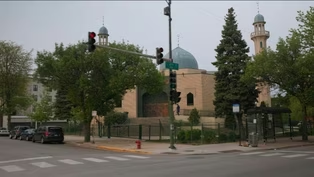
A New Hope for Freedom Preview
Preview: Ep5 | 30s | A photograph reveals the rise of Black Muslim life in northern cities during the Great Migration. (30s)
Providing Support for PBS.org
Learn Moreabout PBS online sponsorship














Support for PBS provided by: