
June 23, 2026 - Full Show
6/23/2026 | 26m 48sVideo has Closed Captions
Watch the June 23, 2026, full episode of "Chicago Tonight."
The Trump administration challenges Evanston’s reparations program. And why Cook County is called the wrongful conviction capital of the country.
Problems playing video? | Closed Captioning Feedback
Problems playing video? | Closed Captioning Feedback
Chicago Tonight is a local public television program presented by WTTW
WTTW video streaming support provided by members and sponsors.
June 23, 2026 - Full Show
6/23/2026 | 26m 48sVideo has Closed Captions
The Trump administration challenges Evanston’s reparations program. And why Cook County is called the wrongful conviction capital of the country.
Problems playing video? | Closed Captioning Feedback
Where to Watch Chicago Tonight
Chicago Tonight is available to stream on pbs.org and the PBS app.

WTTW News Explains
In this Emmy Award-winning series, WTTW News tackles your questions — big and small — about life in the Chicago area. Our video animations guide you through local government, city history, public utilities and everything in between.Providing Support for PBS.org
Learn Moreabout PBS online sponsorship>> Hello and thanks for joining us on Chicago tonight.
I'm Brandis Friedman.
Here's what we're looking at.
Evanston reparations program faces a new hurdle.
This time the feds join a lawsuit challenging the program.
And a new book explores why Cook County has earned the title of the wrongful conviction capital of the country.
>> First off tonight, the push for a city Department of Gun violence reduction gets a boost from Mayor Brandon Johnson.
>> What organizing apparatus has been calling for through multiple administrations.
It's incumbent upon me as the mayor of this city is to hear what these advocates are calling for in finding ways in which the work that we're doing cannot just be a line but strengthen.
>> It is unclear how closely his plan for the department would mayor, what advocates have been calling for.
But he promises more details will come later this week.
This follows the mayor addressing the impact of shootings in and around the city over the weekend.
As the Chicago teachers union calls for a special session in Springfield to pass more funding for education.
>> Governor Pritzker says he agrees schools need more money and has an idea on how to pay for it.
>> amendment to the Constitution does not require the governor.
It actually requires a super majority of the House and the Senate to pass it.
And so I as you know, I've been in favor of a more graduated income tax system and I'll continue to be in favor of that.
But it's something that the Legislature needs to take the >> The teachers union is criticizing the governor and lawmakers saying the state hasn't fully funded the evidence based funding formula for kindergarten through 12th grade schools.
As a result, they argue Chicago public schools is proposing 700 million dollars in reductions, special education teachers, teachers, assistance, librarians and other staff they say, are being notified of job cuts.
Pritzker says though, he's proud that the state has added more funding on top of what's required by the Formula.
Moore is still necessary.
A city lawsuit is going after Airbnb and one of its most active Chicago hosts, a company called Slumber Stay LLC.
The lawsuit filed in Cook County Circuit Court alleges Airbnb and slumber stay profited from unlawful short term rental activity.
The city says the host company was cited nearly 200 times in 2024.
2025. for violating the shared housing ordinance by failing to register short-term units within the city using a non-transferable hotel license number across multiple unrelated properties and continuing to list and rent units unlawfully even after admitting to similar misconduct and paying fines for its part.
The lawsuit says Airbnb processed booking for unregistered and unlicensed units in an email to Wt Tw Airbnb said in part that while it can't comment on active litigation, quote, We are proud to provide everyday Chicagoans with economic opportunity at a time when costs continue to rise for them, they go on to claim.
Airbnb has helped generate over 777 million dollars annually for the Chicago economy.
Up next, a renewed debate over Evanston reparations program right after this.
Chicago tonight is made possible in part.
>> By the Alexander and John Nichols family.
The Pope Brothers Foundation.
And the support of these donors.
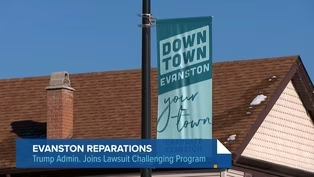
>> The Trump administration is putting its weight behind an effort to end a reparations program in Evanston for its black residents.
The program aims to provide payments to black residents and descendants of black residents who experienced housing discrimination in the city between 1919, 1969, the U.S.
filed to join an existing lawsuit challenging the program last week.
In a statement, assistant Attorney General Harmeet Dhillon of the Justice Department's Civil Rights Division said, quote, They're our sound ways for a city to remedy past discrimination or direct resources to its most vulnerable citizens in neighborhoods simply handing out money based on race, however, is not the answer.
It is race discrimination, pure and simple.
And it is illegal in 2021.
Evanston became the first municipality in the nation to implement a reparations program for black residents.
So joining us now, our Christine Svensson, local council for Judicial Watch.
That's the organization representing the plaintiffs in the lawsuit challenging Evan since program.
And Xavier rainy CEO of the social impacts consulting firm Justice informed.
We also invited representatives from the city of Evanston Bay declined to join us in a statement, a spokesperson said, quote, the city of Evanston maintains its position on the legality of the Evanston reparations program.
While we are cognizant of the filing made by the DOJ, the city does not provide comments regarding active litigation.
My thanks to 2 of you for joining us again.
Welcome back.
So, Christine, I want to start with you.
What is your reaction to the U.S.
Justice Department joining this lawsuit that your organization is filed, challenging the Evanston reparations program.
So Bran is first of all, thanks for having me.
Glad to be here on behalf judicial watch.
>> So I was not surprised to see the Department of Justice intervene.
This would be a classic situation where they would be interested because as Harmeet Dhillon said, this is a relatively straightforward case.
As far as race discrimination goes.
And so this would be sort of a classic type of entree for the Department of Justice.
What does it mean for for how the case will proceed?
So there's a motion that they have filed meeting the DOJ to seek intervention that is being contested by the city of Evanston.
I assume that motion to intervene be granted and litigation will proceed.
The DOJ has added another count alleging that there is a violation of the Fair Housing Act of 1968.
So that will also be borne out.
The case probably in the 3rd inning of the case when they decided to intervene.
So we have a long way to go.
But again, presume that they will be allowed maintain their presence in the case.
Xavier, why do you think the Trump administration took an interest in this?
in line with their past practices patterns of being.
>> Fairly against any racially, specifically mediations for governmental or social harms.
They've already expressed.
We've seen this from the executive orders shortly after President Trump's inauguration and ban saying the closures, various federal offices that were supporting the work of civil rights, particularly those in advance that for racial or gender discrimination as well as the E in die.
So it was not surprising to me that the federal government, Department of Justice, particularly which has been one of the great tools to President Trump, is used to suppress the work of racial equity in America over the last year and a that they joined.
I'm Christine, do you think that the U.S.
joining us lawsuit?
He think >> And it is a benefit.
Your lawsuit.
You think it helps you to strengthen show that, you know, you believe you've got a strong case when he went up to I believe that it does.
I believe that it helps our side.
It's also interesting because there are similar sort of on this is a pioneer test case and all over the country.
There are various municipalities and perhaps even states that are considering these issues.
And everyone's looking towards this case.
And so it is a big statement move that the DOJ decided to join it.
It sends a statement out to these municipalities around the country.
Xavier, for those who might be unfamiliar with the area and its history.
Remind us or what can you tell us about why Evanston implemented this reparations program and how this works?
It's it's a >> specific to housing, right?
So when most people think reparations, they think of chattel slavery in America.
So the preteen 65 era.
>> Where slavery was legalized here in the U.S.
and particularly African-Americans.
We're the ones who were enslaved and used to the economic benefit of the country and primarily through white landowners however, the Chicago Land region specifically has been really hot bed for racial discrimination through other economic means, namely through mortgages prior to 1948.
The usage of what call restrictive covenants was very much common place where white neighbors with sign agreement amongst one another that forbid, any of them from renting or selling to black president, specifically eventually that was struck down there after up until the passage of the Civil Rights Act.
And then later, the Fair Housing Act, we had contracts for deeds where there's another economic tool that predominately white families use to ensure the blacks were not provided real deeds for what seen as mortgages on paper.
But we're actually completely throughout the region.
We've had that challenge, right.
And then, of course, there is a there's redlining which came as well.
Those are different forms our great.
We just probably call redlining.
Exactly.
Okay.
And so instance program, why did do you think they were attempting to do with with the implementation of this reparations for couple things?
One, I think they're trying to acknowledge that it happened at all, which is something that I think that our government has a hard time.
>> Just do period.
Secondly, they were trying to do something and this is where I think it's gonna be interesting to watch this case.
As relates to the question of of Governmental interest, compelling governmental interest.
I personally, I think that the city of Evanston in passing this said that they have a governmental interest in knowing that they have a significant population of African American residents, including those who had experienced direct discrimination on the basis of race of racism due to their race as it relates to mortgage contracts.
They were saying we cannot move forward as a township as a city.
We cannot move forward with black residents as our neighbors, our countrymen, as our friends, unless we actually do the work of relational economic repair.
And I think that that is a that's something that's deviates greatly from the current federal administration, which says we absolutely can move forward as a country without ever doing anything to repair the specific racial harms that have plagued the black community in this country.
Christine, though, you your lawsuit argues that this program violates the Equal Protection Clause of the 14th Amendment.
Tell us how.
>> So the problem with this case is it is it involves race discrimination.
It is discriminating against my clients who are white.
>> Who are also applying to this program in giving money to people that are black just based on the color of their skin.
So when you have race discrimination, you have to have is Xavier mentioned a compelling government interest which is rarely found.
in this case they're compelling government.
They're compelling government interest instance, really relying upon societal discrimination that we all agree has existed.
It did exist 100 years ago and longer, of course.
So the Supreme Court has repeatedly said we're not in the business of remedying societal discrimination.
In addition to that compelling government interest problem.
There are ordinance is not narrowly tailored because the people that are receiving these grants that are African-American do not have to show that either they or their ancestors, our descent.
I'm sorry, the either they or their ancestors suffered housing discrimination.
There's no causal connection between the 2 in the city of Evanston.
Also in the ordinance, they don't actually cite a specific statute that says this was discriminatory.
This caused the harm to African-Americans.
I understand Xavier his point about the redlining and the restrictive covenants and those he is valid points.
The problem is that the city of Evanston, it's not necessarily should not be on the hook for that.
not the ones promulgated those policies is a matter of.
Is it a matter of just the way the law's written had the law been as specific as you name it?
>> Would that would that not be the same case with that?
Not with the problem that be the same for you.
It is a problem the way the law is I'm I'm sorry, don't really.
I just want to saying had the law necessitates a required that recipients prove that suffered under restrictive covenants, redlining where some of those other issues, if that were requirement of the law to receive the funding.
That not be a violation that would help their argument considerably.
But the other problem is that they have to show that there race neutral alternatives as well.
What I mean by that is even though blacks were living in areas where perhaps they could get mortgages or they were blighted neighborhoods, whatever the case may be, there were other races.
The also lived in those areas that also suffered consequences and housing discrimination, those individuals, whatever race you should be should would be part of any sort of lawsuit.
talks about the fact that people were discriminate against a base of housing, not just people about particular race.
Xavier, what's the reaction?
That argument?
Yeah, the plaintiffs that they're said that their families experience hardship.
>> Not racism.
And the basis of racial reparations is where you've been able to prove racism.
No, I agree Christina saying that it would be better perhaps for the families and any of the applicants to this fund of which I just want to be clear, the economic realities of what was taken even here in the city of Chicago is between 3 4 billion dollars it came to the redlining practices between 1948. in 1975, or into the passing of Community Reinvestment Act and 77, sorry, you're talking about billions of dollars.
This is a 25 million dollar fund to give out.
$25,000 mortgage assistance, or cash checks for One, let's talk about the scale.
But the other part you know, I would love to see White Plains coming in and saying the city of Evanston discriminated against my ancestors or my family directly on the basis of me being white in the city of Evanston.
Back in 1945, I would love for that to be the case, but I don't think that it.
This proves either the need for this fund, nor does disprove the reality of of what it would repair because the root of the word reparations as repair.
And I think that's what but the Supreme Court is against.
As Christine said, they have no job and repair of societal harms, but also many and the Trump administration have no have no love for repair and they don't see that as a concern of government.
And it's be nice thing, but it's not a responsibility thing.
And so, yeah, I would love to see those plaintiffs coming in and saying I can prove that on the basis of my race, I was discriminated against 60 years ago were there the same thing for black folks.
got to prove it maybe 10 seconds or so.
Had there not been other instances where the government made reparations for past wrong.
>> Where they stand, the they were yes, I'm thinking Japanese Americans Japanese.
That's the case.
And I'm thinking about absolutely, Christine, would there.
What do you think would be a more equitable way to implement a reparations program for black Americans?
Is there So to me, the most logical one would be.
>> something again, I'm not even saying this passes constitutional muster or that I even agree with it.
But one argument would be descendants of actual slaves would receive reparations to me, that's a better Constitution are now.
I think it's very difficult to prove and goes too far back.
So again, I'm not even saying that that would that would be valid.
But to me, you would have to have a connection to someone who actually suffered from the effects of slavery, whereas this I mean, housing discrimination.
As I said, a lot of people suffer housing discrimination.
A lot like a from a lot of different groups.
To me, that would be your best argument.
But I think it's untenable because it was too long ago.
that's where we'll have to leave it.
Obviously.
We'll see how this case plays out and have you both back later.
Christine's Benson during the thanks to both.
Thank Notes.
Up next, a new book details the system of wrongful convictions.
The author joins us next.
>> Cook County has been called the wrongful conviction capital of the country.
But how to get that title in a new book.
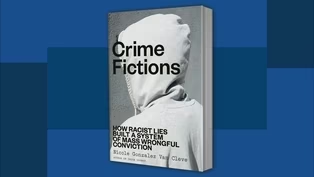
Crime Fiction's How racist lies built a system of mass wrongful conviction.
Author Nicole Gonzalez Van Cleve looks to answer that.
She identifies cases of black youth, some as young as 7 years old who are wrongfully accused and coerced into confessions.
Here to talk about the book and some of these cases is author Nicole Gonzalez Van Cleve.
Welcome back.
Thanks for joining us.
Thank you so much for having me.
So how do police prosecutors, the courts had all of these things collide to produce a wrongful conviction right?
We often talk about wrongful conviction as though it's an accident or a series of accidents.
And what I'm trying to do in this book.
>> Especially as a sociologist that uses data to build an argument is to think about wrongful conviction is a set of pattern to systemic way of kind of doing business by police.
And so this book is kind of a how Don it if we were going to dissect wrongful conviction and say, what are the what are the patterns?
That's what's in this book.
And I take it case by case some viewers will recognize some of these famous cases.
But at the end of the day, we have about 575 cases of wrongful conviction.
Chicago, we're kind of the best at it.
So in some ways, this is the perfect place to kind of do an autopsy, if you will, of how do police keep creating wrongful convictions in the same systemic ways.
And of course, you're you're familiar with with Cook County and with Illinois from your your previous last month where your other book county.
>> All the stories that you focus on in this book, they involved young black children, as we said, some as young as 7.
They're all falsely accused.
How did you begin to identify that pattern?
Well, I started with false confessions.
And so we also are the false confession capital of >> the nation.
And so we think there's no way to ever admit to a crime that didn't do.
How how does somebody going innocent and come out guilty and the eyes of the police?
And the issue is that police have ways of techniques of actually creating wrongful conviction.
Sometimes they're isolating these children.
There's a detective named James Cassidy who would hold children's hands and see the police would forgive, would forgive them the way God forgives them.
And in some ways made his interrogation room into a type of confessional.
He feed them happy meals, get into their space and often they would use black officers to lore these children to kind of warm them up and trick them.
So there are these techniques that are tried and true.
But when the person doesn't confess, they can actually just write whatever they want.
And doctor evidence and doctor documents when that happens, its partially our fault as the public that we only believe the police right there.
Word is a type of evidence that we see is, you know, Yeah, it's a gospel of true.
So it's not the only technique.
False confessions is kind of the engine, if you will, of wrongful conviction.
But police have other ways of coercing witnesses are bringing in kitten as a witness with no lawyer, no parent present and then changing them into a suspect and framing them as well.
So as you said, you know, as of January 2026 of the total 3,767 national cases of wrongful conviction that we know of.
>> As you said, 575 576 are from Illinois with 148 of those convictions, including false confessions.
Do you have a sense of how many from Illinois of the false confessions?
Well, that the those numbers are from Chicago and Illinois.
So I focused on that starting do.
We have a sense of why we have so many and why we have so many.
When we think about the numbers like it when it when we say we're the best or the worst ever wrongful conviction.
>> We're we're creating more false confessions than any other place in the nation.
You know, one explanation is that we have developed exoneration movement, right?
We have multiple universities and dog attorneys on the other side that are helping to expose these cases.
So it's possible that places like New Orleans, they don't have these attorneys.
And so the they have maybe even more cases, right?
This is a national epidemic.
We are just we need to be curious that Chicagoans as to why we are doing this the best.
What are these techniques can we create reforms to repair this?
But the issue is we have never really put our Chicago police in check.
We haven't.
There are no reforms that would in some ways prevent wrongful conviction.
And we see time and time again that we leave the reform to the police themselves and they let us down to the cases of the George Jones case in Chicago police officers were hiding evidence.
They call them the street files.
They were bearing exonerating evidence that could free somebody defendant.
In that case, George Jones was the a son of an officer and they still did to this black child.
He was an honor student when that case was exposed, the police said that they were.
Reforming.
And what ended up happening is that that system continued all the way until now.
We've done really nothing that police have the total authority to assemble a case file and we're none the wiser win.
Exonerating evidence goes missing.
Attorney Candace Gorman who represents young man.
in this book name Abdul Malik Muhammad.
She went into one police precinct at 51st and Wentworth and found 500 cases buried in a boiler room.
And I said to her, what did you think when you she was searching for one so-called street filed for one case and she finds 501 police precinct.
And she said all I could think about is how many of those young people were executed.
And it just sent chills down my spine that we are allowing this to continue because you also write, that's that the flip side of this is that it's one thing for one person to be wrongfully convicted and locked up for probably what is but most or all of their life.
And we're kind of >> waiting on this.
The system of exonerations in attorneys to work to get them out.
But the flip side of that is the safety factor.
wrongful conviction means one.
person who actually did it is walking around, right?
Absolutely.
So in that George Jones case, while they're framing this son of a police officer to this black child there, there's another.
There's another offense.
There's another assault.
>> And so we are really gambling with the safety of Chicagoans, right?
This is a dangerous business.
And one of the things we don't talk about is that police clear about only 50% of cases clearance is a metric of effectiveness, but it only means that the police have charged somebody and that somebody could be anyone once they charge their absolved of any more investigative duties.
But it has no measure of accuracy.
So it's still low.
50% means that we could flip a coin in Chicago and get away with murder.
That's unsettling.
But we don't know how many of the people they do charge are actually innocent.
As you see in the cases that are in this book.
And that to me is a public safety issue.
Are prosecutors and judges should be very concerned.
Our mayor should want to get to the bottom of this as a matter of public safety.
Just a couple seconds left, what more needs to be done?
What has been done?
Well, right now, we have completely stalled looking at in conviction, Integrity Unit.
We have to start thinking of it as not looking in blaming people.
We need to see that.
That is good.
That's kind.
The duty of a prosecutor.
Did they get it right?
And again, it's a matter of public safety.
Don't we want to know?
It's also a matter of system, legitimacy.
If we are just charging young people and we don't really care if it's the right person.
We are betraying victims.
We are betraying the public and were betraying the overall legitimacy of our criminal justice system.
And so I do think we need to take serious and come back and get big.
She's meet the Conviction Integrity Unit to be reviewing cases again, we need to stop making it harder rather than more thorough and a little bit easier for people who have claims of innocent to a good faith have their claims reviewed.
That's the least we can offer people when we take away their freedom.
Okay.
That's where we'll have to leave it offer.
Nicole Gonzalez, Van Cleve, thank you for joining us.
Thank you so much.
>> Again, the book is crime Fiction's how racist lies built a system of mass wrongful conviction.
And we're back right after this.
And that's our show for this Tuesday night.
Join us tomorrow night at 5, 30 10.
>> Now for all of us here in Chicago Brandis Friedman, thank you for watching.
Stay healthy and safe and have a good night.
>> Closed caption is made possible and by Robert a and law firms.
On personal injury and wrongful death.
It
 New
NewNew Book Examines History of Wrongful Convictions
Video has Closed Captions
Cook County has been called the wrongful conviction capital of the country. (8m 26s)
 New
NewTrump Administration Challenges Evanston's Reparations Program
Video has Closed Captions
The DOJ filed to join an existing lawsuit challenging the program, which began in 2021. (12m 15s)
Providing Support for PBS.org
Learn Moreabout PBS online sponsorship New Episode
- News and Public Affairs

Top journalists deliver compelling original analysis of the hour's headlines.
 New Episode
- News and Public Affairs

Today's top journalists discuss Washington's current political events and public affairs.
 New Episode
 New Episode
 New Episode
 New Episode
 New Episode
 New Episode
 New Episode
 New Episode
 New Episode
Support for PBS provided by:
Chicago Tonight is a local public television program presented by WTTW
WTTW video streaming support provided by members and sponsors.