
Skeletons: Skeletons Uncovered
Special | 3m 59sVideo has Closed Captions
Your skeleton is more than a collection of bones. Find out how your skeletal system works.
Your skeleton and the skeletal system is a living structure that keeps you healthy. Your bones help you move, make the blood that runs through your veins and protects your other organs. Take a look under the skin and learn about skeletons and the skeletal system.
Problems playing video? | Closed Captioning Feedback
Problems playing video? | Closed Captioning Feedback
Science Trek is a local public television program presented by IdahoPTV
Major Funding by the Laura Moore Cunningham Foundation and Idaho National Laboratory. Additional Funding by the Friends of Idaho Public Television and the Corporation for Public Broadcasting.
Skeletons: Skeletons Uncovered
Special | 3m 59sVideo has Closed Captions
Your skeleton and the skeletal system is a living structure that keeps you healthy. Your bones help you move, make the blood that runs through your veins and protects your other organs. Take a look under the skin and learn about skeletons and the skeletal system.
Problems playing video? | Closed Captioning Feedback
Where to Watch Science Trek
Science Trek is available to stream on pbs.org and the PBS app.
Science Trek
Science Trek is a place where parents, kids, and educators can watch short, educational videos on a variety of science topics. Every Monday Science Trek releases a new video that introduces children to math, science, technology, engineering, and math (STEM) career potentials in a fun, informative way.More from This Collection
The human body is an amazing thing. It is made up of various systems that work together to keep us breathing, eating, thinking, growing and playing. Find out more about everything from the brain in your head to the bones in your feet.

Five Senses: It's All in Your Head
Video has Closed Captions
You understand the world through your brain. (6m 38s)
Blood: Your Body's Report Card
Video has Closed Captions
Learn about the role medical professional have in caring for your blood. (5m 40s)

Digestive System: Go Inside The Digestive System
Video has Closed Captions
What goes on inside your digestive system? (7m 7s)

Digestive System: Cow Stomach Investigation
Video has Closed Captions
How is a cow’s stomach different from a human’s? (6m 40s)
Video has Closed Captions
Learn how your skin helps maintain your health and keeps you in touch with the world. (4m 53s)
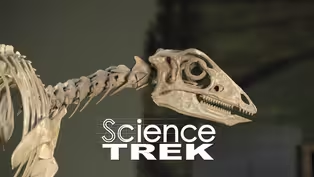
Skeletons: Just How Do They Know It’s A Dinosaur?
Video has Closed Captions
Paleontologists study skeletons to learn about ancient species. (6m 9s)
Video has Closed Captions
Viruses play a big role in disease. But how? (6m 33s)
Viruses: Antibodies To The Rescue
Video has Closed Captions
Antibodies are your body’s way of fighting disease. (6m 26s)
Providing Support for PBS.org
Learn Moreabout PBS online sponsorshipJoan Cartan-Hansen, Host: Your skeleton, the bones that make up your body, is a living structure that keeps you healthy and strong.
Find out more about skeletons and the skeletal system.
[MUSIC] Cartan-Hansen: Your body is made up of 206 different bones.
The smallest are the bones in your middle ear.
And the largest is your femur, the long bone in your upper leg.
Put all the bones together and they make up the skeletal system.
Student: The skeleton gives you structure.
Just like the walls of a box.
Hey!
Let me out!
Student: It protects your internal organs like your heart and lungs.
Student: Your bones act as levers for your muscles so you can move.
[Cheering] Cartan-Hansen: Bones aren't just dry and hard.
They're living tissue with different layers.
The outer surface is called the Periosteum.
It's a thin membrane that contains nerves and blood vessels that nourish the bone.
The next layer is compact bone.
It's smooth and hard like an elephant's tusk.
But it has tiny canals that have arteries and veins running through it.
Inside that are many layers of cancellous bone, which look like a sponge.
And in the middle is the bone marrow.
It's kind of like a thick jelly; its job is to make all your blood cells.
All together your bones weigh about 20 pounds, but this multilayered structure gives them strength, while keeping them light.
Student: So how strong are your bones?
Well, a bone is six times as strong as a steel bar of the same weight.
But if you fall or get hit just right you can still break a bone, so be careful.
Ow!
Cartan-Hansen: There are several different kinds of bones.
Long bones, like the ones in your legs, and short bones, like the ones in your hands, act as levers to help you move.
Flat bones, like your ribs or your skull, are really designed to protect internal organs or your brain.
Sesamoid bones like your knee caps get their names from their shapes, and irregular bones like your vertebrae don't fit in other categories and they tend to have strange parts jutting out that allows them to connect with muscles and other bones.
The place where two bones meet is called a joint.
Joints are held together by ligaments, tissue like a strong rubber band and protected by cartilage, tissue that acts like a cushion, absorbing shock.
Muscles attach to your bone and all the pieces work together to help you move.
But not all joints move.
Like the joints in your skull.
Student: 70 percent of bone material is are made up of different minerals like calcium, so you have to eat foods rich in minerals to keep your bones healthy.
Cartan-Hansen: So your skeleton is the structure of your body.
It protects your internal organs, works with your muscles to help you move, and the bones are where your blood cells are produced.
So take care of your skeleton and all your bones, and they will take care of you.
If you want to learn more check out the science trek website.
You'll find it at science trek dot org.
[MUSIC] ANNOUNCER: Presentation of Science Trek on Idaho Public Television is made possible through the generous support of the Laura Moore Cunningham Foundation, committed to fulfilling the Moore and Bettis family legacy of building the great state of Idaho.
By the Idaho National Laboratory, mentoring talent and finding solutions for energy and security challenges, by The Friends of Idaho Public Television and the Corporation for Public Broadcasting.
Skeletons: Holding It Together
Video has Closed Captions
Clip: Special | 1m 4s | How is your skeleton held together? (1m 4s)
Video has Closed Captions
Clip: Special | 1m 4s | Your skeleton has different types of joints. Find out how they help us move. (1m 4s)
Providing Support for PBS.org
Learn Moreabout PBS online sponsorship New Episode
- Science and Nature

Explore scientific discoveries on television's most acclaimed science documentary series.
 New Episode

 New Season
 New Season





Support for PBS provided by:
Science Trek is a local public television program presented by IdahoPTV
Major Funding by the Laura Moore Cunningham Foundation and Idaho National Laboratory. Additional Funding by the Friends of Idaho Public Television and the Corporation for Public Broadcasting.